Get Full Government Meeting Transcripts, Videos, & Alerts Forever!
Get email alerts on the Forensic Agency Budget topic
No spam. Unsubscribe anytime.
Forensic services agency cites accreditation, staffing shortages and federal grant uncertainty
Summary
The Indianapolis–Marion County Forensic Service Agency reported successful reaccreditation and awards, ongoing backlog reduction efforts and reliance on federal grants for DNA and firearms work; leaders warned that uncertain federal funding could force cuts to federally funded positions and supplies.
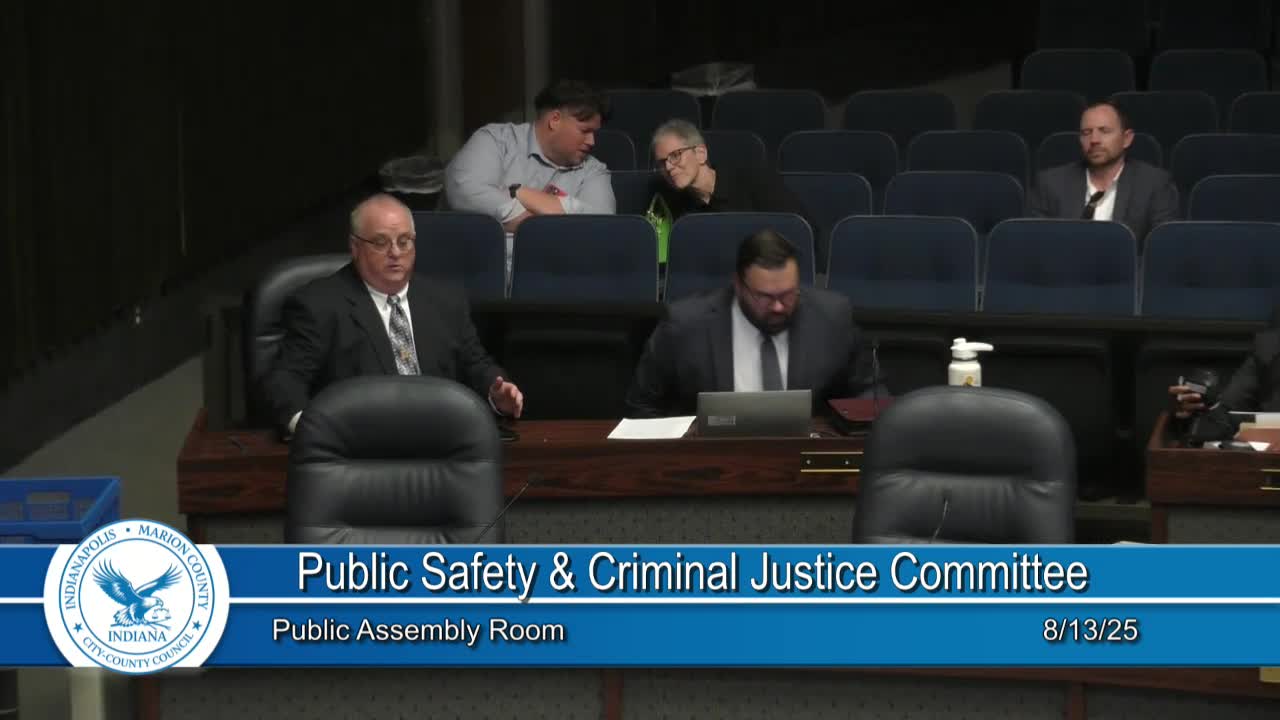
The Indianapolis–Marion County Forensic Service Agency told the Public Safety and Criminal Justice Committee on Aug. 13 that it completed reaccreditation with zero findings, won a Project Foresight Maximus Award and is pursuing backlog reductions while facing federal grant uncertainty that could affect staffing and supplies in 2026.
Director Richard Amberger and Chief Operating Officer Kyle Swalls said the agency processed nearly 12,000 requests and analyzed more than 62,000 evidence items last year, moved operations into a new consolidated facility and maintained ANAB accreditation. Amberger said the agency received a national efficiency recognition: “Out of 220 forensic laboratories, we were one of 14 to receive the Project Foresight Maximus Award,” and staff emphasized the zero‑finding reaccreditation.
Staffing and vacancies remain a constraint: the agency has 75 allocated positions and 71 filled as of Aug. 1, with four vacancies expected to be filled later in the year. The agency is using a combination of in‑house capacity and outsourcing (DNA outsourcing initiative) to reduce turnaround times and is engaged in blind proficiency testing with mentor support from the Houston Forensic Science Center.
Budget details show an agency total near $12.8 million for 2026 with only a modest net decrease from 2025. Swalls warned that roughly 20 percent of the agency budget depends on federal grants; if those grants are not awarded at expected levels the agency may need to eliminate federally funded staff and curtail supplies used for DNA testing and firearms work.
Councilors asked about backlog coordination with prosecutors and detectives, whether sexual assault kit testing backlogs exist and how the agency engages private providers. Amberger said backlog arises in part because agencies submit kits at different rates and that the lab only processes what police submit; he noted local coordination and use of outside DNA vendors in some jurisdictions. On residency rules affecting recruitment, agency leaders said lifting Marion County residency requirements would expand the candidate pool for hard‑to‑fill specialized positions.