Get Full Government Meeting Transcripts, Videos, & Alerts Forever!
Get email alerts on the Major Rezoning Link Lindsay topic
No spam. Unsubscribe anytime.
Council directs facilitated review and defers final vote on Link (Lindsay property) rezoning to Sept. 23
Summary
Facing large public turnout and divided views, City Council voted to direct staff to run a time‑bound engagement process with the developer and community and return to council with the Link rezoning (Lindsay property) on or about Sept. 23.
HARRISONBURG, Va. — After more than four hours of public testimony and a lengthy staff presentation, the Harrisonburg City Council on Aug. 12 directed city staff to facilitate a focused engagement process with the Link project developer and community stakeholders and set a proposed return date of Sept. 23 for council consideration.
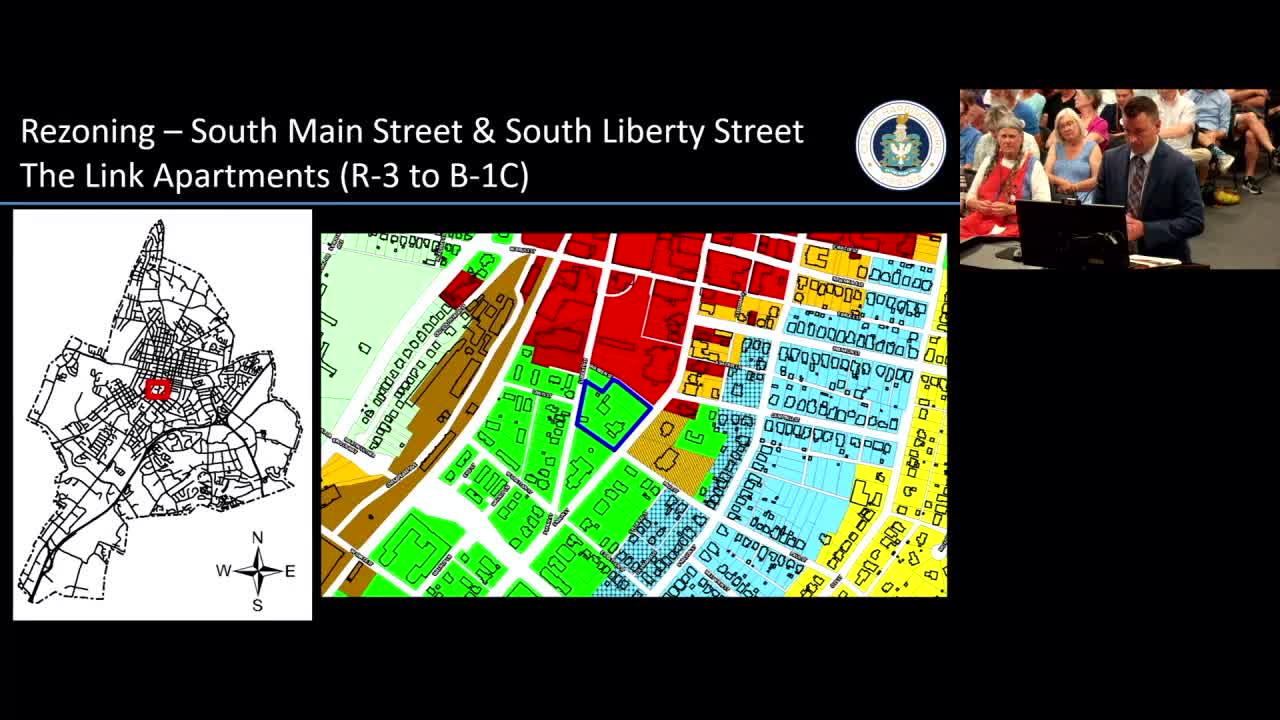
The request before council would have rezoned roughly 2.75 acres south of City Hall (the Lindsay property and adjacent parcels) from R‑3 residential to B‑1C (Central Business, conditional) to allow a mixed‑use, high‑density project the applicant calls the Link. Staff and the planning commission recommended approval; the planning commission’s vote was unanimous though a commissioner later emailed staff expressing regret about that vote.
City staff and the applicant said the proposal is designed to align with the Downtown 2040 plan and includes proffers the developer submitted voluntarily. Planning staff summarized the proposal as proffering a maximum of 265 residential units (minimums and maximums were given by bedroom type), at least 2,000 square feet of commercial space, structured parking with a minimum of 400 spaces, a Paul Street extension through the block, sustainability measures and coordinated access to the planned downtown park.
The applicant team — attorney Todd Ray and developer John Hoover of Timberwolf Capital Partners — emphasized the project’s alignment with the city’s downtown plan, traffic analysis findings and fiscal benefit to the city if the site is developed at B‑1 scale. Timberwolf said the structured parking would be offered separately and would include a reservation of up to 65 spaces for municipal/public use and that rooftop and EV readiness measures are included in proffers.
City public works director Tom Hartman told council that the applicant’s traffic impact analysis (TIA), as reviewed and accepted by Public Works, showed minimal required mitigation from the development beyond what is planned in the Liberty Street corridor work. Hartman said the planned Paul Street extension would also provide circulation options that could reduce an existing failing left‑turn movement at the Grattan/Main intersection.
Housing coordinator Liz Webb summarized student‑generation calculations. Using Weldon Cooper Center rates, staff said the project could generate as many as 88 K‑12 students as a worst‑case estimate; the applicant and school officials noted that Urban Exchange, a downtown multifamily complex used for comparison, currently yields only three public‑school students. Staff also disclosed that a wording inconsistency in the proffers (the commercial floor area was listed as a “minimum” rather than a number modeled in the TIA) had been raised and discussed with the applicant during final review.
More than 80 people spoke during the public hearing, representing a broad range of views. Supporters told council the project would add walkable, bikeable housing close to downtown and JMU, support downtown businesses and retain tax revenue in the city rather than pushing development to surrounding county land. Opponents raised concerns about scale and aesthetics at the downtown gateway, potential impacts on historic buildings, traffic and parking spillover into adjacent neighborhoods, long‑term ownership and management, and the number of student‑oriented bedrooms versus family housing.
Vice Mayor Fleming, noting the volume of public input and outstanding questions about proffers and design, proposed a time‑bounded facilitated engagement process involving the developer, staff and residents and seeking additional information the council and community requested. Council voted to direct staff to run that process and return with further recommendations and any new or revised proffers by a proposed date of Sept. 23. The motion passed on a roll call vote with Council members AlSaduon, Dent, Robinson, Vice Mayor Fleming and Mayor Dina Reed voting aye.
If the engagement process produces substantive changes to the proffers or site proposal, city staff advised council those changes may require further planning commission review before a final council vote. The council’s action was procedural: it paused a final vote to allow further facilitated review rather than approving or denying the rezoning application.