Get Full Government Meeting Transcripts, Videos, & Alerts Forever!
Get email alerts on the Environment Wetlands topic
No spam. Unsubscribe anytime.
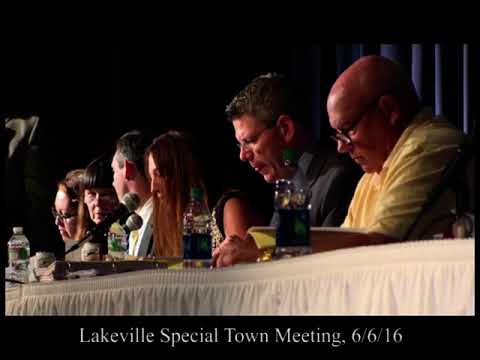
Lakeville debate over citizen-sponsored wetlands bylaw ends with article tabled indefinitely
Summary
A citizen petition to adopt a new Wetlands Protection Bylaw (Article 6) prompted extended public comment and opposition from town officials and the finance committee; a motion to table the article indefinitely passed by the required two-thirds vote.
Moderator Norman Orel opened debate on Article 6, a citizen petition to adopt a new Town of Lakeville Wetlands Protection Bylaw that would add locally enforceable protections beyond the state Wetlands Protection Act (M.G.L. c.131, §40) and 310 CMR 10. The petition text proposed a 25-foot wetland protection zone adjoining wetland resources, new protections for isolated land subject to flooding, definitions and protections for vernal pools, a 100-foot buffer for some resources, and an enforcement regime that included progressive fines ($100/$200/$300) and restoration orders.
Petitioner Martha Schroeder moved adoption ‘‘that the town adopt the wetlands protection bylaw as it is written in article 6 in the warrant.’’ Schroeder said the bylaw was intended to give local protection for wildlife habitat, groundwater recharge, vernal pools and isolated depressions and to respond to reductions in state enforcement capacity. The finance committee opposed the article; a finance committee representative told town meeting the committee “does not recommend approval of this article.”
Derek Maxey, a member of the Conservation Commission, told town meeting the commission had not taken a formal position or held public hearings on the petition and raised several substantive objections about drafting and enforcement. ‘‘There is no may in that sentence. Therefore, I believe there is no possible way to give a waiver for any of these, these wetlands decisions,’’ Maxey said, arguing the bylaw’s wording would make waivers and practical permitting difficult. Resident Bill Martin warned the bylaw would ‘‘constitute the taking of upland land’’ by restricting use of upland areas adjacent to wetlands. Town counsel Greg Corbeau explained the effective-date process for any bylaw approved by town meeting: the article would go to the Attorney General for review, and only after AG approval and publication by the town clerk would the bylaw become effective.
Debate centered on scope (the bylaw reaches upland areas beyond the state resource boundary), enforceability with a single part-time agent, and unclear definitions (for example, how ‘‘isolated land subject to flooding’’ would be delineated in practice). Supporters countered that existing developed lawns, gardens and farm activities were exempted in the petition text and stressed local control and protection for vernal pools that lack state certification.
After public comment, resident Bill Martin moved to table Article 6 indefinitely; the motion was seconded. The moderator explained a motion to table indefinitely ends debate and disposes of the article without a substantive yes/no vote on adoption. Tellers made a counted vote; the moderator announced the motion to table indefinitely met the required two-thirds vote and the article was disposed. No adoption vote on the bylaw was taken by town meeting.
Ending: With the article tabled on a two-thirds vote, the town meeting moved on to Article 7 (Community Preservation Act). The record shows the finance committee did not recommend Article 6 and multiple conservation and planning concerns were raised during public comment; supporters argued the bylaw would restore local protections for wetlands and vernal pools.