Get Full Government Meeting Transcripts, Videos, & Alerts Forever!
Get email alerts on the UNCA Stadium topic
No spam. Unsubscribe anytime.
Asheville residents urge Buncombe County commissioners to oppose UNCA stadium proposal and preserve urban forest
Summary
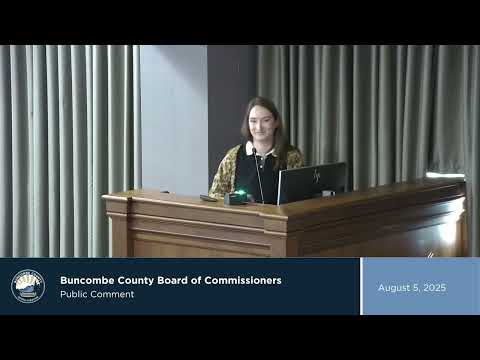
Dozens of residents, students and faculty urged the Buncombe County Board of Commissioners on Wednesday to oppose a proposed stadium and mixed-use development on University of North Carolina at Asheville (UNCA) property that speakers said would clear a mature urban forest.
Dozens of residents, students and faculty urged the Buncombe County Board of Commissioners on Wednesday to oppose a proposed stadium and mixed-use development on University of North Carolina at Asheville (UNCA) property that speakers said would clear a mature urban forest.
Speakers told the commissioners the woods serve as an outdoor classroom, reduce heat and flood risk in Asheville and that alternatives exist for siting a stadium. Multiple speakers asked the commission to pass a resolution opposing UNCA's plan and to help coordinate a land swap so the university and community could both meet their needs without removing the forest.
The public comment period included UNCA alumni, neighborhood leaders and faculty who traced the project’s potential impacts to neighborhood quality, stormwater and tree canopy. Marina Brain, who identified herself as a UNCA alumna, said, “When UNCA states that this property is undeveloped with no educational value, I know for a fact that's not true.” Sam Fontaine, another UNCA alumnus, told commissioners the woods influenced his choice to attend UNCA and said the proposed development would signal a diminished conservation commitment by the university.
Several speakers cited specific concerns and figures. Chris Cateda, president of the 5 Points Neighborhood Association and an organizer with Save the Woods, urged the county to press UNCA to preserve the forest and proposed an alternative: an arboretum and trails in partnership with the university, the city and a private foundation. David Walter, a longtime neighborhood resident, warned it was “pretty guaranteed that if the project goes forward, the whole forest will be clear cut.” Multiple speakers cited a petition with more than 14,000 signatures opposing the project; one speaker referenced “almost 15,000.”
Speakers also raised procedural concerns. UNCA faculty and neighborhood speakers said the university’s administration had not fully shared project details and urged commissioners to question language they said had been added to a state budget that could exempt state university land in Buncombe and Watauga counties from certain local oversight. David Clark, a UNCA professor, said he and others were trying to learn what that budget language means and asked the board to investigate.
Not all commenters limited their ask to symbolic action. Howard Lubell and others urged stronger measures, suggesting that county cooperation for utilities and infrastructure could be withheld absent community engagement. Anne Walsh pressed commissioners to send a clear signal to the UNC Board of Governors, writing that Art Pope—whom she described as an influential member of state GOP politics and a UNC Board of Governors appointee—had asked UNCA leadership whether local elected officials supported the project.
Commissioners did not take formal action on the stadium or the forest during the meeting. Chair Cherry Edwards opened the public comment period and heard the speakers; the agenda proceeded to hearings and other business. Several speakers said the UNC Board of Governors is expected to vote on a lease to a developer in mid-September, and they asked county leaders to act before that vote.
Speakers proposed alternatives to building in the woods. Several architects and neighborhood advocates, according to public comments, said a stadium could be sited where current athletic fields already exist. Chris Cateda said an arboretum and connected greenway would better align UNCA with community values and sustain long-term support for the university.
The commissioners did not debate or vote on any resolution or directive about the project during the meeting. The public comment record will remain part of the board’s minutes and was followed, in the same session, by other agenda items including zoning hearings and budget amendments.
The issue remains a local land-use controversy with state-level implications because of the university’s governance; speakers asked the board to make a public statement and to investigate the reported budget language that could limit local review. A number of residents said they view the matter as urgent because of an anticipated vote by the UNC Board of Governors in September.