Get Full Government Meeting Transcripts, Videos, & Alerts Forever!
Get email alerts on the Zoning Meeting Facilities topic
No spam. Unsubscribe anytime.
Committee forwards amended Bill 60 to redefine "meeting facilities," limit home gatherings and tighten parking for special events
Summary
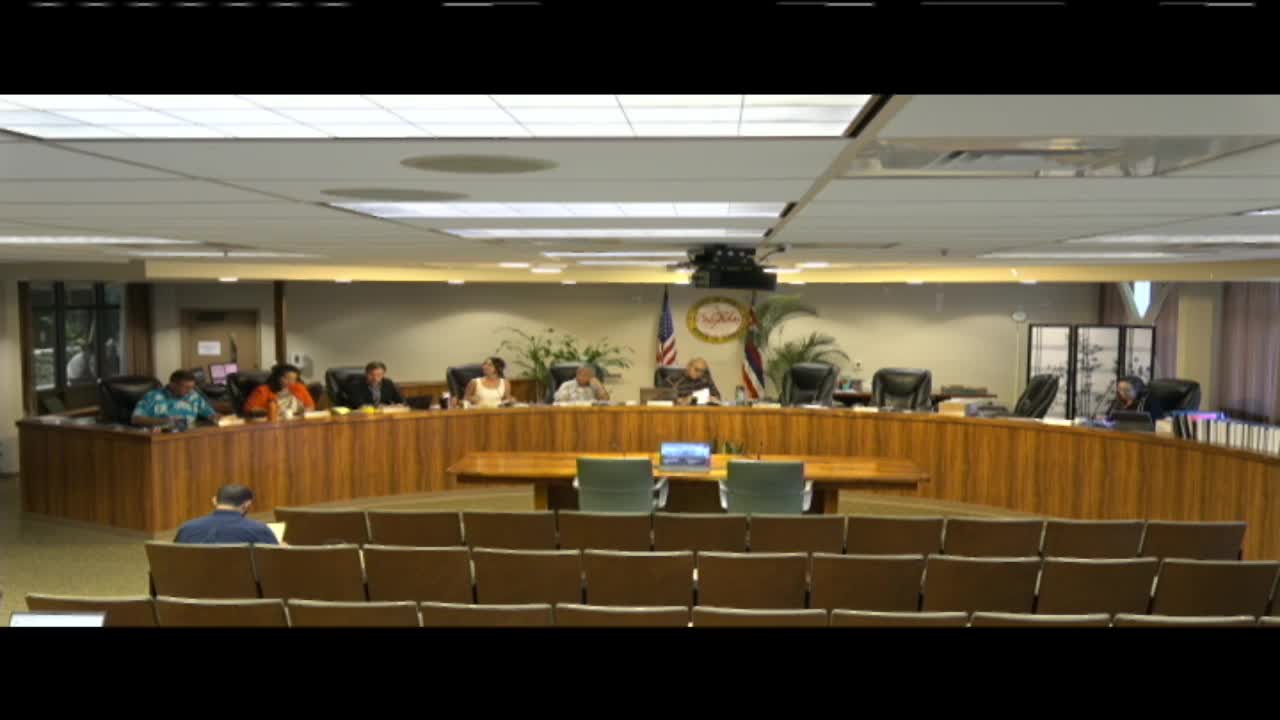
The Hawaii County Policy Committee on Planning, Land Use and Economic Development on Aug. 5 voted 7-0 to amend and forward Bill 60, which rewrites zoning rules for meeting facilities, clarifies limits on home-based gatherings and establishes new parking formulas for special events.
The Hawaii County Policy Committee on Planning, Land Use and Economic Development on Aug. 5 forwarded Bill 60, as amended, to the full County Council with a favorable recommendation after passing an amendment by a 7-0 vote. The measure would amend Chapter 25 (zoning) of the Hawaii County Code to replace existing rules for community buildings, churches, temples and synagogues with a unified definition of “meeting facility,” clarify what counts as a “special event,” and set parking requirements for events held indoors and outdoors.
Committee Chair Ashley Kirkwich said the amendment reflects extensive negotiations between the planning department, corporation counsel and members of the faith community to address concerns raised during prior meetings and public outreach. “There was a major commitment to getting concerns addressed by community members, and that is what we have done here, with this amendment,” Kirkwich said on the record.
The change responds to a zoning dispute that arose after a complaint in Kona and a subsequent investigation, Planning Director Jeff Darrow told the committee. That inquiry flagged an inconsistency in the existing code: churches in residential zones required a use permit while “meeting facilities” were permitted uses, creating potential disparate treatment. The bill combines the different use categories under a single “meeting facility” definition and adds provisions aimed at preventing that definition from being used to open transient-accommodation businesses within meeting facilities.
Key provisions in the amendment
- Home-based gatherings: For residential zones (RS, RSD and RM), the amendment defines gatherings inside a dwelling for social, religious, charitable, political, fundraising, cultural or civic purposes as a home-based assembly — permitted so long as they occur no more than three times per week and each gathering includes no more than 25 individuals, exclusive of family members of residents. Gatherings that exceed those limits are classified as a meeting facility and would trigger plan approval and related requirements (for example, parking).
- Special events and parking: The bill introduces the term “special event” and establishes a clear formula planning staff will use to calculate parking for such events. Where a facility regularly hosts special events, the parking standard for those events is set at one parking space per three people. For general meeting-facility parking, the amendment replaces the previous 1 space per 75 square feet standard with a middle-ground 1 space per 150 square feet and retains a people-based threshold (discussed in committee as 1 space per 7 people for some facilities); whichever yields the greater requirement would govern. The amendment preserves director discretion (“or as otherwise approved by the director”) to account for site-specific conditions and shared parking arrangements.
- Transient accommodations: The meeting-facility definition was edited to add the words “public commercial” before “transient accommodations” to make clear that the definition should not be used to circumvent rules for operating transient lodging.
Planning director Darrow said the immediate impetus for including special-event language and stricter parking calculations was an unpermitted outdoor concert in Waikoloa that strained local parking and infrastructure. He told the committee that commercial, resort and industrial zones already undergo plan approval and typically address parking through that process, but the amendment targets impacts in residential areas where special events can create neighborhood disruptions. “In a residential zone, if they want to hold a special event, it does trigger the need for a use permit,” Darrow said.
Council members’ concerns and balance
Committee members repeatedly raised parking as the main community impact to be managed. Councilmember Onishi and others asked how the rules would apply to one-time events; Darrow and staff clarified that a one-time commercial special event in a residential zone could trigger a use permit requirement if it is outside the ordinary scope of a home assembly. Several members noted the difficulty of drawing clean lines between ordinary residential gatherings and uses that should be regulated; Kirkwich and Darrow said the three-times-per-week and 25-person limits were the negotiated compromise reached after multiple drafts and stakeholder meetings.
Council members also discussed existing facilities and whether they must seek new permits. Darrow said existing meeting facilities would not be retroactively affected unless they began hosting special events that exceeded the new thresholds; for events that already go through liquor permitting or other approvals, planning staff have been coordinating to require updated parking plans reflecting the new one-per-three standard where appropriate.
Votes and procedural outcome
The committee voted 7-0 to amend Bill 60 (motion moved by Councilmember Inaba, seconded by Councilmember Onishi). The committee then voted 7-0 to forward Bill 60 draft 2, as amended, to the County Council with a favorable recommendation; Councilmembers Keneally Kleinfelder and Galimba Villegas were recorded as excused.
What happens next
With the committee’s favorable recommendation, Bill 60 will be scheduled for consideration by the full County Council. Planning staff told the committee they intend to continue refining implementing language and said director-level discretion will remain available to address site-specific circumstances, including shared off-site parking agreements that can satisfy the new requirements.
The committee discussion spanned code language, parking calculations and distinctions intended to protect residential home assemblies while regulating commercial or frequently recurring events that create neighborhood impacts.