Get Full Government Meeting Transcripts, Videos, & Alerts Forever!
Get email alerts on the Water Body Setbacks topic
No spam. Unsubscribe anytime.
Mat-Su planning commission rejects recommended water-body setback ordinance; asks staff to draft revised resolution
Summary
After weeks of advisory-board work and extensive public comment, the Matanuska-Susitna Borough Planning Commission on Aug. 4, 2025 voted down Resolution 25-10 — its recommendation on water-body setbacks — and asked staff to prepare a revised resolution for the assembly that addresses issues raised by commissioners and the public.
The Matanuska-Susitna Borough Planning Commission on Aug. 4, 2025 voted down Resolution 25-10, a recommendation to the borough assembly on a proposed overhaul of water-body setback rules affecting lakes, streams and other waterbodies across the borough.
Planning director Alex Strahan told commissioners the measure grew from a multi-year effort by a nine-member Waterbody Setback Advisory Board and was intended to resolve long-standing enforcement gaps. "This water body setback ... is, right there at the top as far as interest level," Strahan said, summarizing the board's work and a GIS review that found roughly 750 likely setback violations in areas covered by lidar imagery.
The advisory-board draft would keep the borough's 75-foot baseline setback, expand the code to cover commercial and industrial structures, and allow limited encroachment to 45 feet if owners hire a registered engineer and meet stormwater and vegetation-protection standards. It would also ban paved parking and hazardous-liquid storage within 25 feet of water, prohibit fertilizer and herbicide application in that zone, restrict imported-snow stockpiles, and require permits for heavy machinery used inside the 75-foot zone. Property owners with fuel tanks within 75 feet would have five years to comply or to retrofit equipment, under the proposal.
Why it matters: waterfront setbacks shape development, wildfire mitigation, habitat and financing eligibility for waterfront homeowners, and the draft raised questions about enforceability, costs to property owners and whether the borough has authority or capacity to regulate certain activities.
During public testimony, environmental and habitat groups voiced support. Jessica Speed, coordinator of the Mat-Su Basin Salmon Habitat Partnership, said the partnership backed riparian protections in the draft and commended the borough's work: "We commend you for your thoughtful efforts to address identified issues," she said. Margaret Stern of the Susitna River Coalition said she "is in strong support" and praised the advisory board's meetings and recommendations.
Opponents and some community councils said the draft was too broad or too costly for private owners. Esther Huddleston, calling from the public, said the rules were "too restrictive" and urged that many longstanding uses be grandfathered. Meadowlakes Community Council members and other speakers asked the commission to retain the 75-foot standard for new construction and raised concerns about enforcement capacity and potential costs for fuel-tank retrofits and engineered stormwater controls.
Commissioners questioned key details during deliberations. Commissioner McCabe asked about the cost of enhanced enforcement; Strahan said the advisory board recommended "enhanced enforcement" but did not provide staffing or cost estimates. Commissioner Scoggin asked how owners obtain grandfathering; Strahan said the borough charges a fee (about $150) to process a formal determination of preexisting legal nonconforming status using assessment records, imagery and as-built documentation.
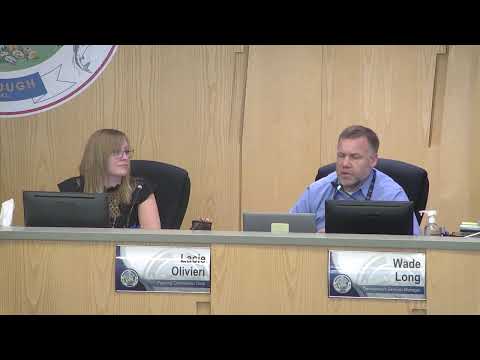
Panel members also asked whether mining operations and activities in the water column would be affected. Lacey Olivieri, planning commission clerk, and Strahan noted the borough's regulatory reach generally stops at the ordinary high-water mark: "Anything over the ordinary high watermark into the water body would not be regulated by the borough," Strahan said, and Olivieri noted federal permits often cover docks and adjacent in-water work.
Commission action and next steps: Commissioner McCabe moved to approve Resolution 25-10; Commissioner Scoggin seconded. At roll call the motion failed unanimously (Carpenter — No; Collins — No; McCabe — No; Scoggin — No; Glenn — No). After discussion, Commissioner McCabe moved and Commissioner Scoggin seconded a separate motion asking staff to draft a new resolution for the assembly that acknowledges the advisory board's work but addresses public concerns and identified gaps (mining, remote properties, enforcement, and costs). That motion passed by voice vote. Planning staff said they will prepare a draft resolution for the commission's unfinished-business agenda at the next meeting and can forward it to the assembly prior to its September meeting if commissioners wish.
What was not decided: the assembly has not yet considered an ordinance; the commission's failed resolution would have been a recommendation only. The commission did not adopt specific enforcement staffing levels, a fine schedule, or a finalized habitat-tax incentive; Strahan said those details would require separate follow-up ordinances or administrative actions. He also said variances would be disallowed within 45 feet under the advisory-board recommendation.
The commission closed the hearing without approving the advisory-board draft and directed staff to prepare a revised resolution that reflects the concerns heard at the Aug. 4 hearing.