Get Full Government Meeting Transcripts, Videos, & Alerts Forever!
Get email alerts on the Public Safety Fire Ems topic
No spam. Unsubscribe anytime.
Consultant recommends weighted combination formula to fund Jackson Hole Fire EMS; staff to refine options
Summary
Emergency Services Consulting International presented options for a joint funding formula to support Jackson Hole Fire EMS and recommended a weighted combination of factors (incident counts, population, staffing). Staff and elected bodies will discuss weights and return to a joint meeting later in the year.
Emergency Services Consulting International presented a joint funding assessment for Jackson Hole Fire EMS and recommended a weighted combination approach to allocate costs between the Town of Jackson and Teton County. The presentation documented recent budget pressures, data availability and next steps for negotiating a joint funding formula.
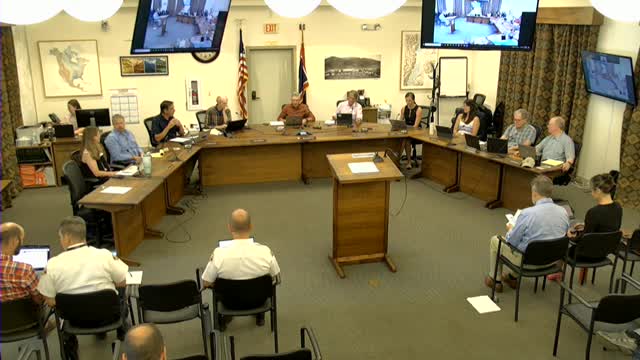
Chris Trudy, senior project manager for the consulting team, told the Town Council and County Board of Commissioners that there is no single correct formula for shared funding but that combined, weighted factors — such as incident counts, staffing and population served — give the most defensible basis for cost allocation. Trudy illustrated the approach with example weightings: an unweighted three-factor split (staffing, incident counts, population) and a weighted example that assigned 50% to incident counts, 30% to population and 20% to staffing.
Trudy described multiple single-factor and multi-factor options, including allocation by incident count, assessed value, response area or road miles, fleet/facility cost, staffing and population. He cautioned against letting negotiations start from fixed dollar amounts rather than agreed principles, saying, "it's absolutely important that the negotiations take place on the value of the characteristics of the department and not necessarily with a calculator that's sitting with you."
Presenters and staff outlined the current shape of the department and its budget context: nonfederal Teton County covers roughly 1,900 square miles while the town of Jackson is about 3 square miles; the department operates six stations (two staffed, four primarily volunteer-supported), employs 46 career personnel and lists about 64 volunteers; the Fire & EMS fund balance has declined to about $0 after reserve draws in recent years. Trudy said the department's budget had grown more than 119% over the past five years, contributing to questions about equitable funding.
Financially, Trudy noted a prior funding split of about 46% town / 54% county had been adjusted to about 38% town / 62% county beginning in 2027 in recent agreements, with a potential reversion if no new formula is agreed. The consultant identified lodging-tax fluctuations and rising expenses as contributing to the department's funding stress.
Jackson Hole Fire EMS leadership and staff told the boards the department already collects much of the objective data that would underpin allocation formulas. The fire chief said regular reporting and the strategic planning process are being used to refine incident counts, staffing metrics and other performance measures; "we collect a lot of data already," the chief told the boards.
Commissioners and council members asked about data collection burdens, the role of volunteers in staffing calculations (the consultant said a common practice is to treat roughly three volunteers as equivalent to one career firefighter for staffing formulas), and how to treat enclave or mutual-aid areas (such as Teton Village Fire District) for population or incident counts. Trudy noted most communities using combination formulas also employ rolling averages to smooth annual fluctuations and recommended negotiating chosen factors and weights before running dollar calculations.
Next steps: staff recommended each jurisdiction hold separate discussions to identify priorities and preferred weighting, then reconvene as a joint body. Town and county staff indicated they have preliminary weighting ideas but preferred to refine them with internal review first. Tyler Sinclair, town manager, said staff expects to continue the process and return to a joint meeting in October with proposed formula options.
Ending: The presentation was informational only; no vote was taken. Officials directed staff to continue data refinement and to work toward a proposed weighted formula, with follow-up conversations planned between town and county prior to a joint decision.