Get Full Government Meeting Transcripts, Videos, & Alerts Forever!
Get email alerts on the Animal Welfare topic
No spam. Unsubscribe anytime.
City Council tightens rules on public sale of pets, adds enforcement steps to HEART ordinance
Summary
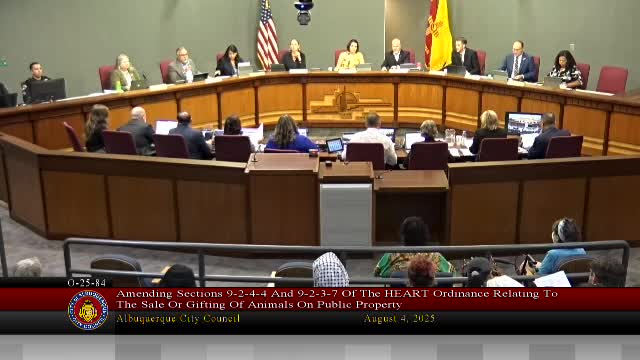
Albuquerque City Councilors on Monday approved amendments to the HEART ordinance that bar public sales of dogs and cats and allow Animal Welfare to seize animals shown for sale and ensure they are spayed, neutered and microchipped before release.
Albuquerque City Councilors on Monday approved changes to the city’s HEART ordinance that bar public sale or gifting of dogs and cats and give Animal Welfare clearer authority to seize animals shown for sale in public.
The council passed O-84 as amended on a 9-0 vote after floor amendments clarified that any animal released from the shelter must be altered and microchipped before release; animals seized under the new language will not be eligible for an intact permit; and an animal not reclaimed within 10 days becomes the property of the Animal Welfare Department.
The measure aims to curb backyard breeding and street sales that Animal Welfare and rescuers say are driving high intake and illness at the shelter. Councilor Peter Piedelkorn, sponsor of the ordinance changes, said the amendments ensure seized animals “are going to get spay, neuter, and hopefully eventually get put up for adoption for somebody that actually cares about them.”
In public comment, volunteers and rescue groups urged more mobile spay/neuter services and community outreach. Laura Cunningham asked the council to “support Albuquerque Animal Welfare by making a two‑year professional services agreement between the city and private mobile spay/neuter clinics” and to park clinics near encampments so people can access services.
Animal Welfare Director Ortega told the council the department will continue offering warnings, civil fines and criminal citations as capacity allows. “We enforce the laws to our capacity,” Ortega said, adding that the department has issued civil fines and that roughly 40% of civil fines issued in the past year have been paid. Ortega also said the department is scheduling mobile clinics and working with partners to increase access to low‑ or no‑cost spay/neuter and microchipping in neighborhoods with high need.
Council members debated enforcement logistics and the balance between punitive and supportive approaches. Councilor Fiebelkorn described the change as targeting commercial breeders and sellers who ignore existing permit requirements: “If you are selling dogs and cats in public spaces in our city, you are breaking the law, and we are going to fix that problem,” she said.
The council and staff also discussed court processing time and workload in city legal offices. City legal staff noted that criminal prosecutions go through the courts, which can delay outcomes; the ordinance adjustments are intended to give Animal Welfare clearer administrative options to remove animals from unsafe situations while preserving owners’ opportunity to reclaim pets after compliance steps.
The ordinance passed with unanimity. Councilors directed staff to meet with community groups about implementation and to return with operational plans for coordinated enforcement that include mobile clinics, clearer outreach materials and a process for pairing citations with offers of services.
The council action follows months of public comment from residents and rescues who said street sales, tethering and unserved litters are harming animals and public health. Supporters said the ordinance aligns enforcement with increased community outreach and low‑cost services; critics at the meeting urged strong support services for low‑income and unhoused pet owners so enforcement does not simply remove animals from the people caring for them.
Councilors said they will monitor impacts and asked staff for quarterly updates on enforcement, outreach and the use of mobile clinics.