Get Full Government Meeting Transcripts, Videos, & Alerts Forever!
Get email alerts on the Transportation topic
No spam. Unsubscribe anytime.
Olympia council studies draft 'Olympia 2045' transportation chapter, emphasizes multimodal priority
Summary
City planners presented the fourth draft of the Olympia 2045 transportation chapter; council members lauded multimodal emphasis, asked for clarifications on street hierarchy, piloting, secure bike parking, and asked staff to align city code and CFP spending with the chapter.
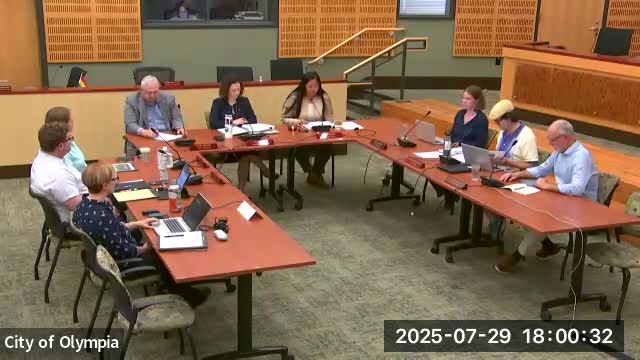
Michelle Swanson, senior planner in Public Works — Transportation, briefed the Olympia City Council on the fourth draft of the transportation chapter of the Olympia 2045 comprehensive plan, saying the update is being done chapter by chapter and that staff intend to return later this year for acceptance and then for full-plan adoption before year-end.
Swanson said the chapter integrates the Transportation Master Plan adopted in 2021 and that it now prioritizes “walking, rolling, biking, and taking transit over driving,” reflecting public and advisory‑committee input. She also noted new state requirements: multimodal performance metrics and inclusion of an ADA transition plan in an appendix, and that the Thurston Regional Planning Council (TRPC) issued provisional consistency certification pending finalization of the land use chapter.
Council members praised the draft’s shift away from car-centric language and asked detailed policy and implementation questions. Council Member Susan Madrone said the city needs to balance policy with staffing and capital resources; Council Member Robert Vanderpool and others pressed staff on whether policies calling for building arterials, major collectors and neighborhood collectors reflected current practice and whether “build” should instead read “reconstruct” or be limited to cases where reconstruction is necessary. Swanson explained the chapter reflects a street‑hierarchy policy and applies when new streets are built or existing streets are reconstructed to ensure multimodal features are included.
Public Works Director Mark Russell explained staffing and delivery constraints during the discussion, saying hiring for engineering positions has been difficult and that many projects require site‑specific design work to avoid unintended consequences (stormwater, utilities). Russell also described where the city uses standard details and when site‑specific design is required.
Council members asked about implementation and funding. Swanson and staff pointed to a local sales‑tax increase approved in December 2023 (a tenth of 1 percent) earmarked for pedestrian, bicycle and active‑transportation projects. Swanson said staff began collecting that revenue in April 2024 and are already using it on projects such as State Avenue and Pacific Avenue resurfacing work that has been scoped to add parts of the city’s low‑stress bike network and a floating bus stop configuration to help transit stay on time.
Council members also requested policy edits and clarifications: replacing “large vehicles” with “service vehicles” where appropriate; adding “pilot” language when studying road closures; considering explicit mention of bus lanes under corridor strategies; expanding language on secure/long‑term bicycle parking beyond downtown; and ensuring compatibility language with neighboring jurisdictions emphasizes safety and accessibility. Several council members expressed interest in piloting incremental or temporary treatments (barriers, pilot reconfigurations) to test street design changes before full reconstruction.
Swanson described outreach to date: two rounds on the city’s Engage Olympia platform (roughly 750 page visitors in the first round, about 230 downloaded documents, 71 short‑survey responses; the second round had about 230 visits and 17 survey responses), briefings to BPAC (Bicycle and Pedestrian Advisory Committee), the Planning Commission, the Social Justice and Equity Commission, Youth Council, and the Land Use and Environment Committee. She said most respondents supported the multimodal direction but wanted projects built sooner.
The council did not vote on any ordinance or action tonight. Staff said the next steps are continued revisions, a return for formal acceptance later in 2025, and coordination with the land use chapter so TRPC can issue final certification under Growth Management Act consistency requirements. The Capital Facilities Plan (CFP) preliminary list is scheduled for publication in early August and will show how the recent local sales‑tax revenue is being used.