Get Full Government Meeting Transcripts, Videos, & Alerts Forever!
Get email alerts on the School Finance topic
No spam. Unsubscribe anytime.
Monroe County School Board presents tentative 2025–26 budget, advertises millage rates
Summary
At a public budget hearing, district finance staff presented a tentative balanced 2025–26 budget, explained advertised millage rates and rollback calculations, and highlighted areas requiring follow-up including food service, health insurance transfers and capital planning.
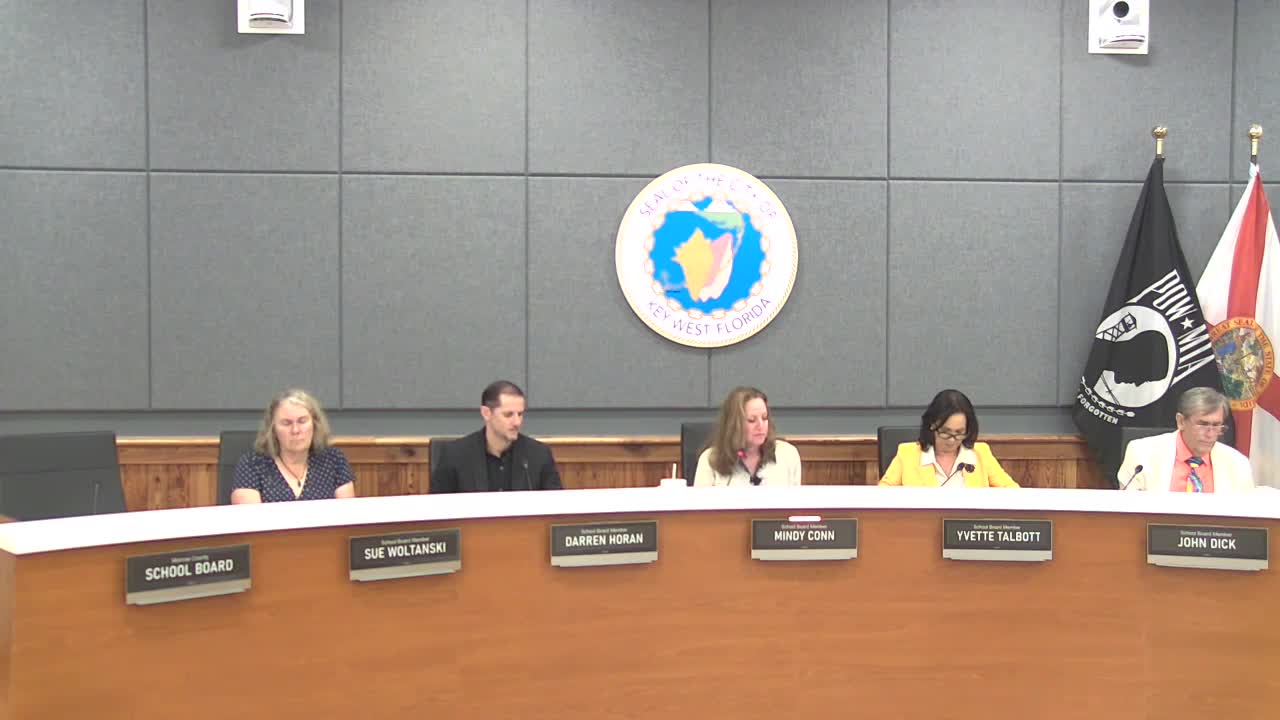
The Monroe County School Board on Monday opened a budget hearing and reviewed a tentative 2025–26 budget and advertised millage rates, hearing a presentation from Charlene White, the district’s executive director of finance and performance.
White said the district has prepared a tentative, balanced budget and that the presentation would be followed by a workshop for more detail. “Preparing the 25‑26 budget has been a team effort … we have a balanced budget,” she said during the hearing.
Board members were shown the district’s advertised millage structure and the rollback calculation used to produce the advertised rates. White explained that the advertised required local effort (RLE) rate publicized as part of the legal advertisement is 1.049, which reflects a base of 1.047 plus a 0.002 prior‑year adjustment. The district’s advertised total millage is 2.947 (comprised of RLE, discretionary operating, voted operating and capital outlay components). White said the calculated rollback rate — the rate that would generate the same revenue as the prior year on new property values — is 2.7453.
Why it matters: the RLE must be levied to receive state funding tied to the Florida Education Finance Program (FEFP). White said the FEFP adjustments and the district’s formula reduce the amount of net state revenue the district recognizes; she said the district’s net FEFP increase for 2025–26 is estimated at about $1.5 million after adjustments.
Key numbers and follow‑ups reported by finance staff during the hearing: - Advertised RLE: 1.049 (explained as 1.047 + 0.002 prior‑year adj.). - Total advertised millage: 2.947 (discretionary operating 0.748; voted operating 0.55; capital outlay 0.60). - Calculated rollback rate: 2.7453. - Save Our Homes cap (homestead assessment limit) for this year: 2.9%. - Example taxpayer impact cited by staff: a homesteaded property with a taxable value of about $500,777 would see an approximate $2.54 monthly increase in countywide services under the advertised levies (staff noted individual taxpayer results vary). - General fund projections cited in the presentation: an estimated general fund figure of about $29,400,000 and an “unassigned” fund balance figure referenced at about $27,000,000 (staff noted the potential transfer to the health insurance fund is not yet finalized). - Health insurance fund transfer: staff estimated a potential $4,000,000 transfer this year, with a multi‑year plan to reduce that amount (estimates of $2,000,000 next year and then to $0 in subsequent years were described as a planning target). - Hurricane reserve (capital): staff estimated a reserve near $9,500,000.
Board members pressed for more detail on several items White said would be provided at the follow‑up workshop. Questions included requests for a breakdown of the $12 million presented as an increase in instruction (staff said $5.3 million of that reflected salary and benefit increases and about $5 million came from FEFP adjustments, with the remainder to be allocated among functions at the workshop) and specifics on why the food service fund projections differed from earlier estimates. White told the board the food service fund is currently presented as balanced but staff are still reconciling expenditures and that borrowing from the general fund remains a possibility; if a deficit occurs the food service fund would reimburse the general fund.
Board members also asked for more detail on planned raises, the composition of special revenue (federal) funds and whether increases in health insurance premiums were included in compensation planning. White said collective bargaining numbers were not yet finalized and that staff planned to revisit compensation after the Labor Day enrollment count to finalize allocations.
What the district will do next: White and other staff said they will provide more granular documentation at the scheduled workshop, including a page‑by‑page review of the budget book, a detailed explanation of the $12 million instruction increase, a breakdown of the potential health insurance transfer, and updated food service estimates. The board set tentative millage rates and adopted the tentative budget later in the meeting (formal votes recorded under action items).