Get Full Government Meeting Transcripts, Videos, & Alerts Forever!
Get email alerts on the Disorderly Conduct Bookings topic
No spam. Unsubscribe anytime.
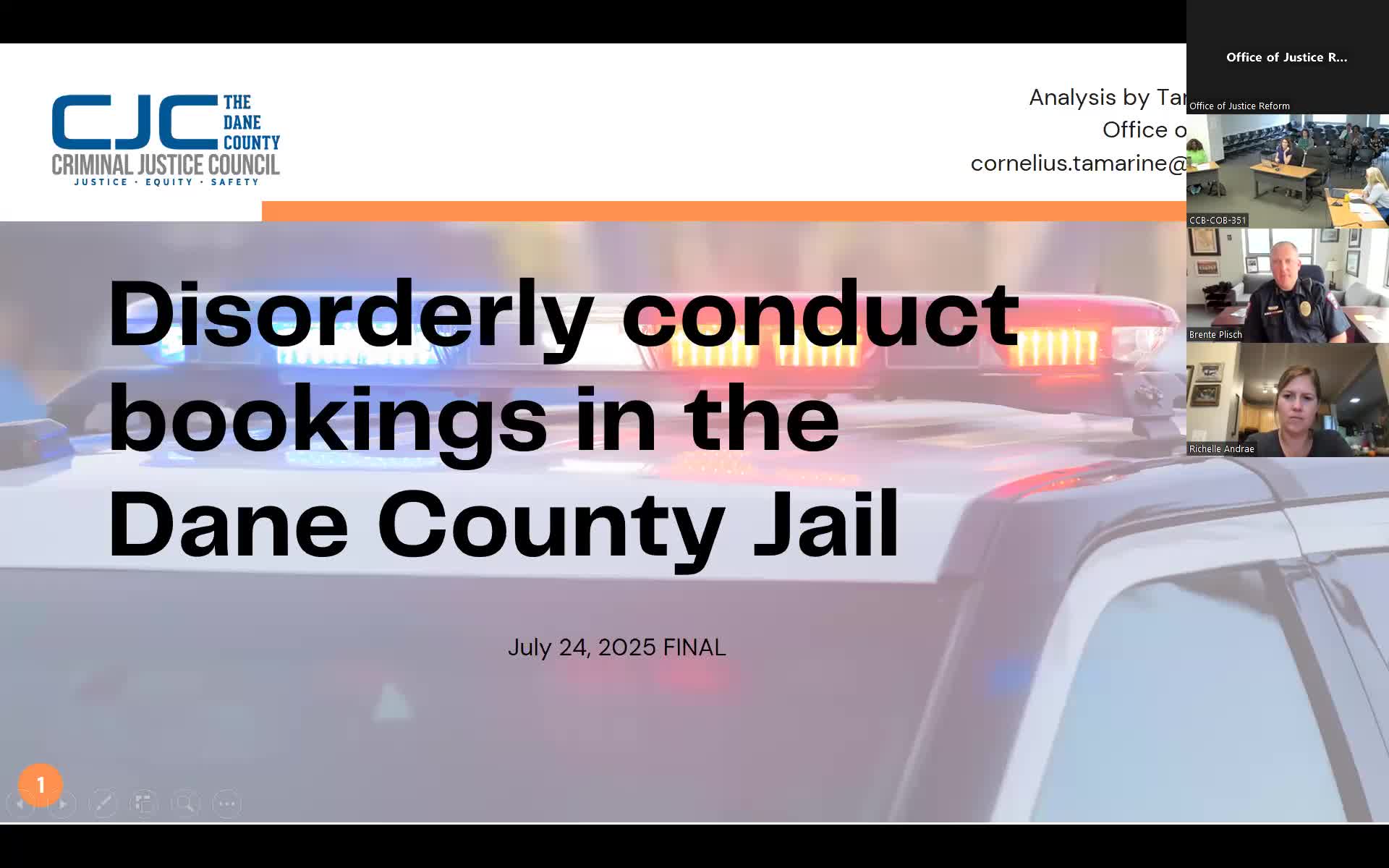
Analysis: More than half of new jail bookings include disorderly conduct; many tied to housing insecurity and repeat bookings
Summary
A Community Justice Council analysis found disorderly conduct listed on 54% of new Dane County Jail bookings from 2020–2024; many of those cases involve a domestic-abuse enhancer, occur on State Street and the West Isthmus, and disproportionately affect people with housing insecurity and repeat jail contact.
Tamarine Cornelius, the Community Justice Council research analyst, told the council that disorderly conduct was the most common offense recorded on new jail bookings in Dane County from 2020 through 2024.
Cornelius said the council’s analysis covered about 23,000 new arrest bookings and found that 54% included a disorderly conduct charge, far more than the next-most-common charge, battery. “Disorderly conduct is the most common offense on bookings by a lot,” Cornelius said.
The nut graf: The analysis — produced with sheriff’s office data under a data-sharing agreement and reviewed by local partners — breaks out a subset of largely discretionary arrests (disorderly conduct with no other offense and no statutory enhancer). That subset points to concentrated geographic, demographic and system-use patterns that council members said warrant follow-up by the CJC and partner agencies.
Cornelius described the dataset and definitions used in the analysis. It excluded bookings that were solely for serving sentences or for warrants and focused on bookings tied to new arrests. Over five years, about 23,000 such bookings were analyzed. In the subset labeled “simple disorderly conduct” — bookings with only a disorderly conduct charge and no enhancers — there were about 1,300 bookings across five years.
Key quantitative findings the presentation flagged include: 54% of new-arrest bookings had a disorderly conduct charge; about 58% of disorderly conduct charges carried a domestic-abuse enhancer; roughly 5% were county-ordinance violations; there were about 4,400 bookings over five years with a disorderly conduct charge and no other offense; and about 1,300 bookings over five years were disorderly conduct only with no enhancer.
Cornelius said Madison (the Madison Police Department) was the arresting agency for the largest share of bookings: 54% of all new-arrest bookings and 60% of bookings that included a disorderly conduct charge. The sheriff’s office accounted for roughly 15% of all bookings and about 13–16% of disorderly-conduct bookings depending on the subcategory; Sun Prairie and other suburbs made up smaller shares.
On the people arrested in the “simplest” disorderly conduct category (no other charges and no enhancers), Cornelius said the demographic profile was similar to the jail population overall: about 59% identified as white, 38% as Black, 1% Asian and 1% Native American; about three-quarters were male and the average age was in the mid-30s. Cornelius said this group was, however, more likely to be housing insecure and to be “high utilizers” of the jail — defined in the analysis as three bookings within any six-month period.
Cornelius described how the team matched bookings to court records to identify outcomes and cautioned that many cases could not be matched to a court filing in the days after booking. “The biggest share of those, I can’t say for sure what happened to them. They don’t have a case in CCAP in the couple days after they were booked that matches to their name and date of birth,” Cornelius said, noting that this makes outcome conclusions uncertain. Of the bookings that matched to a court case, about 12% were declined by the district attorney; among matched cases, outcomes split between misdemeanor prosecutions and forfeiture/ordinance cases. For misdemeanors that proceeded, Cornelius said roughly half resulted in convictions without a jail sentence, about 29% were dismissed, and about a quarter resulted in jail — and of those, two-thirds of jail sentences were treated as time already served.
The presentation mapped arrest locations and showed a clear concentration on the West Isthmus and around State Street in downtown Madison. Cornelius said about one in eight of the simple disorderly conduct bookings in the county occurred inside a half-mile circle centered on State Street. She also said people arrested in that State Street area were more likely to be younger (including many under 25) and more likely to be housing insecure compared with other jailed people.
Council members and law enforcement representatives followed with questions about data fields and operational practice. Chair Patrick Miles and others asked whether the jail’s “enhancer” field included a domestic-violence marker; Cornelius said the jail database does include a field indicating enhancers and that the domestic-violence enhancer appears in that column. Chief Patterson and others emphasized that officers sometimes book rather than issue citations because they do not feel the behavior will stop or they need an immediate “time out.” “Jail is used as that means to create the time out that’s necessary,” Chief Patterson said, adding that officers already issue many disorderly-conduct citations but do not always consider citation an adequate response if the behavior may escalate.
Several council members, and a representative of the county executive’s office who requested the review, said the findings raise questions about upstream responses such as increased housing supports, diversion services, warm handoffs, and targeted outreach on State Street. Supervisor Andre and others asked whether behavioral-health data could be integrated into future analyses; Cornelius said that analysis was not part of this dataset but that the challenge includes privacy constraints and the limits of available records.
Cornelius and the council discussed next steps: refining matches to court records to reduce the “unknown outcome” portion; producing more granular analyses on youth (including requests for 17-year-old counts) and on race and outcomes where sample sizes support reliable conclusions; and coordination with housing and behavioral-health committees for follow-up interventions.
The presentation was made under a data-sharing agreement between the Community Justice Council and the sheriff’s office, and Cornelius thanked sheriff’s‑office staff and Michelle DeForest for data support. No formal action was taken by the council on the disorderly conduct analysis; members directed staff to pursue further data work and to bring findings to subcommittees for policy discussions.
Looking ahead, council members asked for a follow-up report and for the CJC’s data team to try to produce clearer outcome matches and demographic cross-tabs when the small-sample caveats allow.