Get Full Government Meeting Transcripts, Videos, & Alerts Forever!
Get email alerts on the Land Use topic
No spam. Unsubscribe anytime.
Northwood Park residents press commission over alleged deed-restriction violations; Fauville Crossing Place replat approved with conditions
Summary
Neighbors urged the Planning Commission to address alleged deed-restriction and unpermitted commercial activity in Northwood Park during public comment on the Fauville Crossing Place replat (Item 66); staff recommended approval and the commission approved the replat subject to standard conditions after applicant assurances on fencing and access.
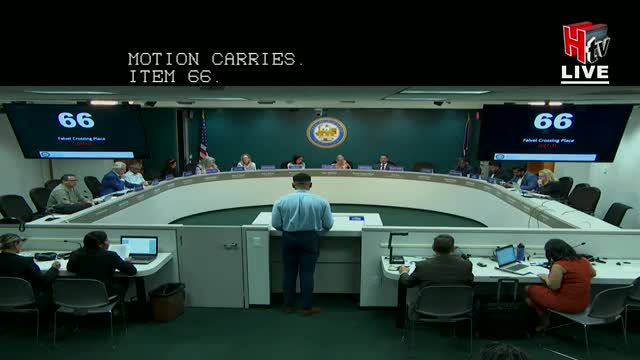
Neighbors from Northwood Park told the Houston Planning Commission on July 24 they have endured multiple alleged deed-restriction violations, parking and flooding problems, and what several speakers called misleading permit filings. The concerns came during the public hearing on Item 66, the Fauville Crossing Place replat, which the commission approved with staff conditions.
“[The developer] lied to us. He says it's gonna be a barndominium... It is a little office in there, and that's all there is to it,” said Ed Curry, a resident who identified the structure across from his house and said county permit filings misrepresented its use.
Multiple neighbors described commercial activity, trucks and trailers parked in the street, flooding and loss of residential character. Timothy O'Leary, who distributed a pamphlet to commissioners, outlined a series of alleged violations and said the neighborhood lacks resources to pursue legal remedies. William Gentry, president of the Northwood Park Civic Association, told the commission the neighborhood has filed complaints with county agencies and the fire marshal but sees ongoing activity.
Kenny Calhoun, staff planner, presented the replat as a 1.2 acre proposal in Harris County's extraterritorial jurisdiction (ETJ) to consolidate five lots into one commercial reserve; staff recommended approval subject to CPC form conditions and noted the applicant met notification requirements. Several residents asked whether the city could enforce deed restrictions in the ETJ; Paul Barnes from the City’s neighborhood services section told the commission that deed-restriction enforcement is a private matter between property owners, and that the city’s authority to enforce deed restrictions is limited to parcels inside city limits.
Applicant Sohail Ali told the commission his team is not proposing a driveway from Ramsgate, agreed to include fencing, and said he wants to work with residents on tree buffers and site grading. “We are not proposing a driveway from Ramsgate. We ourselves do not want traffic in from Ramsgate,” Ali said and added that his engineer would incorporate fencing into the building line and site design.
Commissioners and staff clarified regulatory limits: detention and drainage must comply with Harris County Flood Control District and Texas law; billboard rules and drainage are governed by county or state regulations in the ETJ. Paul Barnes said drainage obligations would fall under county flood-control and that diverting stormwater is constrained by the Texas Water Code.
After discussion, the commission approved staff's recommendation to approve the replat subject to the standard CPC 101 form conditions. The approval was recorded by voice vote; the meeting transcript records commissioners voting “Aye” and the chair announcing the motion carries, but the transcript does not list individual vote tallies.
The public record for this item includes residents’ requests that conditions be applied or noted on the plat: no driveway access from Ramsgate, fencing around detention, preservation or use of trees as a buffer, shielded lighting, and limits on signs. Staff and legal noted some of those protections are addressed by deed restrictions or county regulation and that enforcement in the ETJ may be limited.
The commission did not adopt new enforcement authority at the meeting. Residents were encouraged to continue engagement with the applicant and to pursue county enforcement avenues for active violations.