Get Full Government Meeting Transcripts, Videos, & Alerts Forever!
Get email alerts on the County Insurance Pools topic
No spam. Unsubscribe anytime.
CTSI briefs Rio Blanco commissioners on county insurance pools, training and risk controls
Summary
Meredith Burcham, executive director of Colorado Counties Inc. Service, updated the Rio Blanco County Board of Commissioners on the county-focused insurance pools (CWCP, CAP, CHP), pool finances, training services and items staff is considering for 2026 renewals.
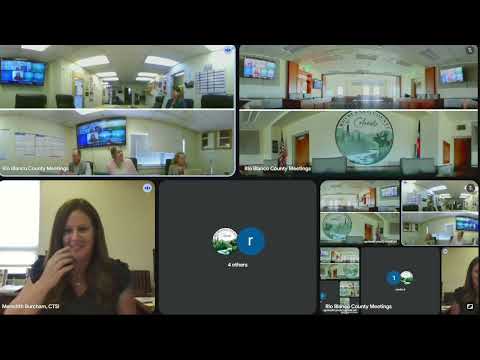
Meredith Burcham, executive director of the Colorado Counties Inc. Service (CTSI), told the Rio Blanco County Board of Commissioners on July 22, 2025, that the county remains an original member of CTSI's pools and that the pools are financially sound as the organization prepares renewals for 2026.
Burcham said the CTSI pools are county-owned and operated and are structured to spread risk across many counties. "We like to say you can't get more local than owning your own insurance company," she said, adding that the pools aim for broad coverage tailored to county operations rather than "off-the-shelf" commercial policies.
CTSI oversees three county-oriented pools discussed in detail: CWCP (workers' compensation), CAP (casualty and property) and CHP (health plan). For CWCP, Burcham described the contribution formula (which uses two-year-old payroll data to provide budget stability), the pool retention level and loss-control services such as return-to-work programs and safety training. She said CWCP holds roughly $25,000,000 in equity and that in recent years the pool has returned $3 million to $4 million in equity distributions to members to reduce contributions. The pool pays claims up to a pool retention layer of $875,000 and then purchases excess coverage; CTSI is evaluating whether raising that retention to $1,000,000 would lower overall costs for members.
On CAP, which provides property, general liability (including public officials and professional liability), law enforcement liability, automobile liability, crime and cyber coverage, Burcham said the market hardened nationally in 2021 and carriers reacted by tightening capacity and raising costs. She cited increased law-enforcement liability exposure, including litigation trends and state-level changes such as SB 217, as contributors to higher costs. CAP's equity is "back up about $12 to $13 million" year-to-date; combined equity and interest income returned $1.4 million to members last year, Burcham said.
Burcham said CAP and CWCP continue to emphasize loss-control services: ergonomics and body-mechanics training, MSHA and flagging certifications, defensive-driving classes, fleet policies and backing-only protocols for vehicles. CTSI also provides in-house claims adjudication and reporting and has added services such as a human-resources specialist and a pre-loss legal consult (30 minutes with a CTSI attorney) to help counties reduce employment-related claims.
On CHP (the health plan), she said the plan saw elevated increases in recent years attributable to higher utilization and medical-cost inflation; CTSI is bidding the stop-loss contract and examining options such as online enrollment tools and benefits enhancements (dental/vision). Burcham said the stop-loss market and catastrophic claims will influence final 2026 pricing.
Cyber coverage, Burcham said, has softened compared with the market peak, helped by counties adopting multi-factor authentication and other security practices; CTSI expects improved carrier competition for cyber limits. She also said CTSI is monitoring artificial intelligence exposures and considering adding drone coverage to CAP because a recent member survey showed a majority of counties now deploy drones.
Burcham described internal staffing and service updates: CTSI employs about 19 staff across the pools; one loss-control position is being refilled; an HR specialist has provided harassment and drug-and-alcohol training; and CTSI is evaluating a learning-management system for training delivery and a claims automation effort.
Commissioners asked no substantive follow-up questions during the presentation. Burcham closed by thanking the board and noting CTSI will continue to analyze renewal options for 2026.
CTSI materials and the presentation noted the pools are audited annually and that CTSI seeks to use equity distributions and risk-management services to stabilize member contributions.