
Cheyenne engineering director urges modest increase in maintenance funding to preserve city streets
Get AI-powered insights, summaries, and transcripts
Sign Up Free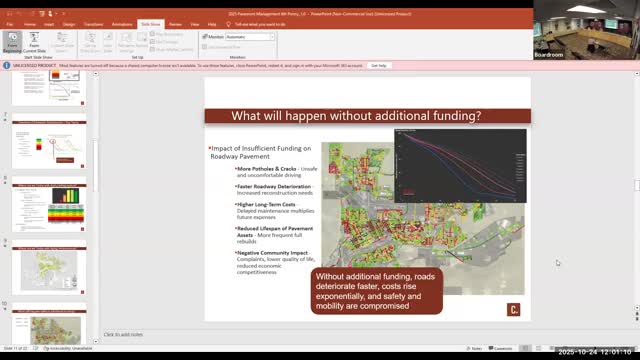
Summary
Engineering Director Tom Cobb reported the city’s average pavement condition index is 68 and urged the council to ask voters to raise a maintenance levy from $14 million to $15 million to keep road conditions from declining.
Tom Cobb, director of the Engineering Department, told the City Council at its Oct. 24 work session that Cheyenne’s pavement network is in “fair” condition and that modest additional funding is needed to prevent accelerating deterioration.
Cobb said the city’s most recent pavement condition survey (2023) shows an average pavement condition index (PCI) of 68 — above the national average he cited as roughly 60–65 — with about 4.4% of total roadway area below a PCI of 40, a threshold he described as “when we get in trouble.” Cobb said the city maintains roughly 370 miles of streets.
Why it matters: Cobb said delaying routine maintenance raises long-term costs because streets that fall below serviceable condition require reconstruction instead of cheaper surface treatments. He told the council that reconstruction can cost about $1.5 million per mile and that preventative treatments (crack sealing, patch-and-seal, slurry seals) can extend pavement life at far lower cost.
Key findings and numbers: Cobb credited the previous voter-approved maintenance fund (identified in the presentation as $14 million over five years from the “sixth/fifth penny” source) with increasing annual maintenance capacity by about $2.8 million per year. He reported 2025 maintenance accomplishments of 94 miles of crack seal, 115 miles of slurry seal and 8 miles of overlays (centerline miles), and said those actions helped keep the PCI above the national average.
Funding scenarios presented: Cobb ran multiple fiscal scenarios for the next decade: - If funding falls to an estimated $5.5 million per year (his projected baseline from the fifth-penny source starting in 2027), the citywide PCI would fall toward the mid-50s by the mid-2030s. - Holding annual investment at about $10 million would largely stabilize current conditions. - Investing roughly $13 million annually could raise the average PCI into the low 70s. - Eliminating the backlog of failed streets, Cobb said, would require roughly $21.7 million per year for nine years (and about $16.3 million in a tenth year) — a level he called infeasible given other city priorities and local construction capacity.
Recommendation and next steps: Cobb asked the council to place a measure before voters to increase the maintenance program from the previously authorized $14 million to $15 million (equating to about $3.0 million per year rather than $2.8 million) to offset inflation and “stay even.” He also told members that while $22 million per year would be the level to fully preserve the system, that target is not realistic now.
Council questions and staff responses: Council members asked about contractor capacity, cost drivers and material choices. Cobb said labor availability — not materials — is the primary constraint and that contractor capacity in the region is limited. He noted localized choices such as concrete on busy corridors (citing Del Range Boulevard as a recent or planned concrete section), which can lengthen service life to 30 years but can carry higher upfront cost and local supply pressures. When asked about the fifth-penny baseline and whether the presentation assumed existing road miles only, Cobb said his models used the city’s current network (about 370 miles) and did not include new streets.
Operational notes and near-term projects: Cobb reviewed planned 2026 work that he said totals about $22 million across maintenance and capital projects, including Del Range phase 2 (concrete and mill-and-overlay segments), two mill-and-overlay packages (about $5.5 million), crack seal (approx. $600,000) and patch-and-seal (approx. $2.5 million). He also listed capital projects moving toward construction: the widening at Fifth and Deming, Del Range/Whitney improvements, Story Boulevard extension, and intersection upgrades at Del Range & Yellowstone and Converse & Del Range. Cobb said he and Public Works staff are coordinating drainage maintenance and vegetation management projects as part of the effort.
What was not decided: The meeting was informational; council did not take votes on funding measures during the session. Cobb asked the council to forward a funding question to voters; no formal action was recorded at the meeting.
Ending: Cobb emphasized preservation over a “worst-first” reconstruction approach, saying his strategy prioritizes keeping streets in their current category and preventing modestly degraded streets from slipping into failure. "I can't ask for a bunch of money and not be able to use it," he said, noting both fiscal stewardship and regional contractor capacity as limits on how quickly the city could spend a larger appropriation.