Get Full Government Meeting Transcripts, Videos, & Alerts Forever!
Get email alerts on the Housing Business Licenses topic
No spam. Unsubscribe anytime.
Sedro-Woolley council discusses requiring single business license for multiple rental properties, weighs exemptions and fees
Summary
Council and staff reviewed a draft municipal-code change that would require owners with multiple rental properties in city limits to hold one Sedro-Woolley business-license endorsement and considered tiered fees, exemptions for owner-occupied units and notification steps before enforcement.
Sedro-Woolley — City staff told the council on Sept. 3 that the municipal code treats owning and renting property as "doing business," and proposed adding a specific property-rental section to the business-license endorsement rules that would allow an owner with more than one rental within city limits to hold a single city endorsement.
Finance Director Kelly Conkin said the proposed change aims to clarify how the city's existing business-license rules apply to landlords and to set a clear endorsement fee structure. "It seems to make the most sense that if you own more than one rental property in city limits that you would still only need one business license endorsement from the City of Sedro-Woolley," Conkin said.
The council heard that implementing the code as currently written — which says a person transacting business at two or more separate locations must obtain separate licenses for each location — could unintentionally require a separate endorsement for every rental unit a private owner holds. Conkin told the council the city can identify many rental owners through utility billing records but acknowledged the city will not be able to identify every landlord without outreach.
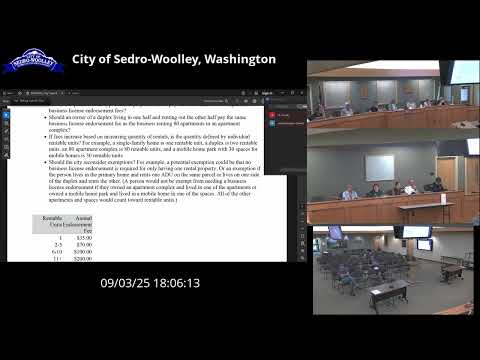
Council members discussed several policy choices: keep a flat $35 annual endorsement fee for all rental owners; create a tiered fee by number of units (for example, 1 unit; 2–5 units; 6–10 units; 11+ units); or exempt some owner-occupied situations such as accessory dwelling units (ADUs), mother-in-law apartments, or owners who live on-site in one unit of a duplex, triplex or similar. Councilman Lavaca and others urged caution about sudden enforcement without notifying long-standing owners who did not previously have licenses.
Councilman Henderson and others favored an exemption for owner-occupied properties with an on-site ADU or similar arrangements, while saying larger commercial operators (large apartment complexes or firms that manage many units) could reasonably pay more. Councilwoman Diamond raised concerns about enforcement mechanics and noted the city currently notifies businesses by phone or email rather than door-to-door code enforcement.
Conkin noted a deadline tied to the state's licensing portal: any fee-structure changes must be submitted by Oct. 1 to align with the statewide business-license process. No ordinance was passed on Sept. 3; staff will draft language and return with an ordinance for first reading on Sept. 10 and a second reading on Sept. 24 if council directs it.
The council asked staff to include proactive notification plans so homeowners who rent a single unit are not surprised by a new licensing requirement, and to return with draft ordinance language clarifying which owner‑occupied situations — such as ADUs, mother-in-law units, and live-in duplex/triplex arrangements — would be exempt if the council chooses to do so.