Get Full Government Meeting Transcripts, Videos, & Alerts Forever!
Get email alerts on the Vacant Buildings topic
No spam. Unsubscribe anytime.
St. Paul reviews vacant‑building program: staff propose refinements, emphasize equity and capacity
Summary
Legislative Hearing Officer Marcia Mormon and Department of Safety and Inspections staff told the St. Paul City Council organizational committee that the vacant‑building program—created in 1974—remains an essential, operationally intensive tool to protect neighborhoods and to return properties to safe occupancy.
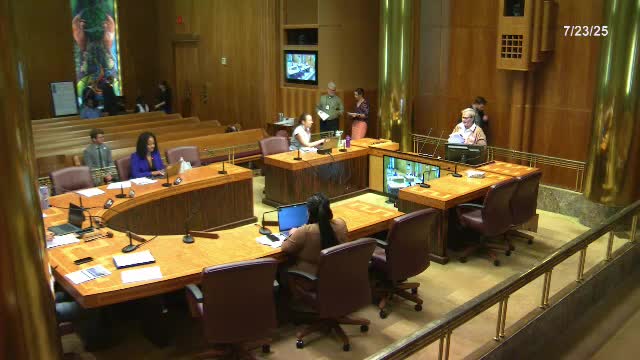
The St. Paul City Council organizational committee received a detailed review of the city’s vacant‑building program on a morning agenda that included presentations from Legislative Hearing Officer Marcia Mormon, Department of Safety and Inspections (DSI) Deputy Director David Hoban and DSI Director Angie Wiese.
Marcia Mormon summarized the program’s origin and purpose and said the ordinance traces to the 1974 creation of the vacant‑building program after a violent incident in an empty University Avenue building prompted the city to act. She described the program’s twin goals: enforce minimum rehabilitation standards and return properties to safe, occupied use.
DSI staff presented data and operations details. Staff said the city currently registers roughly 400–450 vacant buildings, with about one‑quarter of registered vacant properties located in Ward 1 and notable representation in Wards 5, 6 and 7. Combining single‑family houses and duplexes accounts for roughly three‑quarters of the registered vacant buildings, staff said.
The ordinance divides properties into three categories used to set monitoring frequency and fees. Staff said category 1 properties typically lack utilities and can be returned to occupancy after basic life‑safety work; category 2 properties show multiple maintenance violations and are monitored at least monthly; category 3 properties are severely dilapidated and face the most intensive enforcement, including orders to abate and possible demolition. Staff noted that the majority of registered properties are category 2 and that the list turns over—many properties enter and leave the registry rather than remaining static.
Staff presented counts by time on the list: 74 properties have been registered more than five years, 97 between two and five years, 94 between one and two years and 123 less than one year. DSI described the “sale review” process for properties on the list: prospective buyers must complete a full inspection, obtain contractor estimates, and demonstrate financing for the required repairs before permits are issued; staff said this approach has reduced recidivism by preventing undercapitalized buyers from starting repairs they cannot finish.
On funding, staff said vacant‑building monitoring and abatements are intended to be cost‑recovered through fees, special assessments and, for demolitions in limited cases, Community Development Block Grant (CDBG) dollars or the general fund. Ramsey County parcels that become vacant through tax forfeiture are registered with the city; the county pays the city’s initial registration invoice but not ongoing monitoring costs, producing an estimated $280,000 shortfall over the past decade, staff said.
Staff also listed program challenges: the work is time‑intensive and resource‑heavy; due process and hearing schedules can delay urgent abatement; marginalized residents sometimes lack access or capacity to participate in the sale‑review and enforcement process; and current online permitting systems do not let prospective buyers complete required permit steps while a property is in the vacant‑building workflow. Staff proposed refinements rather than wholesale changes, including improved online permitting tied to sale reviews, clearer expectations for owners and prospective buyers, stronger engagement with neighborhood development corporations, and exploring an administrative‑citation tool as a calibrated enforcement option.
Council members asked about ownership patterns, the concentration of vacant properties in lower‑income neighborhoods and time on the list. Staff said ownership tracking is possible for current registrants but is more complicated historically because properties often change hands (private owner → flipper → eventual owner occupant or tax‑forfeit → HRA). Council members also raised the possibility of prioritizing long‑term vacant properties for demolition and reuse where rehabilitation is not feasible.
DSI said the program has a long record of successful reoccupations and cautioned that due process and legal protections for property owners shape how quickly the city can act. Staff asked the council for continued support for resources, clarified that vacant‑building fees are for monitoring (not fines), and said more upstream prevention and clearer, accessible processes for marginalized property owners would make the program more effective.