Get Full Government Meeting Transcripts, Videos, & Alerts Forever!
Get email alerts on the Federal Policy topic
No spam. Unsubscribe anytime.
Staff warns of uncertainty from H.R. 1 and federal actions; LCPS federal funding under review
Summary
Loudoun County staff and the county's federal lobbyists told the county's finance committee on Sept. 9 that H.R. 1 and related executive-branch actions create significant uncertainty for local programs, federal grant awards and benefits administration.
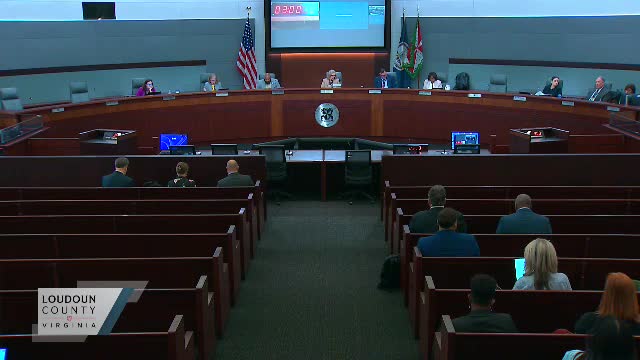
Loudoun County staff and the county's federal lobbyists briefed the Finance, Government Operations and Economic Development Committee on Sept. 9 about the potential local impacts of H.R. 1 and related federal actions, warning that substantial uncertainty remains about how provisions will be implemented and how grant funding may be affected.
Megan Burke, Office of Management and Budget (OMB), introduced the presentation and asked Mike Franks (OMB) to give an overview. Franks told the committee, “At this time, the most important thing to remember is that significant uncertainty continues to exist” around the legislation and its implementation.
Staff listed provisions described in the legislation and related administration actions that are already effective and others that would take effect later. Immediately effective provisions identified by staff include a moratorium on streamlining Children's Health Insurance Program (CHIP) regulations, an expansion of Supplemental Nutrition Assistance Program (SNAP) work requirements from ages 18–54 to 18–64, and a narrowed definition of which lawfully present residents qualify for Medicaid and SNAP. Staff said the county does not yet have locality-level counts of residents who could be affected.
Future provisions flagged by staff include expanded low-income housing tax credits, the elimination of certain incentives to Medicaid-expansion states, reduced federal reimbursement for SNAP administrative costs, a requirement to redetermine Medicaid eligibility every six months rather than annually, additional Medicaid work requirements and changes to renewable energy tax credits.
Separately, staff briefed the committee on an executive order requiring senior appointees to review and approve federal discretionary grant funding opportunities, with the power to retroactively review existing awards. Clarence Williams and Alfonso Lopez, federal lobbyists from Becker & Poliakoff, told the committee they were seeing that notices to awardees frequently arrive before a first check is issued and that a growing number of awards are being rescinded "for convenience" after award letters but before payment. Williams said he has not yet seen a case in which funds already in hand were required to be returned, noting these actions so far have been "forward-leaning" and occur before cash disbursements.
Mike Franks said Finance staff and the county attorney are reviewing federal awards to confirm the county meets the certifications and assurances included in grant terms and conditions.
The committee also heard that Loudoun County Public Schools (LCPS) is the subject of a Title IX review that staff said LCPS believes could affect approximately $25,000,000 in federal funding. OMB staff and several supervisors clarified that LCPS's funds are administered through the Commonwealth of Virginia, which adds complexity to timing and eligibility questions. Franks said staff expect to know more after LCPS submits its reimbursement request.
Supervisors raised issues including the potential for clawbacks of funds that have already been received, the effect of SNAP and Medicaid work-requirement changes on older adults caring for dependents, and the potential administrative burden on county human services staff if eligibility redetermination frequency increases. Clarence Williams warned nonprofit and small business clients that termination-for-convenience notices have been "utilized quite often" in recent practice and that debriefing on such rescissions can be difficult because the decisions may originate with centralized offices beyond the awarding agency.
Committee members directed staff to continue monitoring legislative and administrative developments, to flag resource requests in the county budget that are driven directly by federal changes, and to return with further detail as events unfold. Staff said the next regular update would be in December, and several supervisors said they might request an interim briefing if major developments occur sooner.