Get Full Government Meeting Transcripts, Videos, & Alerts Forever!
Get email alerts on the Tenant Rights topic
No spam. Unsubscribe anytime.
Residents, service providers press Douglas County commissioners to place tenant 'right to counsel' on Oct. 1 agenda
Summary
About three dozen speakers at the Douglas County commissioners' Sept. 3 public comment period urged the commission to put a tenant right-to-counsel ordinance on the Oct. 1 agenda, citing local eviction rates, national studies and local program experience.
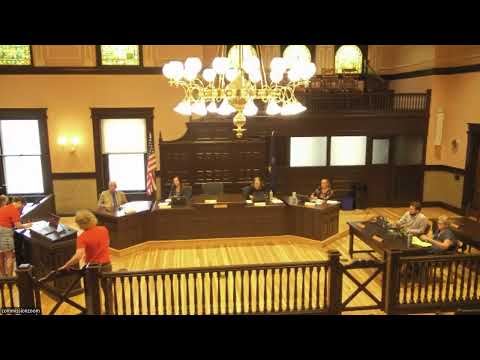
Dozens of tenants, service providers and community members urged the Douglas County Board of County Commissioners on Sept. 3 to schedule a vote on a tenant right-to-counsel ordinance for the board's Oct. 1 meeting.
Speakers told the commission during the public-comment portion of the meeting that legal representation for tenants facing eviction would reduce homelessness, correct power imbalances in eviction court and save public resources. "I wanna thank this commission for supporting the A Place for Everyone plan to end chronic homelessness," said Joe Cassad of Justice Matters. "There is a reason why it was included in the plan because it helps to reduce homelessness."
The request was supported by a mix of residents and nonprofit staff. "Tenants have counterclaims. Our stories are rarely heard in court without an attorney," said Cassandra Barrett, a Lawrence renter, describing experience living with raw sewage for months and fearing retaliatory eviction. "Put tenant right to counsel on the agenda for October 1 and vote yes," Barrett said.
Community advocates and service providers cited local data and national program results. Micah Cox, a Douglas County renter, told commissioners that "there were over 400 evictions filed in Douglas County last year" and said landlords are represented by attorneys at far higher rates than tenants. Professor Charles Epp, identifying research he cited from a Kansas City study, said contested eviction outcomes shifted markedly after right-to-counsel implementation: "Before right to counsel was adopted in Kansas City, in contested eviction cases, 0.2% of those cases were decided in favor of the tenant. After adoption ... 82% of those contested cases were decided in favor of the tenant." Epp said that figure came from a thesis study using Kansas City data.
Service providers described the practical limits of current supports. "I have been a volunteer at the legal self help office at the Douglas County Courthouse," said a volunteer who identified herself as Samia; she added volunteers cannot give legal advice and that existing stopgap measures are insufficient. Kyle Rogenkamp of the Ballard Center said staff are frequently asked to accompany families to court but are not legal advocates: "I don't have the expertise. ... I shouldn't be the dude that people are asking to go to court."
Speakers described program design suggestions and asked the commission to consider funding strategies. Several urged a one-year pilot funded from the county general fund to be transitioned into the regular budget cycle. "Fund this program for 1 year out of the general fund and then put it on the regular budget cycle," Cassandra Barrett said. Multiple speakers pointed to existing materials and model ordinances, including the A Place for Everyone plan and templates circulated by national right-to-counsel groups.
A subset of speakers addressed concerns raised about mediation and other alternatives. "Neutrality sounds like an admirable quality, but it does nothing to protect tenants facing illegal eviction," said Genevieve, a lifelong Lawrence resident who said mediators do not advise tenants of legal claims they might raise. Several speakers likewise rejected mediation as a substitute for counsel once a case is filed.
Not all speakers shared the same perspective on program details. A private-sector landlord, James Dunn, asked how the ordinance would apply to squatters, lodgers and senior living properties and urged commissioners to consider operational issues for landlords. Dunn's questions were recorded as part of public comment but did not result in board action at the meeting.
Speakers repeatedly asked the commission to place the ordinance on the Oct. 1 agenda and to vote in favor. "Please put tenant right to counsel on the agenda October 1 and vote yes," said multiple commenters; the last in-person public commenter to make that request was Carson Walker.
The commission did not take a vote on the tenant right-to-counsel ordinance during the Sept. 3 business meeting and made no formal scheduling decision on the record that evening. The public-comment period that produced these remarks concluded before the meeting moved to appointments and administrative items.