Get Full Government Meeting Transcripts, Videos, & Alerts Forever!
Get email alerts on the Elections topic
No spam. Unsubscribe anytime.
Collin County court approves new voter-registration and poll-book system after vendor collapse; officials require printed wet-signature option
Summary
Collin County Commissioners approved contracts to replace a failing poll-book vendor with VR Systems and to adopt a ballot-on-demand workflow, with county officials requiring a printed label that preserves a voter—s wet signature for verification, after public concern about electronic signatures and a tight implementation timeline.
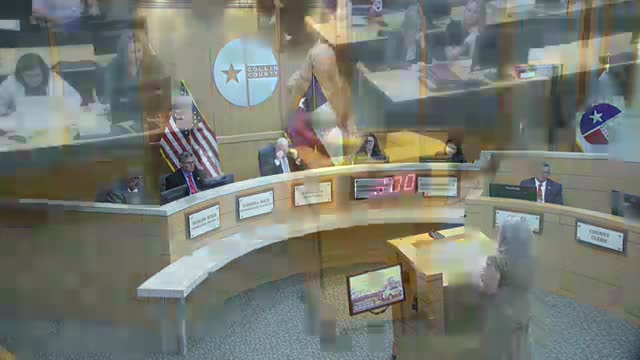
Collin County—s commissioners on Monday approved contracts to move the county—s voter-registration and electronic poll-book systems to VR Systems and to adopt a ballot-on-demand check-in workflow, after the county—s previous vendor signaled it could no longer support operations.
The decision follows public comment urging the court not to adopt electronic signature capture and several days of rapid vendor and technical work by county elections and IT staff. Cable Breaux, Collin County elections administrator, told the court the new system can be deployed quickly and that the vendor can print a label that preserves an ink (wet) signature for post-election verification.
Why it matters: The county—s existing vendor, Votec, told counties in Texas it was raising maintenance fees and then informed the state that it might cease operations, an action that put Collin County on a fast timetable to secure a replacement. County officials said a gap in support could leave poll books and voter-record access at risk for upcoming elections; updating both the voter-registration system (VR) and poll books to a certified, aligned vendor reduces the risk of two vendors blaming each other during a problem.
Breaux told the court that because —our poll books and our voter registration system should be aligned— the county sought a single vendor that communicates directly with the Texas statewide system. He described the choice this way: —You never want to be in the middle of an election and you have 2 vendors pointing the finger at 1 another when something doesn't work— and added, —you want 1 throat to choke.—
Public concerns and technical response
At the meeting two residents, Debbie Lindstrom and Lee Moore, urged the court not to adopt an electronic signature-only check-in process. Lindstrom said she opposed —spending just under $2,000,000 on unnecessary technology— and asked, —Will voters still provide wet signatures during check-in or will this system replace them with electronic signatures?— She concluded, —I urge you to vote against this proposal and direct these funds towards proven measures that truly protect election integrity.—
Breaux and other officials responded with descriptions of the technical design, the legal requirement to operate electronic poll books for countywide vote centers, and the operational trade-offs. Breaux explained that the Secretary of State requires certain prompts and that —all poll books within that operate within the state of Texas follows a certain set of prompts.— He also said the county remains an —offline county— for ballot security and that the vendor—s poll book is certified in Texas.
Cost, timeline and safeguards
Breaux outlined an aggressive schedule: if the court approved the contract, the vendor would freeze county data on Aug. 28, perform the conversion, hold training Sept. 8—12 and aim for a Sept. 12 go-live. He also said the county expects modest year-to-year maintenance savings (he cited roughly $40,000) and significant ongoing data-plan savings because the new approach uses a single MiFi per polling location rather than separate cellular cards for each laptop, an —about 80% savings— on data plans, he said.
Commissioner comments focused on preserving a human-verifiable signature. One commissioner told the court, —I would prefer to have something that you're signing in a wet signature— and asked staff to confirm whether the vendor could print a label that carries the ink signature and the ballot ticket information. Breaux and vendor representatives confirmed that a label-based wet-signature option is available and can be produced without delaying implementation.
Vote and next steps
After a brief pause to confirm vendor capabilities, the court approved both agenda items relating to the voter-registration system and the poll-book/ballot-on-demand solution (items 1E2 and 1E3) by a 5-0 vote. The court instructed staff to adopt the configuration that preserves a printed wet signature on the voter label while maintaining the new poll-book alignment. The elections office will invoice and work with purchasing and IT on the contract and implementation steps.
What remains open
Officials said they will keep the label-based wet-signature as the default for now but will continue to work with the vendor and county IT to document export and roster procedures for post-election signature checks. The county will also continue short-term staff and training work to meet the tight schedule.
Ending: County elections staff and IT said they would publish operational details for poll workers and post updated check-in procedures online; court members said they would monitor the rollout and the first election using the new system to confirm the signature and verification workflow worked as promised.