Get Full Government Meeting Transcripts, Videos, & Alerts Forever!
Get email alerts on the Bicycling Infrastructure topic
No spam. Unsubscribe anytime.
Bicycle working group urges intersection redesigns, continuous protected lanes to raise ridership
Summary
A volunteer working group presented a plan to boost cycling in Los Alamos, recommending continuous, separated bike lanes, intersection redesigns guided by NACTO and Vision Zero principles, and pilot trials on Central Avenue to reduce through-traffic and slow vehicles.
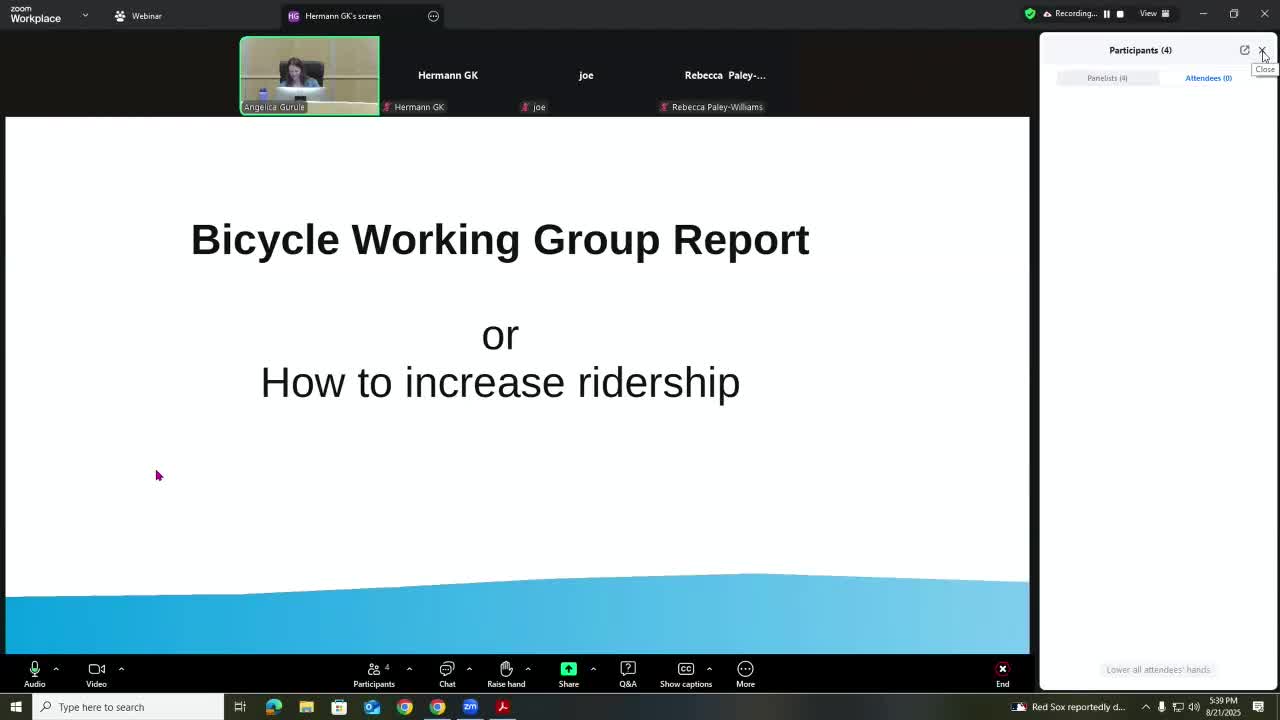
Herman Geppert Kleinrath, presenting the Transportation Board's bicycle working group report to the Los Alamos Environmental Sustainability Board on Aug. 21, said infrastructure is the primary barrier to higher bike ridership in town and urged redesigns that prioritize safety and continuity.
"Infrastructure makes usability," Geppert Kleinrath said, arguing that safe, continuous, and intuitive routes attract riders beyond the current small share of cyclists. He cited the League of American Bicyclists' most-recent figures showing Los Alamos' bicycle commuter share at 2.64 percent and said that low-quality, high-stress facilities tend to attract only risk-taking, experienced cyclists.
The working group recommended using design guidance from the National Association of City Transportation Officials (NACTO), adopting Vision Zero intersection principles, and increasing physical separation between people on bikes and motor vehicles where traffic speed or volume is high. Geppert Kleinrath highlighted intersection treatments that give cyclists a head start ahead of turning cars, corner hardening to slow vehicle turns, raised crossings, and smaller or mountable center islands that reduce vehicle speeds while allowing large vehicles to pass.
The report identifies specific high-priority locations, including the Canyon/Diamond intersection and stretches of Diamond and Trinity, where current bike lanes narrow or disappear. Geppert Kleinrath said interruptions such as narrow segments, parked cars on bike lanes and dangerous intersections make routes unusable for women, older adults and children. He recommended redesigning those junctions and ensuring continuity so riders are not forced to detour onto sidewalks or busy streets.
The group also proposed low-cost pilots to test concepts such as temporary modal filters and one-way conversions on Central Avenue to discourage through-traffic, and suggested pedestrianizing sections as a longer-term option after public input. Geppert Kleinrath said trials could be run for limited periods to gauge public reaction and usage.
He recommended that road projects include bicycle upgrades as part of every repaving or capital project and that the county adopt NACTO's "Designing for All Ages and Abilities" and intersection guidance to inform engineering decisions. The presentation also discussed speed-control techniques that change street geometry and parking patterns to lower vehicle speeds without relying solely on signed limits.
Board members asked about next steps. Geppert Kleinrath said the Transportation Board received the report and planned further internal discussion; he encouraged the Environmental Sustainability Board to consider a formal recommendation to county council to support the report's implementation.
The working group stressed education as a complement to engineering, including outreach about recent law changes (for example, New Mexico's adoption of Idaho stop rules for cyclists) and materials for drivers, cyclists and pedestrians so all road users understand revised expectations.
Any formal recommendation or design work would require engineering detail, right-of-way review and public input, the presenter said. He emphasized that many improvements can begin with incremental, reversible trials before committing to permanent reconstruction.