
Marathon County reports 62% successful completion rate for Family Keys pilot, urges budget plan to sustain program
Get AI-powered insights, summaries, and transcripts
Sign Up Free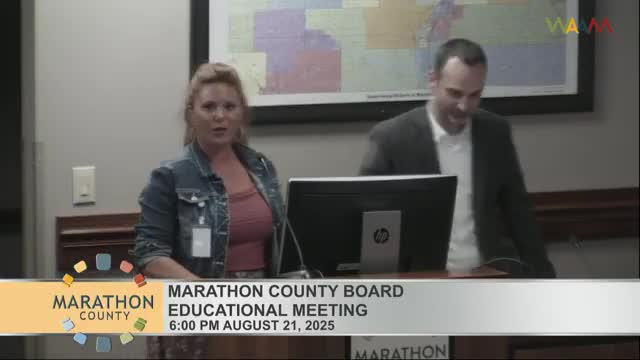
Summary
Marathon County social services told the County Board on Aug. 21 that its Family Keys pilot helped keep families together and generated measurable fiscal savings while the program’s state grant has ended.
Marathon County social services told the County Board on Aug. 21 that its Family Keys pilot helped keep families together and generated measurable fiscal savings while the program’s state grant has ended.
Krista Jensen, social services director, said the county enrolled 21 families (53 children) in Family Keys during 2023–24 and that 13 of those families, or 62 percent, “successfully discharged from the program.” Jensen said a successful discharge meant the family had stable housing at exit and the children remained, or were returned, to parental custody.
The program targeted families for whom housing instability was the primary safety concern and required participating families to follow a handbook and program rules. Jensen said families were asked to save 30 percent of their income during enrollment, accept weekly case management and allow background checks for household members and frequent visitors.
Jensen described outcomes and costs: “We served 21 families total, which was, 53 children included within those 21 families.” She told the board Marathon County spent “around a $129,000 on Family Keys” in 2023 and “around a $106,000 on Family Keys” in 2024, for a combined Family Keys expenditure of $234,528. Jensen and staff calculated that placing those 53 children in foster or other out-of-home care at the county’s lowest average placement rate would have cost $491,239, producing an estimated county savings of $256,711 over the two years. She said the Family Keys grant paid these program costs; the county did not fund Family Keys with levy dollars during the grant period.
The presentation included short participant remarks played for the board. One excerpt read, “I had a home a week later. I was able to move in right away. They helped me financially to build a nice amount of savings.” Another participant is quoted in the presentation as saying, “They saved my life, my kids’ life.”
Board members and staff described the program as a strategy embedded in the child-protection case process rather than a stand-alone service. Administrator Leonard said Family Keys is “a strategy within what I’ll say is our overall child welfare or child protective services process.” Jensen confirmed families remain open to child protective services after Family Keys participation and said the county typically remains involved for at least six months post-reunification (commonly a year) to monitor ongoing safety.
Board members asked for details about unsuccessful discharges. Jensen said some families left the program because they declined to comply with the program’s accountability measures—examples included not saving the required 30 percent, not allowing case managers into the home, not meeting for weekly budgeting sessions or not otherwise engaging with program services. She said some families who discharged unsuccessfully were nonetheless in “a much better spot” than before the program because of the skills and supports they received while enrolled.
Jensen explained some longer-term follow-up: of the 13 successful discharges, 77 percent (10 families) have maintained housing since exit; 23 percent were “unknown” (staff could not reach them). She said none of the new child-protection reports for those successfully discharged were related to renewed housing instability.
Jensen described community partnerships as essential. She identified North Central Community Action Program (NCAP) as the primary housing case-management partner, and listed North Central Health Care and other local agencies as collaborators. She also said a local nonprofit purchased a house to serve Family Keys clients and volunteers helped ready it for occupancy.
On sustainability, Jensen told the board the Family Keys grant from the state of Wisconsin ended June 30. She recommended the county aim to roll continuing Family Keys costs into the 2026 budget with “no additional tax levy ask,” using existing child-welfare funding lines—such as targeted safety support funds and Family First Prevention Services funding—to cover rent and case management where eligible.
Several supervisors praised the program’s impact on children and county costs and asked follow-up questions about program capacity, housing availability and tracking results long-term. Jensen said the program has been able to find housing within 30 days for families in the pilot and that the county will continue to recruit landlords and pursue grant funding. She said other counties have asked about the Marathon County model; she and staff have presented at conferences but said Marathon County will not enroll outside counties’ families into its grant-funded slots.
The board did not vote on a formal measure at the meeting. Jensen and Administrator Leonard said staff would propose funding and implementation details to the standing committees and work to include Family Keys in future budget planning.
For now, with the state grant expired, Jensen said the county will seek to sustain the program by repurposing eligible child-welfare funds, applying for grants and continuing landlord outreach and community partnerships.
Krista Jensen, social services director, presented the report and answered board questions. Other supervisors who spoke during the discussion included Supervisor Robinson, Supervisor Lemmer and Supervisor Johnson.
The board’s next steps, as presented, are for staff to bring concrete funding options to HR Finance & Property and other standing committees during the 2026 budget process so members can consider whether and how to continue Family Keys without a new levy request.