Get Full Government Meeting Transcripts, Videos, & Alerts Forever!
Get email alerts on the Housing topic
No spam. Unsubscribe anytime.
Mount Pleasant staff and CMU intern present 2025 housing report highlighting affordability gap and aging housing stock
Summary
Planning intern Yuyang Ding presented a draft 2025 housing report to the Mount Pleasant City Commission showing rising prices, a rental shortage, aging housing stock, and recommendations including zoning review, financial supports, and targeted programs.
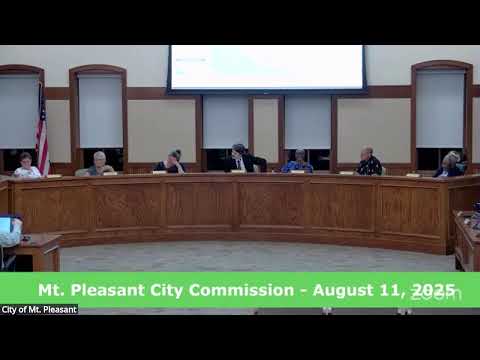
Yuyang Ding, a planning and community development intern, presented a draft 2025 housing report to the Mount Pleasant City Commission on Aug. 11, outlining current housing conditions, affordability gaps and policy recommendations.
The report found Mount Pleasant’s population shifting as Central Michigan University enrollment declines, an increase in non‑CMU residents, and household growth driven by single‑person and aging households. Ding said 2024 data show about 9,500 non‑CMU residents and projected non‑CMU residents of 10,681 by 2029, with total population projections included in the draft. He reported a median home sale price of $170,000 for sales between Jan. 1, 2022 and March 19, 2025, and said active listings on March 19, 2025 had a median asking price of $220,000 — a roughly 29% increase over that interval, compared with statewide increases of about 25% and national increases of about 14%.
The report said the city’s for‑sale inventory rate was about 1.2% with roughly 2.5 months’ supply, below a typical balanced market (4–6 months), indicating a seller’s market. Ding reported market‑rate vacancy for conventional units at 3.9% and nonconventional units at 0.3% from a May 2025 national research survey. He also summarized a projected rental gap the report attributed to the city: at least 962 rental units and 567 for‑sale units needed locally; the county gap figures were larger.
Ding said housing stock issues include a higher share of owner‑occupied units built before 1970 than county and state averages and a higher incidence of incomplete plumbing or kitchens in renter‑occupied units. By unit type, he reported roughly 40% single‑family homes, 36% multi‑unit complexes and 24% other types (duplexes, triplexes, fourplexes, mixed use). He estimated that 60–65% of units (by unit count) are renter‑occupied while 35% are owner‑occupied; by parcel count 63% of parcels were owner‑occupied.
The draft report aligns with the city’s 2050 master plan and maps neighborhood‑level differences, including vacant parcels and development potential. Ding said students from Central Michigan University helped map neighborhoods and found that neighborhoods often lack formal names and that residents sometimes view vacant parcels as buffers or green space, which can affect receptivity to infill or redevelopment.
Recommendations Ding offered include: increase production and quality of housing; use financial supports such as employer‑assisted housing programs, tax increment financing, neighborhood enterprise zones and pilot programs; bolster property maintenance and rental licensing and inspections; consider zoning reform to enable missing‑middle housing types (townhomes, triplexes, fourplexes, pocket neighborhoods); and use neighborhood enhancement programs and code enforcement tied to the International Property Maintenance Code to raise housing quality.
Commission discussion focused on who rents market units (students and lower‑income residents), the effect on workforce recruitment and retention, and the practical constraints of limited developable land. Commissioner Rollins pressed whether public safety workers and other city employees can afford local housing; Ding said median salary estimates imply many city jobs require additional income to afford typical two‑bedroom rents. Commissioners said the presentation reinforced the urgency of pursuing both production and regulatory changes to increase housing availability and affordability.
Ding said the draft report will include additional neighborhood data such as density, vacant‑parcel development capacity and parcels eligible for rezoning and that staff welcome feedback before finalizing the published report.