Get Full Government Meeting Transcripts, Videos, & Alerts Forever!
Get email alerts on the Housing topic
No spam. Unsubscribe anytime.
Mass. housing adviser urges Lakeville to form housing trust, monitor expiring affordability
Summary
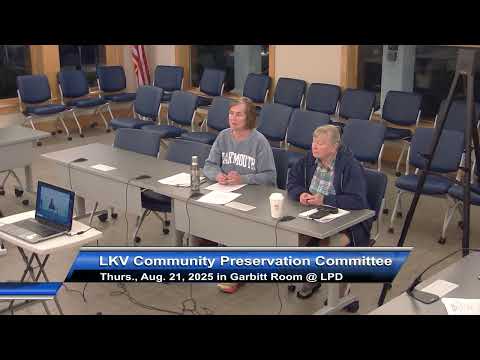
At an Aug. 21 Community Preservation Committee meeting, a MassHousing Partnership adviser outlined how Community Preservation Act funds can be used for affordable housing and urged Lakeville to form an active Affordable Housing Trust to pursue preservation and smaller-scale projects.
Shelley Gehring, a community assistance specialist with the Massachusetts Housing Partnership, told the Town of Lakeville Community Preservation Committee on Aug. 21 that towns can use Community Preservation Act (CPA) funds to acquire, create, preserve and support affordable housing and that a local housing trust can speed and simplify some preservation work.
Gehring said CPA funds can be used to acquire existing multifamily buildings, support small-scale homeownership programs, invest in new construction or adaptive reuse projects, and to preserve affordability where restrictions are set to expire. "Under the CPA statute, you can only use CPA funds to rehab or restore housing that was created or acquired with CPA funds," Gehring said, noting a separate, higher bar for what qualifies as "preserve."
The presentation reviewed examples from across Massachusetts in which modest local contributions—often leveraged with state and federal funding—helped keep units affordable. Gehring cited a Barnstable acquisition that used $500,000 in local CPA funds to preserve 124 units, Gloucester roof-repair work combining $86,000 in CPA with state funds to protect units at risk, and Amherst's decision to bond $1,250,000 to keep 41 units affordable in perpetuity. She also described buy-down programs, voucher-style subsidies for homebuyers and smaller rental developments sponsored by local housing trusts.
Committee members raised Lakeville-specific capacity questions: the town has no housing authority and has been operating with limited planning staff. Committee members said there is an existing housing trust bylaw and about $122,000 in a related account; they also reported a cluster of expiring affordability dates (including a large development with restrictions that extend to about 2039 and smaller expirations in the mid-2020s). Gehring advised starting outreach early to property owners and focusing first on units with expiring restrictions that are nearer-term.
Committee members discussed how CPA and a housing trust could work together. Gehring said a town could transfer CPA funds to a trust for a specified purpose and duration (for example, a cap on how funds are used or a clause returning funds if a goal is not achieved), and that the select board by statute must have a member on the trust. She also outlined technical-assistance options: MHP runs an annual assistance round (applications open in November) and can provide trainings and targeted help to three or four communities each year.
The Committee agreed to delay sending a memo to the select board for a month to allow more discussion among CPC members and to draft a recommendation asking select-board members to view Gehring's presentation. Members said they will return to the topic at the CPC's Sept. 18 meeting with a draft memo and suggested language describing the committee's expectations for trustee appointments and any conditions the CPC would like the select board to consider.