Get Full Government Meeting Transcripts, Videos, & Alerts Forever!
Get email alerts on the Land Use topic
No spam. Unsubscribe anytime.
Planning staff to consolidate eight county land-use ordinances; commissioners direct separate energy ordinance
Summary
Bannock County planning staff presented a draft consolidation of eight land-use and development ordinances and commissioners directed staff to pursue the rewrite with public workshops while preparing a separate energy ordinance for wind, solar and other energy provisions.
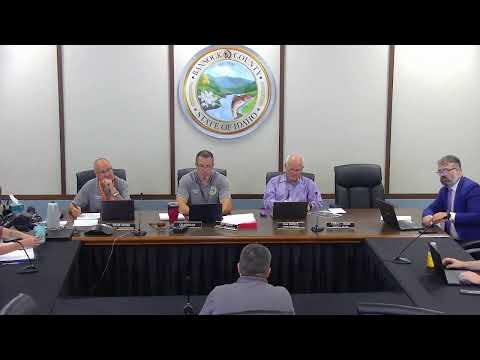
Bannock County planning staff on Aug. 21 told commissioners they have prepared a consolidated draft of eight existing county land‑use and development ordinances and plan public workshops and outreach before finalizing the rewrite.
Tristan Borkwin, assistant planning director, said the project’s goal is to combine current ordinances, remove redundancies, modernize regulations and ensure Idaho Code compliance given recent state changes that took effect July 1. “We have a consolidated draft. It is still in the very rough draft stage,” Borkwin said; the draft has been sent to the county’s legal team for review.
Staff proposed workshops, surveys and in-person meetings in both north and south county to gather public input. Commissioners discussed whether to include energy provisions in the consolidated ordinance. Several commissioners recommended treating energy — including solar, wind and potential modular nuclear provisions — as a separate ordinance because energy issues are complex and evolving.
Commissioners directed staff to proceed with the consolidated land‑use and development ordinance process with public input and to prepare a separate energy ordinance with its own workshops and hearings. Staff said the consolidated draft would continue through legal review before public outreach and that separate definitions (for large‑scale, mid‑scale, and small‑scale energy installations) would likely be included in the energy ordinance.
No formal vote was recorded; the transcript records direction and consensus to pursue the two-track approach.