Get Full Government Meeting Transcripts, Videos, & Alerts Forever!
Get email alerts on the Education Assessment topic
No spam. Unsubscribe anytime.
Haysville board reviews annual building needs assessment, flags absenteeism, home internet access and curriculum fidelity as barriers
Summary
At a special Aug. 18 workshop, Haysville USD 261 board members reviewed annual building needs assessment data required by state law, agreed to carry forward most prior barriers, and added internet access and curriculum-fidelity concerns to the list of obstacles to students reaching levels 3 and 4 on state tests.
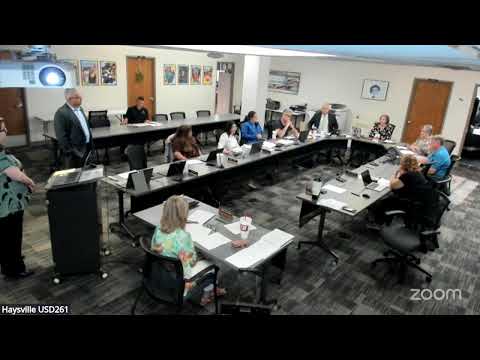
At a special meeting Aug. 18, 2025, the Haysville USD 261 board of education met to complete its annual building needs assessment required by state law and to identify barriers that keep students from achieving levels 3 and 4 on state assessments.
Board members and district staff said most previously identified barriers — including chronic absenteeism, limited parental involvement, and underfunding of special education — remain and should be carried forward into the district’s budget planning. Board members added lack of reliable home internet access and “fidelity to curriculum” as explicit concerns, and staff noted several specific budget items under consideration to address those issues.
District staff member Jen, who led the workshop, told the board the assessment is completed each year to guide budget decisions and that each building supplied demographic data and answers to three required questions: (1) barriers to having all students reach levels 3 and 4 on state assessments, (2) budget actions needed to address those barriers, and (3) the amount of time the board estimates it would take to reach that goal. Jen said the district used assessment data from 2022–2024 because 2025 results were not yet available.
Discussion: barriers and budget actions Board members repeatedly cited chronic absenteeism as a persistent barrier. One board member said the district’s chronic absenteeism rate remains “over 20%,” and panelists compared that with pre-COVID rates of about 18–20%. Members asked staff to correlate chronic absenteeism with performance levels 1 and 2 to better understand the relationship in USD 261.
Several participants said home internet access is an ongoing socioeconomic barrier despite the district’s 1-to-1 Chromebook distribution. "We've given all these kids a 1 to 1 Chromebook, but we have no idea whether or not they can go home and actually use them," a board member said, and staff confirmed the district does not currently have up-to-date data on how many families retain home internet access since COVID-era connectivity programs ended.
Board members also added “fidelity to curriculum” to the barriers list after staff explained efforts to use pacing guides and to align tiered instruction so students see material before testing. Staff described the district’s multi-tiered system of support and said some tier 2 and tier 3 students now have additional curriculum resources available.
On budget actions, the board discussed a range of items that staff said are already in the pipeline or under active consideration: stipends tied to LETRS (Language Essentials for Teachers of Reading and Spelling) completion for the current cohort, targeted purchases for middle-school reading and secondary math, credit-recovery subscriptions (Edgenuity), and expansion of career and technical education (Project Lead The Way/CTE). Jen said the district had offered a $1,000-per-year stipend in prior cohorts for staff who completed LETRS training and the seal of literacy requirements, but noted the state no longer funds LETRS and that the district’s current approach relies on reimbursement options such as a WSU course that costs $500 and is reimbursable to staff.
Board members agreed to remove a separate budget line for “parent university,” noting that existing district platforms (PowerSchool, Remind and other materials) can host parent-engagement resources without additional dedicated funding. The group also discussed incentive plans for staff attendance and acknowledged that any ongoing changes to pay or negotiated terms are subject to collective-bargaining and existing agreements.
Program and capacity notes Staff described an expansion of alternative-learning options that previously served small cohorts and now operates more like a Hazel High-style program with scheduling, social-emotional supports and credit-bearing classes. The alternative program is limited to roughly 15 students per classroom currently, with a goal to add another classroom next year if staffing and funding permit.
Staff said out-of-district enrollment is about 100 students; board members noted that those students produce mixed effects on overall district performance depending on their incoming academic level. The district also maintains a substitute pool and noted substitute costs and staff attendance trends as part of thinking about any attendance-incentive plans.
Testing windows and participation Jen reminded the board that state testing is bound by testing windows and that each subject generally has two test dates; the district cannot create additional official state test dates for individual students because that would violate test security rules. Jen also said the district must meet a 95% participation threshold for state assessments; she added that in her time coordinating district assessments the district has not fallen below that participation level.
Timeline and expectations Board members discussed how long it might take for all students to reach levels 3 and 4. Building teams had drafted a range of time estimates; one building had suggested an 8-to-10-year horizon for some goals. Several board members described the statewide metric of every student reaching those levels as “unattainable” under current funding and external conditions. Jeremy, a board member, commented, “This is unattainable,” a view other members echoed while also saying the district should continue incremental improvements and realistic, data-driven goals.
Next steps Jen said staff will compile board comments on the needs assessment, post the finalized document on the district website as required by law, and present budget items at upcoming hearings. The board was told a session on the revenue-neutral rate will be held Sept. 8, before the regular meeting and budget hearing.
The board’s discussion will inform the district’s budget submissions and the formal needs-assessment posting required by state law.