Get Full Government Meeting Transcripts, Videos, & Alerts Forever!
Get email alerts on the Housing Rhid topic
No spam. Unsubscribe anytime.
Leavenworth County commissioners find Riverbend Heights RHID would have adverse effect after hours of public comment
Summary
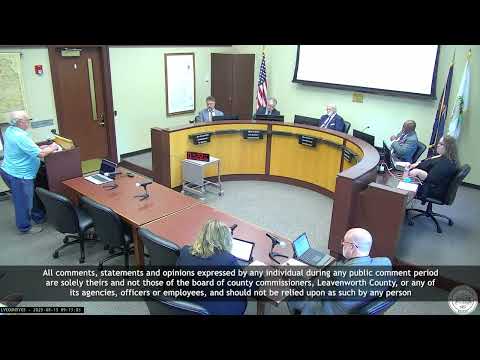
Leavenworth County commissioners voted 4-1 to adopt a resolution finding that the proposed Riverbend Heights Reinvestment Housing Incentive District (RHID) would have an adverse effect on county finances and services after extensive public comment and presentations from Lansing officials and the developer.
Leavenworth County commissioners voted 4-1 to adopt a resolution finding that the proposed Riverbend Heights Reinvestment Housing Incentive District (RHID) would have an adverse effect on county finances and services, after more than two hours of public comment from residents, city officials and the developer’s representatives.
The commission’s resolution follows lengthy public testimony for and against the RHID, including concerns from residents about traffic, school financing and long-term taxation, and presentations from Lansing city staff and the developer estimating broader economic benefits.
The Riverbend Heights proposal would create a district around the planned subdivision in Lansing and divert a portion of property tax growth from taxing jurisdictions to reimburse project costs. Supporters said the tool is necessary to make large-scale housing development feasible in Lansing and to attract rooftops that could draw retail and job growth. Opponents said the proposal would shift long-term costs onto county taxpayers and risk public services by diverting funds away from roads, bridges and other county needs.
The public-comment period opened with several residents and local officials making the case against the RHID. Rebecca Mahan told commissioners she and neighbors felt discredited by proponents of the plan and asked the county to “follow the golden factors” and the county’s own RHID policy when evaluating the proposal. John Redden, a Lansing-area resident, warned that the RHID would increase the school district’s deficit because the district’s actual per-student costs exceed the revenues the development would generate.
Lansing Councilman Daniel Clemons and city officials presented the municipal view that housing is Lansing’s primary strategic priority and that the Kansas Department of Commerce’s RHID program is widely used across the state. Clemons explained the RHID captures incremental increases in real property taxes created by development and said Lansing is not requesting the full 25 years allowed under state guidance, but is using terms intended to make the project viable. Tim Bridal, a Lansing staff member, told the commission the city and school board believe the RHID will support growth and bring new residents who could sustain local businesses.
Developer and financing presentations were delivered by a representative of Ad Astra and by attorney Joe Oakes of Polsinelli, who asked the county “to take no action” and allow Lansing to proceed with the district if the county chose not to take a position. Oakes and the developer’s team provided estimates showing the project would increase local assessed value and reported analyses from consultants (including Raymond James and RSP) that they said show net benefits to the Lansing school district and the city over time. The developer said it negotiated a limit on the RHID reimbursement with the city.
Opponents highlighted other analyses. Several speakers referenced a county staff model that estimated increases in county service costs — principally road maintenance and public safety — attributable to the new population. Residents also raised safety concerns at the K‑7/McIntyre Road intersection and asked for a traffic study and additional turn lanes before approval. Multiple commenters said the planned subdivision of about 406 homes and the RHID’s structure (an 80% diversion of incremental taxes in early years, per presentations) would transfer financial risk to taxpayers while delivering developer profit.
After public testimony and an executive session, the board considered a motion to adopt Resolution 2025‑27, finding the RHID would have an adverse effect on Leavenworth County. The motion passed 4‑1; the resolution states the county’s analysis indicated a net fiscal impact to county government and listed factors such as increased county service costs and the effect of diverted incremental taxes on county revenues.
Votes at a glance
- Resolution 2025‑27 (finding Riverbend Heights RHID would have an adverse effect on Leavenworth County): Passed 4 yes, 1 no. (No individual vote attributions were recorded in the meeting transcript.)
- Contract with Pfefferkorn Engineering & Environmental LLC for construction engineering on the 230 Fifth Street project: Approved. The contract value was $910,134.17 with a 7.5% contingency (see separate note below); commission vote recorded as unanimous on that item.
What commissioners said
Commissioners debated the RHID on fiscal and policy grounds. Supporters of a cautious approach said RHIDs should be used sparingly, primarily to address blight or other public-policy priorities, and questioned whether the county should subsidize development that other developers have accepted without public incentives. Commissioners also noted the county has invested in roads and infrastructure in recent years and said large, long-term tax diversions change how the county funds services.
Opponents of the resolution argued that new rooftops can support local business and economic development, and noted that Lansing, the city directly affected, and the Lansing School District both approved the RHID. Those who supported the RHID said the city and schools will live with the outcomes directly, and that the district is a financing tool to make development viable where the market otherwise will not build at scale.
Ending
The commission’s finding that the Riverbend Heights RHID would have an adverse effect is a policy determination based on the county’s fiscal model and testimony presented at the meeting. The resolution does not directly block city or school decisions but reflects the county’s formal position; further procedural steps, appeals or revisions to the project could follow. Commissioners said they expect additional RHID or incentive requests in the future and signaled they will review each proposal individually.