Get Full Government Meeting Transcripts, Videos, & Alerts Forever!
Get email alerts on the Recreational Marijuana topic
No spam. Unsubscribe anytime.
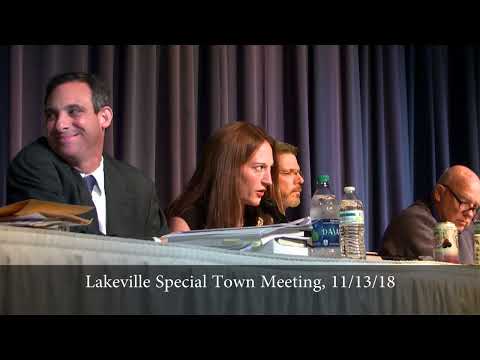
Lakeville voters defeat citizen petition to ban retail recreational marijuana sales
Summary
A citizen petition to remove zoning authorization for adult-use retail marijuana in industrial districts failed at the Oct. 17 special town meeting by a counted vote, after an extensive public discussion about revenue, public health, zoning and host-community agreements.
Lakeville residents defeated a citizen petition at the Oct. 17 special town meeting that would have removed town zoning authorization for adult-use retail marijuana in industrial districts.
The petition sought to change the zoning bylaw to prohibit adult-use retail marijuana retailers (changing the use from 'special permit' to 'no') and to delete references to retail marijuana special-permit provisions. The motion was introduced as a citizen petition; the Finance Committee recommended not approving. After extended public comment by selectmen, planning-board members, health-board representatives and residents, Town Meeting voted 54 in favor and 81 opposed; the moderator declared Article 10 defeated.
Speakers at length addressed three recurring points: 1) process and whether voters had an adequate chance to consider banning retail sales at the annual town meeting; 2) revenue projections and whether the town would forfeit substantial local-option and mitigation revenue by banning retail; and 3) public‑safety or public‑health concerns raised by residents opposing retail sales.
Supporters of the petition, including the article mover, argued voters had been denied a prior opportunity to submit a moratorium or ban, and that dozens of nearby communities had placed bans or moratoria on retail sales. Opponents, including members of the Board of Selectmen and the Board of Health, pointed to host-community agreements, locally negotiated mitigation/community-impact fees, and a local-option 3% tax on retail sales that, they argued, could generate significant revenue for schools, public safety or other town needs. Selectmen and the petition opponents also said cultivation and other cannabis-related businesses already located in town would continue to produce wholesale revenues under host-community agreements regardless of tonight’s retail vote.
Town counsel and the Selectmen clarified that (a) a host-community agreement is required before a retail establishment may open, (b) the Cannabis Control Commission has issued guidance on community impact fees (including a 3% cap), and (c) the town’s negotiated host-community agreements in this case included a $25-per-pound payment on wholesale cultivation. Selectmen estimated one projection of retail sales at $15 million annually between potential retailers, producing roughly $450,000 at a 3% local-option tax and another $450,000 if a 3% mitigation fee were negotiated; the town also has a negotiated $25-per-pound wholesale payment estimated by proponents at roughly $500,000 annually in some projections. Opponents stressed that banning retail would eliminate the local-option revenues tied to retail sales.
After debate that lasted well over an hour, Town Meeting counted the votes and defeated the petition.