Get Full Government Meeting Transcripts, Videos, & Alerts Forever!
Get email alerts on the Preschool For All Tax Indexing topic
No spam. Unsubscribe anytime.
Multnomah County reviews indexing, tax-credit options for Preschool for All amid revenue uncertainty
Summary
County staff outlined indexing options for the Preschool for All income tax, two tax-credit concepts and administrative issues; outside economist warned indexing and credits would reduce revenue and staff stressed the program—s revenue volatility driven by capital gains.
The Multnomah County Board of Commissioners on Aug. 5 held the first of two briefings on proposals to "index" the county—s Preschool for All (PFA) income tax and on two tax-credit ideas, hearing staff estimates of revenue impact, administrative caveats and an outside economist—s presentation on migration of high-income earners.
Multnomah County economist Jeff Renfro and Chief Financial Officer Eric Cariano summarized two main indexing options under consideration: (1) begin annual automatic inflation adjustments to the tax thresholds starting in a future tax year, and (2) a larger "rebase" approach that would first retroactively raise thresholds to account for inflation since the tax began in 2021 and then index going forward. Cariano told the board, "I really see this as if you were to push forward, potential indexing for Preschool for All, is that we don't do it in a in a middle of the tax year," stressing any change should take effect for a future tax year to allow for system, form and taxpayer communication work.
Why it matters: staff said modest per-filer benefits from indexing accumulate quickly across thousands of filers and would reduce annual PFA revenues. Jeff Renfro warned the county—s revenue mix is highly volatile because a small group of very high-income filers (with a large share of capital-gains income) contributes a disproportionate share of tax receipts; capital gains accounted for about 17% of taxable income in 2022 and about a third in 2021 for the county—s payer population. That volatility complicates matching PFA—s entitlements and seat commitments to an unpredictable revenue stream.
What staff presented - How indexing works: staff described two inflation measures under consideration: a regional CPI (CPI-W, West urban area) used by the county for personnel and business-tax adjustments, and a state-based CPI measure used to inflate Oregon income-tax brackets. Cariano noted Metro used the state approach for its supportive-housing tax indexing.
- Two implementation methods: (a) apply indexing beginning tax year 2026 (example year in staff slides) or (b) rebase thresholds back to 2021 and then index annually. The rebasing option produces a larger, one-time revenue reduction because it would effectively remove bracket creep that already occurred since the tax began.
- Examples: staff ran three single-filer examples showing how modest wage growth could push filers into higher brackets without indexing and how indexing would prevent that. Renfro explained he is designing a variant that can protect lower- and middle-income filers pushed into liability by inflation while limiting the indexing benefit for the very highest earners.
- Fiscal planning context: Renfro reminded commissioners the PFA program was planned with an initial surplus period to build a fund balance that smooths later years when seat growth drives expenses higher than revenues. He said updated models show indexing would deepen mid-term deficits and likely require programmatic changes or different assumptions to remain cash-flow positive.
Tax-credit proposals reviewed - Nonresident filer credit (Commissioner Singleton): staff modeled a small tax-credit for nonresidents who pay PFA tax but cannot use the program because they do not reside in Multnomah County (for example, a nonresident with a 3- or 4-year-old). Using American Community Survey proxies for household children and the county—s 2023 nonresident filer count (5,355), staff estimated an annual foregone revenue roughly $197,000 (median-payment approach). Staff cautioned considerable uncertainty in nonresident address data on returns and noted the number is a rough, order-of-magnitude figure.
- Applicant-not-seated credit (Commissioner Bridal Edwards): staff estimated a refundable or nonrefundable credit for Multnomah County resident filers who applied for a PFA seat but did not receive one. Using program-application data and multiple assumptions (including that about half of the unserved applicants would be PFA payers and that all eligible families would apply), staff—s preliminary estimate produced a maximum near $4.5 million in foregone revenue in an early year, declining toward about $1 million after seats scale up — a figure staff called likely biased upward and subject to substantive data limitations.
Administrative, legal and operational issues - Administration: City of Portland currently administers the tax under an intergovernmental agreement (IGA). Cariano said the IGA requires 30 days— notice to the city before code changes and that meaningful changes require lead time so payroll processors, tax software, CPAs and employers can update withholdings and systems.
- Implementation capacity: staff said the county and city lack current audit and validation capacity to administer some refundable-credit concepts; adding credits would require additional administrative resources and cost estimates.
- Conformity: staff said aligning index methodology with Metro would reduce taxpayer and administrative burden but is not required.
Board discussion and outside analysis - Commissioners pressed for more detailed numeric scenarios, demographic updates and programmatic trade-offs before any decision. Commissioner Bridal Edwards emphasized her proposal should prevent indexing benefits from accruing to top filers who did not gain real purchasing power.
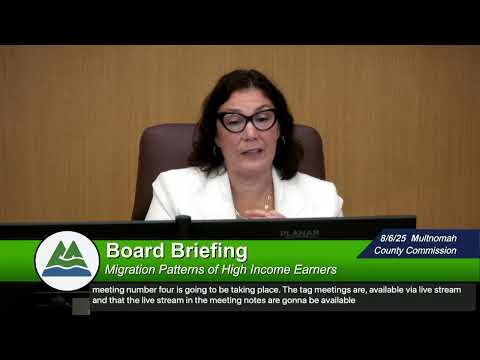
- External economist: Professor Young (researcher, migration and taxation) briefed the board on national data spanning two decades and updated pandemic-era findings. He said millionaire migration is small in magnitude: overall cross-state migration by million-dollar earners is low, and only about 15% of those interstate moves yield a net tax advantage — equal to roughly a 0.3% millionaire tax-migration rate. He said migration is primarily a young-person phenomenon and that investing in amenities, transit and early-childhood supports helps attract and retain future higher-income earners.
What the board directed/stated publicly - Commissioners asked staff for updated numeric scenarios showing (a) indexing using different inflators, (b) the rebasing scenario dollar impacts, and (c) model runs showing how each option affects the fund-balance path and the date to universal coverage. Staff scheduled a follow-up PFA briefing with outside consultants and a public listening session later in August; the board also scheduled additional briefing and work sessions in mid- to late August for continued public and board deliberations.
Ending note: no vote taken yet No formal vote or code amendment occurred at the briefing. Commissioners and staff framed the August meetings as a multi-step public process: more data and external analysis will be presented before any ordinance or ballot-language action is scheduled. Professor Young summarized the policy takeaway: tax-induced migration of the wealthy is measurable but modest; policy to attract and retain younger workers and familiesincluding investments in childcare and other serviceshas greater potential to build a stable future tax base.