Get email alerts on the State Legislature topic
No spam. Unsubscribe anytime.
State representative reviews long legislative session, transportation package and local impacts
Summary
Representative Mark Owens summarized the 2025 Oregon legislative session, discussed a shortfall in revenue forecasts, changes to several bills affecting rural services and ODOT staffing, and described how Harney County secured flood and infrastructure grants.
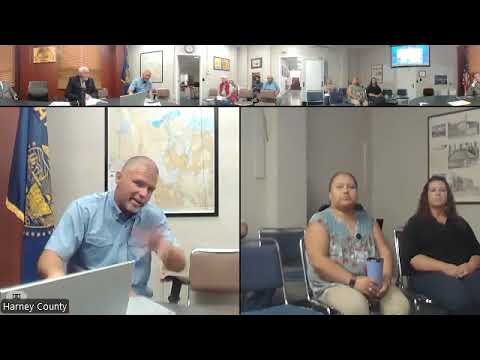
Representative Mark Owens gave Harney County Court a broad overview of the 2025 Oregon legislative session and highlighted several bills and budget issues that could affect the county.
"Odd years are the long sessions," Owens said, noting the session ran about 165 days from Jan. 21 to June 27. He told the court the Legislature processed thousands of measures and that late revenue forecasts reduced available discretionary funding: "the last revenue forecast ... had a reduced forecast of over $500 [million] compared to the previous revenue forecast." He said that cut made it difficult for many policy bills that carried fiscal costs to clear ways and means.
Owens described several bills that passed with relevance to Harney County. He summarized support for rangeland protection and equipment assistance through House Bill 3349 and a separate measure that allowed the Oregon Department of Forestry to give surplus equipment to Rangeland Fire Protection Associations; that effort, Owens said, was capitalized with $1 million to support small volunteer groups' basic needs such as tires, fuel and radios.
On the proposed transportation package (House Bill 2025), Owens said the initial proposal was large and included a broad revenue increase: "It was a $15,000,000,000 revenue increase" and many tax changes. He said the proposal stalled because of intra-party opposition and concerns about where money would be spent, and that a later stopgap with a smaller gas tax increase also failed. Owens said the governor planned layoffs at ODOT and had called a special legislative session for Aug. 25 to consider a revised proposal: "The proposal now is a 6¢ gas tax to maintain the $50.30 20 split." He told the court the immediate shortfall prompted ODOT to prepare layoff notices and that continuing to pay ODOT staff without new revenue would cost roughly $5 million per month.
Owens also described several other enacted measures he said matter locally, including legislation on exempt well usage that he said allows limited commercial irrigation for small producers under a 3,000-gallon-per-day cap, wolf compensation adjustments, and a change reducing permitting burdens for some small biomass air-permitting projects.
He closed with local success stories: Harney County received about $2 million through a resiliency allocation for flood work and $3 million for the city of Burns for infrastructure needs. Owens said additional federal- and state-funded relief and reauthorized OJD funds are available for jail-related court improvements.
Ending: Owens invited questions and said he would continue to work with county officials on transportation, staffing and funding priorities.
AI generated
The text on this page is AI generated. Summaries, highlights, analysis, and video transcripts are all produced from the original source material.
AI can make mistakes, so if you spot one, and we will fix it for everyone.
Note: the source content is unaltered by us. Any content source we link to, be it a video, an audio recording, or a document, is presented exactly as its publisher released it. That publisher is usually a government body, sometimes an individual official or another organisation.