Get Full Government Meeting Transcripts, Videos, & Alerts Forever!
Get email alerts on the Local Sales Tax topic
No spam. Unsubscribe anytime.
Santa Clara County supervisors unanimously place temporary 5/8¢ sales tax measure on November ballot to offset federal Medicaid cuts
Summary
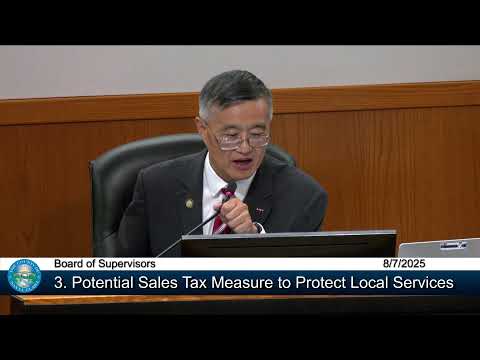
The Board of Supervisors voted 5-0 Aug. 7 to put a temporary, five‑year 0.625% county sales tax on the Nov. 4, 2025 special election ballot after county officials warned HR 1 will slash Medicaid funding and threaten hospitals and safety‑net services.
President Lee and the Board of Supervisors on Aug. 7 voted unanimously to place a proposed, temporary five‑year sales tax of five‑eighths of a cent (0.625%) on the Nov. 4, 2025 special election ballot to help offset deep federal cuts to Medicaid enacted by HR 1.
County Executive James Williams told the board the federal law known as HR 1 will produce unprecedented losses for county health and social‑service programs. "HR 1 presents an extraordinary threat to core safety net services," Williams said, warning of an initial $500,000,000 revenue loss for the coming fiscal year that could grow to more than $1 billion in later years and describing how those cuts would hit Medi‑Cal reimbursements and supplemental payments that support the county's hospitals.
The measure is one part of a three‑pronged strategy Williams described that includes working with the state, reorganizing county services to prioritize core programs, and asking voters to provide short‑term revenue. "It would raise about $330,000,000," he said of the sales tax proposal, calling it a temporary measure to give the county breathing room while broader structural changes and state‑level negotiations continue.
Nut graf: County leaders said the cuts in HR 1 will significantly reduce funding for Santa Clara Valley's health system — which operates multiple hospitals and clinics and handles a large share of the county's trauma and emergency care — and endanger services for residents who rely on Medi‑Cal, CalFresh and other safety‑net programs. Placing the sales tax on the ballot is intended to blunt those immediate impacts while the county pursues state partnerships and internal efficiencies.
Speakers who testified at length included physicians, hospital administrators, nonprofit leaders and labor representatives. Dr. Daniel Nelson, chair of emergency medicine at Santa Clara Valley Medical Center, said emergency departments already operate beyond capacity: "On average, at Santa Clara Valley Medical Center, we operate at 207% of our ED capacity, and there are times when that number surged over 500%." He and other clinicians warned cuts would worsen wait times and patient outcomes.
Business and philanthropic leaders urged voter support. John A. Sobrato, founder and chair emeritus of the Sobrato Organization, said the tax would amount to "less than a penny per dollar spent" while providing "at least $350,000,000 in annual funding" to sustain services. Labor and nonprofit groups — including the South Bay Labor Council, Silicon Valley Council of Nonprofits and community clinics — likewise pledged to support the measure and to help educate voters.
Board members stressed the proposal is not a complete solution. Supervisor Ellenberg, who moved the motion to accept the administration's recommendations, and Vice President Arenas, who seconded it, both emphasized that even with the tax the county will need to pursue cuts, reorganizations and other efficiencies because the projected federal losses exceed the revenue the measure would generate. Ellenberg said the board will begin more detailed budget priority discussions in October and requested additional reporting and oversight structures.
County staff said the ballot authority follows state law enacted in 2023 (SB 335), which temporarily permits counties to ask voters for a sales tax up to five‑eighths of a cent. In the roll call after the public hearing, the board voted 5‑0: Supervisor Abe Koga — Aye; Supervisor Yoon — Yes; Supervisor Ellenberg — Yes; Vice President Arenas — Yes; President Lee — Aye. County counsel confirmed the measure will appear on the Nov. 4, 2025 special election ballot.
The board and administration said they will return to budget‑setting conversations in October, include reserve‑policy materials in that process, and implement public reporting and an oversight body contemplated in the draft measure. Officials repeatedly framed the tax as a temporary, local step to protect hospitals, emergency and behavioral health services, housing and other programs that serve Medicaid beneficiaries and other vulnerable residents while the county seeks longer‑term solutions.
Ending: The board adjourned after the unanimous vote. Officials urged community groups and leaders who testified to help build voter outreach for the November special election and said more detailed budget proposals and updates will be presented to the board in the fall.