Get Full Government Meeting Transcripts, Videos, & Alerts Forever!
Get email alerts on the School Discipline Cell Phones topic
No spam. Unsubscribe anytime.
Broward School Board keeps code of conduct, directs rulemaking on high‑school lunchtime phone access
Summary
After an hour and a half debate, the Broward County School Board voted to adopt the revised Code of Student Conduct as presented and directed the superintendent to begin rulemaking on allowing high‑school students to use cell phones during lunch; the board emphasized compliance with state law and the need for consistent enforcement.
The School Board of Broward County on Thursday adopted a revised Code of Student Conduct and directed the superintendent to begin rulemaking to consider allowing students to use cell phones during the lunch period at high schools.
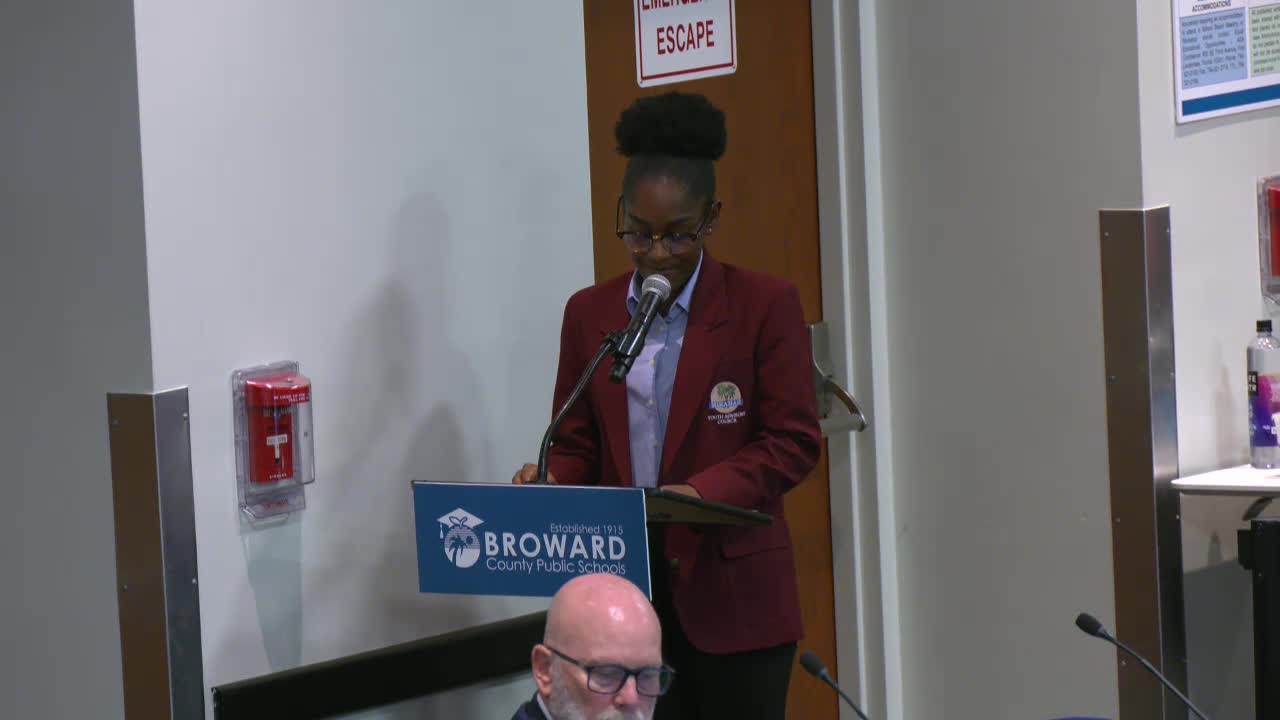
Supporters said a limited lunch exception would give students a needed moment to check in with family, manage jobs and responsibilities, and use tools for mental‑health support. Student speaker Taylor Berry, president of Miramar's Youth Advisory Council and an Everglades High School student, told the board: "I'm simply asking for access to our own devices during the 1 break we get in our day." Board members who supported the direction cited student and parent surveys indicating strong support for lunch access.
Opponents warned of harms tied to social media, cyberbullying and instructional disruption. Public commenter Vincente Thoreau said cell phones "have become a tool to bully kids" and urged the board to keep strict boundaries. Several board members also cited research linking phone use to mental‑health concerns and said enforcing a single, district‑wide standard was a priority.
The discussion included operational and legal considerations. General Counsel counsel (Miss Batista) advised the board that making a substantive change to the Code of Student Conduct would trigger the Administrative Procedures Act process and require re‑advertising and a second board meeting for final adoption. Staff explained the practical timeline: if rulemaking is started immediately, the earliest special meeting to complete the rulemaking would be Aug. 26; school starts Aug. 11, and the district would need time to publish, collect and process code acknowledgement forms — a process that staff estimated would take several weeks.
After multiple competing motions and procedural clarification, the board voted to adopt the Code of Student Conduct as presented and to direct the superintendent to initiate rulemaking on the section addressing cell phone usage during lunch (section 5.C.2 in the draft). The board did not change the policy text at final adoption during the meeting; any change allowing lunch access would require further rulemaking and final adoption before it becomes effective.
The board emphasized consistent enforcement if any change is adopted. Jody Washington, director of school culture and student support, outlined the existing disciplinary matrix for high school cell‑phone violations (progressive steps from verbal/written warning and parent contact to detention/confiscation to suspension and loss of extracurricular participation for repeat offenses) and said schools already use electronic systems to collect code acknowledgments.
Board members also asked staff to return with operational details should the board later approve a lunchtime exception: how schools would implement the change, how staff would track and enforce violations during large lunch periods, the human‑capital impacts of re‑issuing code forms mid‑year, and how to ensure compliance with state law during the transition.
The board recorded the motion on the floor as: "Pass the policy as is today and direct the superintendent to initiate rulemaking for the portion of the student code of conduct that deals with cell phone usage during lunch break for high school students," and the motion carried following roll‑call voting. The board did not finalize any change to allow phones at lunch at the meeting.
Looking ahead, staff told the board that if the board proceeds with a substantive change it could not be implemented before the district completes required rulemaking, distribution of updated code forms and collection of acknowledgements; that timeline likely pushes any effective date into late August or September depending on scheduling of required workshops and meetings.
The board also discussed the policy's broader aims — student safety, instructional time protection and mental‑health supports — and asked staff to coordinate outreach to principals, teachers and parents to prepare for any future change.