Get Full Government Meeting Transcripts, Videos, & Alerts Forever!
Get email alerts on the Charter Schools topic
No spam. Unsubscribe anytime.
Guam Legislature advances Bill 68, citing need to limit government liability and increase charter-school oversight
Summary
Senators moved Bill 68 to third reading after debate about placing financial liability on charter schools and increasing the Guam Academy Charter School Council's authority to monitor boards of trustees following testimony about autonomy and past audit liabilities.
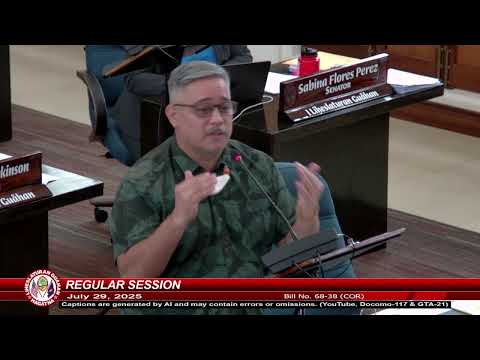
Senators on the floor of the Guam Legislature moved Bill 68 to third reading after lawmakers debated changes intended to limit government liability for charter-school debts and to strengthen oversight of charter-school boards of trustees.
Senator Barnett, speaking in support, said the bill “provides a lot of safety and security for the people of Guam and our tax dollars,” and praised the measure as a stopgap to prevent the government from inheriting charter-school liabilities. Barnett noted his prior sponsorship of Bill 62, which he said lifted the cap on the number of charter schools and enabled schools such as BTACS, Chief Herral Academy, Mount Carmel and others to convert to charter status.
The debate focused on testimony delivered at earlier public hearings by Evangeline Cepeda, chair of the Guam Academy Charter School Council. Barnett summarized Cepeda’s concern that boards of trustees currently operate with “total autonomy and power to decide the day to day operations of a charter school,” and that the council lacks statutory authority to require trustees to report regularly. He said Cepeda recommended quarterly reporting by boards to the council so problems could be detected and addressed earlier.
Barnett and other senators described a pattern of audit findings and liabilities cited by the public auditor’s testimony. Barnett recounted examples given at the hearing — amounts such as $2,000,000 in one case and larger liabilities reported elsewhere — and argued the bill would shift financial responsibility away from the government when charter schools incur debt or fail to meet financial requirements.
Senator Blas, who presented the bill on the floor, characterized the measure as a temporary fix while broader procedural and statutory reforms are developed. “This is a stopgap measure for something right now that is problematic,” Blas said, and said he would work with colleagues to address longer-term governance and oversight questions raised during hearings.
On the floor, Blas moved to add a list of senators as cosponsors; no objections were recorded and the motion was approved by unanimous consent. Blas then moved to place Bill 68-38 COR, as amended by committee and further amended on the floor, on third reading; that motion also faced no objections and was carried. The senate recessed for dinner and scheduled return at 7:30 p.m., after which the bill is expected to appear for third reading.
Discussion versus decision: the transcript shows substantive debate and an explicit direction to proceed with the bill to third reading; it does not record a final passage on third reading during the excerpt. Senators discussed possible amendments to give the Guam Academy Charter School Council stronger reporting authority — for example, a quarterly reporting requirement for boards of trustees — and Barnett volunteered to work with the chair of education on such language. The formal outcomes recorded in this session excerpt were procedural motions (adding cosponsors and placing the bill on third reading) approved without objection.
Next steps: Bill 68-38 COR was placed on third reading after the session resumed; any further amendments or a final vote would be reflected in subsequent floor proceedings.