Get Full Government Meeting Transcripts, Videos, & Alerts Forever!
Get email alerts on the Arts Culture topic
No spam. Unsubscribe anytime.
New ACME office outlines cultural facilities priorities; Raleigh Austin pitches expansion of cultural trust
Summary
The newly formed Office of Arts, Culture, Music and Entertainment (ACME) described its launch, facilities and engagement work; Raleigh Austin presented progress and asked the task force to consider expanding the cultural trust program for affordable creative space.
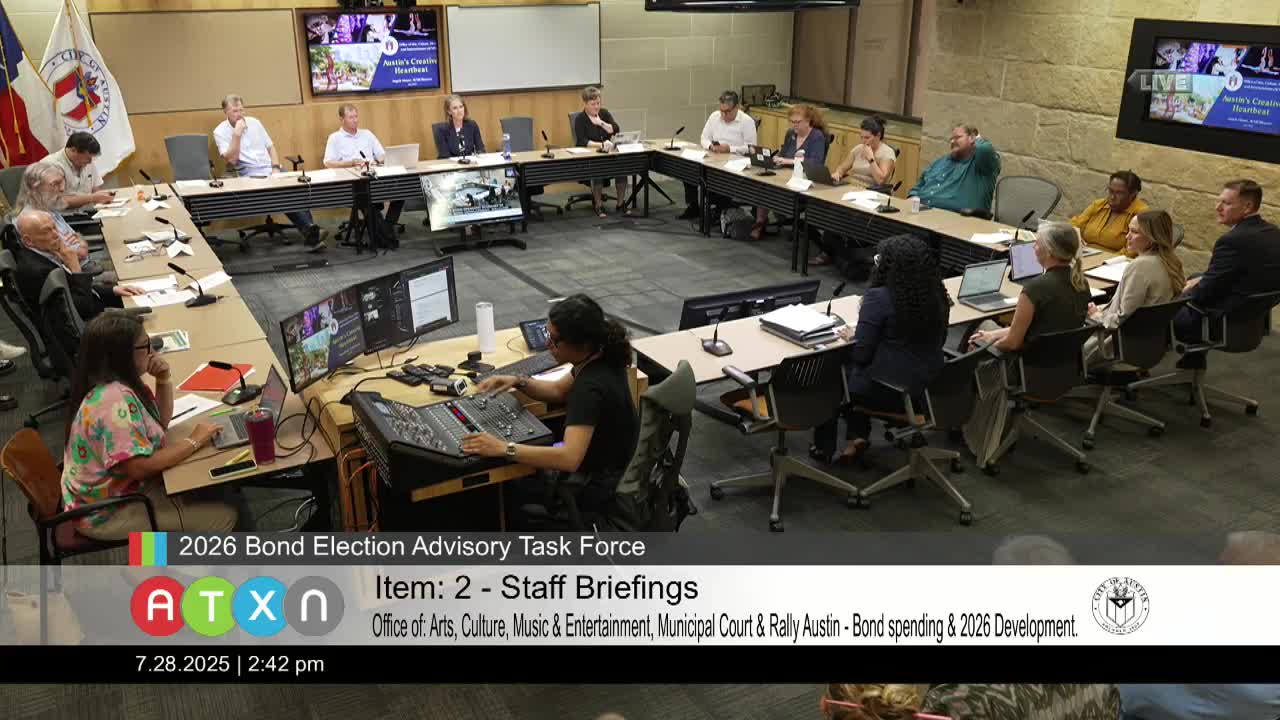
Angela Means, director of the City of Austin’s newly formed Office of Arts, Culture, Music and Entertainment (ACME), and representatives from Raleigh Austin briefed the 2026 Bond Election Advisory Task Force on July 28 about arts and cultural facility needs and the cultural trust program created after the 2018 bond.
Means said ACME launched in February 2025 by consolidating five city functions and about 100 staff to create a single point of contact for creatives and cultural institutions. She framed arts and culture as essential city services and listed more than a dozen city cultural facilities under ACME’s oversight, including the George Washington Carver Museum, the Emma S. Barrientos Mexican American Cultural Center and the Asian American Resource Center. Means said ACME has conducted listening sessions and collected more than 1,500 responses to shape a Creative Reset strategic plan.
David Colligan of Raleigh Austin described Raleigh’s work in managing the 2018 cultural trust program. He said voters approved $12 million for the Cultural Trust in 2018 and council added $15 million in subsequent allocations. Raleigh Austin outlined a selection and delivery process that it said produced dozens of proposals, of which a smaller set are advancing; the organization emphasized public‑private leveraging and long‑term affordable agreements for creative venues.
Why it matters: Presenters described cultural facilities as community anchors vulnerable to redevelopment and underscored the role of dedicated capital and acquisition funding to preserve affordable space for artists and legacy cultural businesses.
What was not decided: The task force did not approve any arts allocations at the July 28 meeting. ACME and Raleigh Austin said they will provide prioritized project lists and more detailed cost and delivery plans to working groups for further review.
Ending: ACME and Raleigh Austin asked the task force to consider cultural facilities and the cultural trust as part of the bond conversation; both organizations said they will return with more detailed project lists to working groups and the task force.