Get Full Government Meeting Transcripts, Videos, & Alerts Forever!
Get email alerts on the Master Plan Implementation topic
No spam. Unsubscribe anytime.
Lakeville committees push for full-time town planner as housing, redevelopment and sidewalks compete for staff attention
Summary
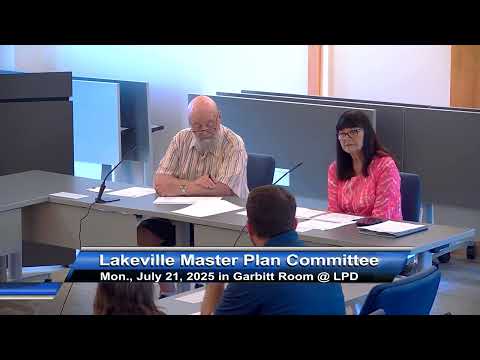
At a July 21 joint session, Lakeville planning officials and the master plan implementation committee reviewed an updated implementation chart and said staffing constraints are slowing progress on open-space rules, housing overlays, major redevelopment sites and sidewalk requirements.
At a July 21 joint meeting of the Town of Lakeville Master Plan Implementation Committee and the Lakeville Planning Board, members said the town needs a full-time town planner to manage multiple incoming projects, housing program options and updates to subdivision and open-space rules.
The committees reviewed a master plan implementation chart last updated Dec. 17, 2024, and discussed a range of priorities including a draft open-space residential development (OSRD) zoning proposal, state housing incentives (including recently proposed "starter home" provisions sometimes referred to in the meeting as "40Y"), redevelopment of the former hospital site, and requirements for sidewalks and bicycle facilities in subdivision rules.
Why it matters: committee members said several development proposals and planning tasks are proceeding at once and that the town lacks staff capacity to advance them all. That, participants said, is slowing zoning work intended to preserve open space, add senior and affordable units, and guide commercial redevelopment along Routes 18 and 44.
Main points from the meeting
Full-time planner: Multiple speakers argued that a full-time planner is needed to move the master plan goals forward and to manage a growing caseload of site-plan reviews, subdivisions and state-driven mandates. "We really do need to have that full time planner," a planning board member said during the discussion, adding that without that staff capacity the town is constantly "playing catch up."
Development updates: Committee members reported several active or pending projects. Rhino Development remains listed as pending in the implementation chart; site-plan review has proceeded on at least one parcel and a multiple-building contract was said to have passed final review. A parcel adjacent to a pet store on Route 44 has an approved site plan for retail space that members said could include restaurants or a gym. Members also noted nurseries under construction on Route 44.
Housing programs and overlays: The board discussed several state housing tools that could affect local zoning. Participants described the "starter home" proposal (referred to in the meeting as 40Y) as defining a starter single-family house at no greater than about 1,850 square feet and noted payment incentives tied to 40R-style zoning. They also discussed the existing Chapter 40B comprehensive permit process and 40R districts, and debated where a possible 40R-style district could be located given the program's proximity limits to transit. Committee members also discussed using an OSRD ordinance to require a senior or affordable component — the draft referenced a 10% set-aside tied to the town's Subsidized Housing Inventory (SHI) — and questioned whether minimum or maximum acreage thresholds (they discussed earlier figures of about 20–25 acres and compared Rocky Woods at roughly 200 acres) would help or hinder conservation goals.
Former hospital site and cleanup funding: Committee members discussed the former hospital site as a large redevelopment opportunity but one with substantial cleanup costs. Participants reported cleanup estimates mentioned during the meeting ranging from roughly $11 million up to as high as $15–17 million, and said discussions are ongoing about applying for remediation funding, possibly with nonprofit partners.
Economic development and grants: The committee heard that a MassDevelopment Rural Development Fund application for an economic development strategy had been submitted; the applicant said the town would learn whether it received support in October. Members said any resulting corridor analyses would be shared with the Economic Development Committee (EDC), the planning board and the select board for feedback.
Sidewalks and subdivision rules: The group reviewed a recommendation to update subdivision rules and regulations to require more bicycle and pedestrian facilities. The kickoff with a regional consultant was reported as scheduled; members said the town received $48,000 to do a deeper review of roadway acceptance scenarios and sidewalk connectivity, and that sidewalk waivers are a frequent point of contention in subdivision review.
Other operational items: The committee received several administrative updates: bids for the town fire station are due Aug. 27 with site work expected in the fall if funding and bids permit; four firefighters originally funded by American Rescue Plan Act money were converted to general-fund staff in Feb. 2025; and the town's food pantry had completed construction with a grand opening scheduled for the coming Friday.
Scheduling and next steps: Committee members agreed to continue the joint meeting format and scheduled the next session for Sept. 22 at 6 p.m. Speakers said they will circulate an updated implementation chart and post it to the town website.
Meeting context and limitations: Many remarks were procedural or exploratory; the committee did not adopt new zoning language or finalize decisions on staffing levels during the session. Committee members repeatedly emphasized that several efforts — the OSRD draft, sidewalk and subdivision-rule updates, and large redevelopment projects — will require additional staff time or consultant support before any zoning changes are placed before town meeting voters.