Get email alerts on the Permits And Plan Review topic
No spam. Unsubscribe anytime.
City of East Point staff outline permit and plan-review process, timelines, common pitfalls
Summary
City of East Point permitting staff explained what work requires a building permit, plan-review timelines, documentation standards, resubmittal rules and certificate-of-occupancy steps during a public presentation.
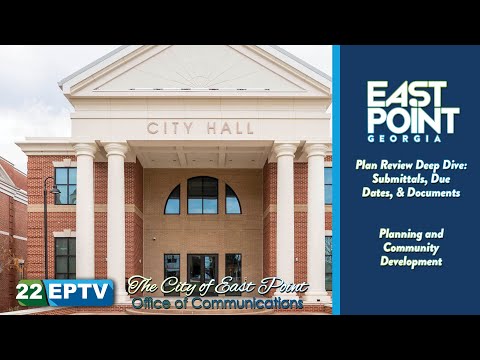
The City of East Point Permit Manager outlined what work requires a permit, how plan reviews are scheduled, and common causes of resubmittal denials during a public presentation on Oct. 26, 2025.
The presentation summarized which projects require permits and which require plan review, typical review time frames (new construction: two weeks; existing residential additions: five business days), document standards, contractor licensing requirements, resubmittal rules and steps to request plan-review meetings or concept reviews.
Permit scope and plan-review triggers
City staff said work that typically requires a permit includes new construction, additions, accessory structures above certain sizes, pools and spas, decks, docks, fences, garages (attached or detached), new roofs, driveway or walkway work and removal of multiple trees. The Permit Manager said new construction also requires an “infill packet,” a comparison of the proposed building to surrounding homes to show the project is compatible with the neighborhood.
“New construction always requires a permit. Additions always require a permit,” the Permit Manager said. The presentation identified siding, demolitions, decks and school projects as examples that usually trigger plan review.
Plan-review timing, payment and intake
Staff said plan-review timing depends on the project type: generally two weeks for new construction and commercial projects, and five business days (about seven calendar days) for most residential work. Review does not begin until the permit, plan-review and administrative fees are paid. Staff demonstrated that applicants receive an invoice email with a link to the BS&A payment portal and said reviews are routed only after payment is confirmed.
“If you don’t pay your fee, your review will not start,” the Permit Manager said.
Document standards and submissions
Staff emphasized that submissions must be legible, to scale and show a site plan with property lines, setbacks and the location of existing and proposed features. A formal survey can be used, but applicants must overlay the current layout and proposed work on that survey or provide an equivalent site plan. For many accessory projects — for example, decks — reviewers expect both a site plan and construction details showing materials and connections.
The Permit Manager said electronic PDF submissions through the city’s portal are required for tracking and to avoid repeated denials caused by illegible scanned paper plans. The city provides guidance documents and sample checklists on the applications page at eastpointcity.org.
Design professional and residential vs. commercial submissions
Staff said commercial projects require a design professional (architect or engineer) to stamp drawings; commercial submittals will not be accepted without a design professional’s accountability for structural or life-safety calculations. For residential work, staff said a licensed architect or engineer is not required, but plans must be professionally legible, drawn to scale and sufficiently detailed for field crews, inspectors and reviewers.
“You don’t have to have architect- or engineer-stamped drawings for residential. They need to be legible construction documents,” the Permit Manager said.
The presentation noted applicants may use tools such as AI to create drawings for residential submittals, but if the project is commercial the drawing package will still need a design professional’s stamp before final approval.
Resubmittals, denials and plan-review meetings
Staff explained the city’s resubmittal process and recommended requesting a plan-review meeting early if a first review results in denial or significant comments. The Permit Manager said reviewers will attach comment lists to denial emails and provide a resubmittal link; applicants should upload corrected documents via that link rather than emailing or dropping off paper copies.
The city allows three plan-review cycles covered by the initial plan-review fee. After three resubmittals, ordinance requires charging the plan-review fee again for additional reviews. Staff repeatedly urged applicants to use the resubmittal link and to include a comment summary or bubble marking corrections within the drawings so reviewers can verify fixes quickly.
“If we can get a plan-review meeting, almost 90% of the time your questions will be answered,” the Permit Manager said.
Escalation and appeals
When reviewers and designers disagree, staff said the chief building official can make determinations about gray areas of code and that applicants can request escalation meetings with the director, assistant director and chief building official. Staff said appeals processes exist in some cases but are rarely needed because most issues are resolved by a meeting of the reviewers, the applicant’s designer and city staff.
Inspections, contractor credentials and permit issuance
After approved plans and payment, staff said plans are stamped and the permit may be issued if the permit holder (contractor) has the required business license and any applicable Georgia state certifications (for example, general contractor, electrician, plumber or HVAC). The Permit Manager warned the city cannot issue permits for work that under state law must be performed by licensed tradespeople unless those credentials are on file.
“If the contractor doesn’t have the credentials, the plans can still be approved but you may need another contractor to obtain the permit,” the Permit Manager said.
Permit expirations and activity
Staff said construction permits expire after 180 days with no activity; an inspection request advances the permit’s expiration clock. Tree permits, staff said, are valid for one year.
Open records, unpermitted work and real-estate cautions
The Permit Manager urged buyers and owners to submit open-records requests to check for past permits, inspections or liens on a property before purchase. Staff said they frequently find renovated homes sold without permits and cautioned that unpermitted work may require removing finished surfaces so inspections can be completed or obtaining third-party code-compliance inspections signed by a qualified engineer or architect.
“Who looked at the electrical that was behind that wall? Not the city,” the Permit Manager said, urging prospective buyers to check records.
Certificates of occupancy and commercial signoffs
For commercial properties, staff said applicants must submit a certificate-of-occupancy application (fee stated as $115) and obtain signoff from the building official and the fire marshal. Staff said the city has aligned internal signoff timing so applicants can often receive a CO promptly after a successful building final inspection if the CO application is in place.
Concept reviews and large projects
Staff described a separate concept-review application for early-stage commercial development on vacant sites. Concept reviews provide preliminary comments from multiple departments (zoning, transportation, land-disturbance and others) and a virtual meeting with reviewers to outline next steps such as rezoning, traffic studies or curb-cut requirements.
Neighborhood disputes and setbacks
Staff reviewed how site plans and setback lines protect neighbors and explained the city’s role is limited when property-line disputes arise. If two surveys conflict or a fence crosses a property line, staff said the dispute commonly becomes a civil matter that may require court resolution. The city can provide permit records and site plans in open-records responses but said it does not adjudicate private boundary disagreements.
Ending
City staff closed by reiterating applicants should use the city portal, follow the guidance documents on the applications page, pay fees promptly to start reviews, and request plan-review meetings early when denials or complex comments arise. Staff said reviewers hold a weekly virtual window for plan-review meetings and encouraged applicants to include the person who drafted the plans in any meeting so reviewers can explain specific corrections to the designer.