Get Full Government Meeting Transcripts, Videos, & Alerts Forever!
Get email alerts on the Wastewater Capacity Fees topic
No spam. Unsubscribe anytime.
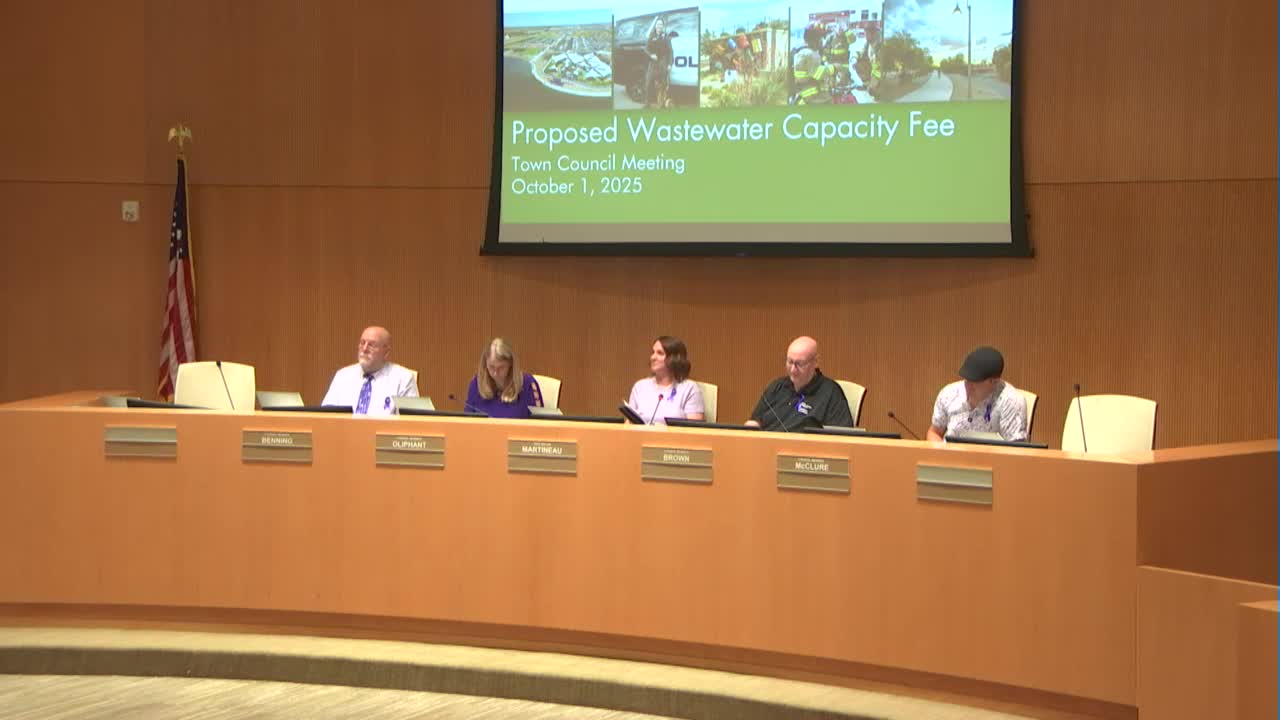
Queen Creek council opens 60-day notice to raise wastewater capacity fees; motion passes 5-0
Summary
The Town of Queen Creek voted 5-0 to begin a statutory 60-day notice of intention to raise wastewater capacity fees, setting a Dec. 3 public hearing and proposing a Jan. 5, 2026 effective date. Staff and consultants described a roughly 112% fee increase tied to plant expansion and methodology changes affecting multifamily and large meters.
Deputy Town Manager and Chief Financial Officer Scott McCarty told the Queen Creek Town Council on Oct. 25 that the meeting’s primary action was starting the process to increase the town’s wastewater capacity fees. "The agenda item for you tonight is the initiation of the process to increase our wastewater capacity fees," McCarty said, describing the proposal and the state-law process that triggers a 60‑day public comment period.
Nut graf: The council voted 5-0 to approve a 60‑day notice of intention to increase wastewater capacity fees, setting a public hearing for 6:30 p.m. on Dec. 3, 2025 and proposing an effective date of Jan. 5, 2026. Town staff and a consultant told council the change is driven by near-term demand that will require treatment-plant expansions and shifts in how the town attributes costs to multifamily housing and larger meter connections.
Officials said the town’s Greenfield Water Reclamation Plant (GWARP) currently has 4 million gallons per day (MGD) of capacity and plans to add 2 MGD, for a total of 6 MGD; the town also anticipates an additional east-side treatment facility in years nine and ten of the planning horizon. Utilities Director Mark Skocific said Queen Creek’s wastewater footprint roughly matches town boundaries and that flows move westward, creating reuse and recharge constraints that affect where future plants can be sited. "We have 4,000,000 gallons of capacity at the Greenfield Water Reclamation Plant, and it is planned to add another 2 MGD to it for a total of 6," Skocific said.
Kuda, managing director with DTA Public Finance, summarized the fee calculation and the components staff used to arrive at a recommended fee. He said the analysis estimates a 10-year build of about 14,600 equivalent residential units (ERUs) under a 2.5‑MGD demand scenario; for the 2‑MGD expansion considered in this update, the town calculated it would support just under 12,000 ERUs. Kuda said the resulting fee recommendation is about $6,100 per ERU — roughly a 112% increase from the current fee — and attributed the jump to the need to fund treatment-plant expansion and related transmission and buy‑in costs. "We're able to determine a fee, per equivalent house of about $6,100 which as you saw on the first slide is about 112% increase on the fee," he said.
Staff identified several cost and revenue elements included in the proposed calculation: a roughly $2.6 million payment to lease partner capacity from Mesa/Gilbert while expansions are designed and built; about $6.6 million in growth-attributable buy-ins and transmission improvements; a $15 million payment tied to the Ebcore/EPCOR exchange that staff said was made on behalf of properties that previously did not pay capacity fees; and a $10 million state-lands contribution that staff said reduced the net fee obligation. Scott McCarty explained the town moved recharge-related costs (post-treatment) to the water utility fund to reflect that recharge is a water-system expense rather than wastewater.
Councilmembers asked for clarifications on timing and subsidies. Councilmember McClure noted the expansion timeline and asked whether planning for an east-side facility should begin now; staff said design and construction can take five years and emphasized the town is already considering east-side options. Councilmember Brown asked about underbilling and whether prior methodology had shifted costs onto existing customers; McCarty and the consultant said multifamily metering and meter-size-based allocations in prior studies produced variance that contributed to faster-than-expected capacity use and that the town aims to correct that in this update to better align who pays for growth. McCarty credited Town staff member John Vandevortch with bringing the multifamily usage variance to the town’s attention.
The consultant and staff proposed two methodology changes: set multifamily at 75% of single-family ERU usage (based on census and local meter-flow comparisons) and evaluate large commercial/industrial connections on a project‑specific basis rather than relying solely on meter-size ratios. The changes are intended to allocate costs more closely to actual wastewater generation rather than meter size alone; the consultant cited analysis showing multifamily annual flows ranged from roughly 50% to 95% of single-family flows across local complexes, and settled on 75% as an equitable baseline.
Vice Mayor Martineau opened public comment on the item; James Ashley of the Home Builders Association said the HBA recognizes the need for wastewater capacity and praised the town’s stakeholder engagement, while noting the association and builders will continue discussions about timing and mitigation of impacts. Staff said the statutory 60‑day notice provides additional stakeholder opportunities before the Dec. 3 public hearing. "Consistent with the town's approach towards stakeholder engagement... it was a very informative meeting and a very open, transparent meeting," Ashley said.
On a formal motion read into the record, the council approved a 60‑day notice of intention to increase wastewater capacity fees, set the Dec. 3, 2025 public hearing at 6:30 p.m., directed posting and publication of the notice, and identified Jan. 5, 2026 as the proposed effective date. The motion passed by a 5‑0 vote. The motion was moved by Councilmember Brown; a second was recorded but a named second was not specified in the meeting transcript.
Ending: The action begins the statutorily required public process; staff and consultants said they will continue stakeholder meetings over the 60‑day period and return to council at the scheduled Dec. 3 hearing to consider final adoption. If adopted on Dec. 3, the fee would not become effective until the statutory waiting period is complete, per McCarty’s outline.