Get Full Government Meeting Transcripts, Videos, & Alerts Forever!
Get email alerts on the Building Codes Housing topic
No spam. Unsubscribe anytime.
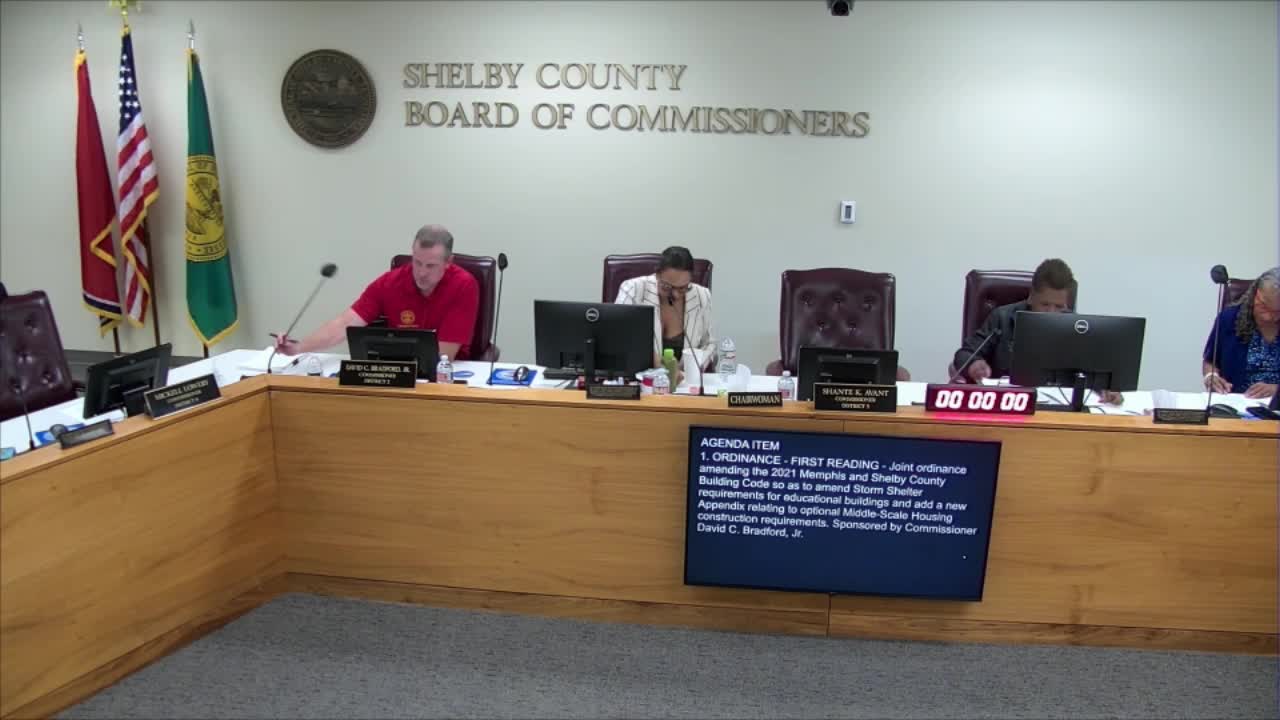
Shelby County committee advances optional storm-shelter rule and new ‘middle-scale housing’ appendix to align with state adoption of 2021 code
Summary
A joint Land Use committee voted to advance three related first-reading ordinances that amend the 2021 Memphis and Shelby County building and existing-building codes and align the county’s fire code language.
A joint Land Use committee voted to advance three related first-reading ordinances that amend the 2021 Memphis and Shelby County building and existing-building codes and align the county’s fire code language.
Rita Anderson, building official for the Memphis and Shelby County Division of Planning and Development, described two main proposals: an option-based approach for storm shelters in educational buildings and a new appendix (termed “middle-scale housing”) that creates an alternative compliance path for low-rise multifamily buildings with three to 24 dwelling units.
Anderson said the storm-shelter language mirrors the State of Tennessee’s recent adoption of the 2021 International Building Code and the state’s decision to remove a mandatory storm-shelter requirement for educational buildings. “There’s a specific language that we use the word may, and that means” the requirement is optional, Anderson said. The county’s proposed language would therefore allow — but not require — installation of ICC 500 storm shelters in new or existing educational facilities.
On middle-scale housing, Chief of Development and Infrastructure for the City of Memphis John Zena told the committee the appendix aims to create an alternative compliance route that reduces construction costs compared with commercial-code requirements and encourages smaller-scale infill multifamily development to increase housing options and affordability. Zena said maximizing the alternative path on three- to eight-unit structures might save roughly 8–10% in construction costs, with diminishing savings beyond eight units.
Committee members pressed for cost estimates and details on which provisions would change. Commissioner Mills asked about likely savings and seismic/structural factors; Zena noted savings depend on choices in the alternative compliance path and that other factors (seismic rules, for example) remain in the codes. Commissioner Brooks asked for reassurance that the storm-shelter language would be optional; Anderson said the draft uses “may.”
All three items passed the committee’s first-reading vote and will return for subsequent readings. The recorded committee tallies showed multiple abstentions: several commissioners abstained during first-reading votes (tallies reported 2 ayes, 2 abstentions on the initial ordinance, and similar results on the companion existing-code ordinance). The committee recorded a favorable recommendation to proceed to the next reading stage.
The county’s planning division said the middle-scale housing appendix was developed with city and state fire marshals, zoning, and code enforcement and has already cleared the city council’s first reading. The proposals aim to align the international building code, the existing building code and the national fire code for enforcement and clarify options for developers and schools in Shelby County.
The ordinances are on a multi-reading process and remain subject to additional review and amendment at later readings.