Get Full Government Meeting Transcripts, Videos, & Alerts Forever!
Get email alerts on the Mayors Office Budget topic
No spam. Unsubscribe anytime.
Council trims Mayor’s office pay package, removes two auto allowances
Summary
Jacksonville City Council’s finance committee moved this week to reduce the proposed mayor’s office salary increase and to remove two small auto allowances after extended debate over fiscal priorities and transparency.
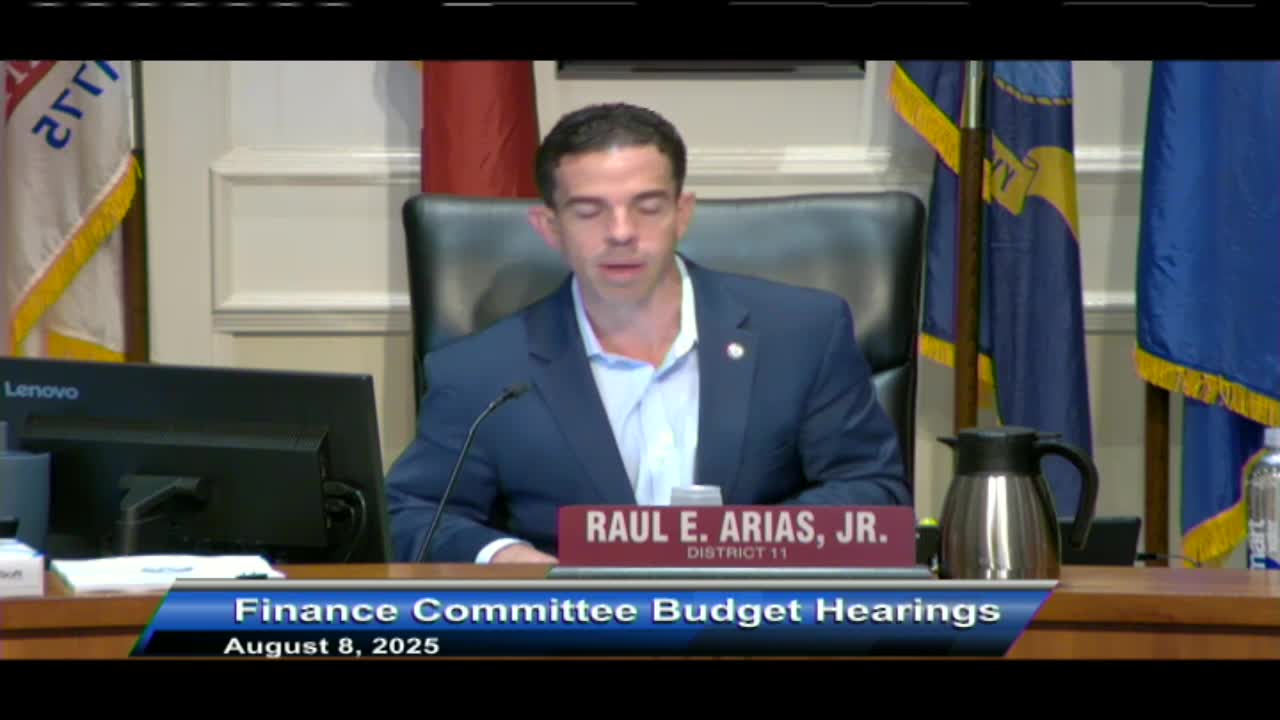
Jacksonville City Council finance committee members on Aug. 8 voted to reduce proposed increases in the mayor’s office salary line and to remove two auto allowances the mayor’s office had included in its proposed budget.
After more than two hours of debate, the committee approved an amendment that reduces the mayor’s office personnel budget by $300,000. The committee also voted to remove two auto allowances totaling $7,200 that had been proposed for two mayoral appointees.
The salary amendment was introduced after council members expressed alarm at the scale of the mayor’s office pay increases. Committee members described a pattern of larger-than-typical salary increases in the mayor’s staff and pressed administration representatives to explain part-time hires and the staffing mix. Councilman Rory Diamond, who had proposed a smaller $150,533 reduction, later supported the larger $300,000 amendment offered by Councilmember Ron Salem. The amendment passed by voice vote; the committee then approved the motion as amended.
Council members also debated two $3,600-per-year auto allowances that the mayor proposed for senior staff. Supporters said the allowances reflect travel and insurance considerations for staff who drive frequently for official business. Opponents argued the allowances were discretionary and inconsistent with recent budget tightening; the committee voted to remove $7,200 from the proposed budget for the two allowances.
Administration officials said some of the salary growth reflects full-year funding for positions that had been partially funded or recently converted from part time to full time. Mike Weinstein of the mayor’s office and Chief Administrative staff described travel and staffing needs for a large, citywide office. Kim Taylor, the council auditor, detailed the line‑by‑line increases and noted the committee’s changes would materially lower the mayor’s requested increase.
Discussion points included whether nonrecurring one‑time funds should be used to support recurring staff costs, and whether some mayoral staff positions should instead be funded by other revenues or deferred. Committee action reduced the mayor’s office personnel request by $300,000 and removed $7,200 in auto allowances; both items were approved by voice votes.
The committee’s action reduces the mayor’s proposed personnel costs for the office and signals increased scrutiny of executive‑branch staffing and compensation in this year’s budget cycle. Additional amendments to other mayoral line items were considered later in the hearing.