Get Full Government Meeting Transcripts, Videos, & Alerts Forever!
Get email alerts on the Animal Feeding Operations topic
No spam. Unsubscribe anytime.
Kosciusko planners to study zoning changes for animal feeding operations after poultry, livestock concerns
Summary
The Kosciusko County Area Plan Commission voted to direct staff to research possible zoning and ordinance revisions on animal feeding operations, including setbacks, notification and enforceability, following testimony from poultry, hog and dairy producers about avian influenza and manure regulation.
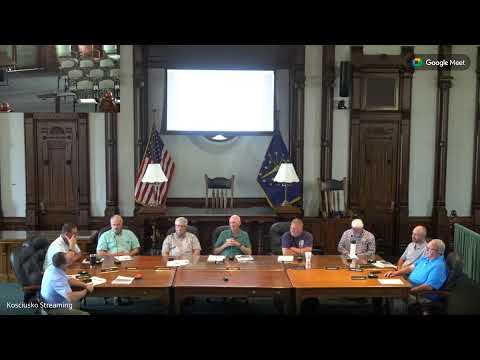
The Kosciusko County Area Plan Commission voted Tuesday to direct county planning staff to research potential revisions to local zoning and ordinance language governing animal feeding operations and to convene a committee of stakeholders to advise the work.
The directive came after two hours of testimony from poultry integrators, hog and dairy producers, and residents about disease risk (including highly pathogenic avian influenza), setbacks, manure regulation and notice requirements for new barns and confinement operations.
Kosciusko County planning director Matt Sandy opened the discussion, calling it an "educational, fact-finding meeting" and noting that the commission had no advertised cases but had invited stakeholders to speak on animal feeding operations (AFOs). Sandy said the county currently treats AFOs and larger confined feeding operations (CFOs) similarly in ag districts and that any change would need to be written so staff could reasonably enforce it. "This is a broad topic," Sandy said. "Education is gonna be the baseline of this."
Producers who spoke urged the county to consider setbacks and notice requirements to limit concentration of barns and to reduce the local economic and public-health impacts of disease outbreaks. Steve Miller of Creighton Brothers described supply-chain and permitting disruptions his company faced when control zones were imposed after bird-flu positives in nearby counties: "We had to start doing permitting to move eggs from farms, permitting to move any mortality, permitting for everything we did," Miller said, describing months-long impacts on his operation.
Luke Singh of Maple Leaf said his company is vertically integrated and relies on contract producers; he supported measures that would prevent the kind of dense clustering seen in parts of Elkhart and LaGrange counties while warning against rules that would unduly hinder agricultural growth. "Anything that's not going to hinder potential growth in the area," Singh said, "is what we'd like to see." Maple Leaf and other integrators said they already require biosecurity measures from contract growers, including vehicle disinfection and changing into dedicated barn clothing.
Local producers and neighbors repeatedly raised concerns that buildings under certain size thresholds can be sited and populated without notice to surrounding property owners. One speaker said the county's permit process requires notifying owners within roughly a half-mile for larger operations, but smaller poultry buildings can be erected without that notice. Several speakers urged at minimum improved neighbor notification and consideration of minimum lot sizes or building-size thresholds to reduce clustering.
County staff said example ordinances from LaGrange County and Adams County were provided for review. Sandy said LaGrange's standards include minimum acreage thresholds and that Adams County's regulations were driven largely by concerns about manure application and interplay with the state chemist's authority.
After public comment and discussion among commissioners, a motion directing staff to research ordinance revisions and gather input passed by voice vote. The commission also agreed to form a limited committee of stakeholders to assist planning staff in developing options; members will include local producers and other affected parties as the staff list is assembled.
Votes at a glance: - Motion to direct planning staff to research potential ordinance revisions concerning animal feeding operations and to convene a stakeholder committee — approved by voice vote; exact roll-call counts were not specified in the meeting record.
Why it matters: County officials said any local changes could affect where and how poultry, hog and dairy operations locate, and could influence enforcement burdens on county staff. Producers warned that tighter local requirements could alter local production patterns and that disease outbreaks can have prolonged economic consequences; speakers described examples in neighboring counties where concentrated outbreaks led to large losses and months-long business disruptions.
Next steps: Planning staff will compile example ordinances, consult state agencies and local stakeholders (including IDEM, the state chemist's office and the Board of Animal Health as appropriate), and return to the commission with proposed language and recommendations. The commission said it will seek a balanced, enforceable approach and warned against hasty or non-enforceable measures.
Reporting note: Quotes and details in this article are drawn from testimony at the Kosciusko County Area Plan Commission meeting on the animal feeding operations discussion. Speakers included planning staff, poultry integrators and local livestock producers.