Get Full Government Meeting Transcripts, Videos, & Alerts Forever!
Get email alerts on the Tenant Habitability topic
No spam. Unsubscribe anytime.
Tenants press council for stronger repairs, photo documentation and rent relief; council advances housing items
Summary
Multiple tenants and tenant-advocacy speakers urged the Los Angeles City Council for stronger enforcement of habitability standards, including before-and-after photo documentation of repairs, mold testing, language access and limits on rent increases when landlords fail to repair.
Dozens of public speakers used the City Council public-comment period to urge stronger tenant protections, more transparent habitability enforcement and limits on rent increases when landlords fail to make required repairs.
Speakers representing tenants'advocacy groups, including ACE, recounted individual housing conditions and asked the council to adopt specific measures: require inspectors to take before-and-after photographs of repairs; expand mold testing authority for the housing department; improve language access and appointment coordination for inspections; and prevent landlords from raising rents when they do not complete repairs. Public commenters named examples of broken stoves, doors and mold-related concerns and said they had waited repeatedly for repairs.
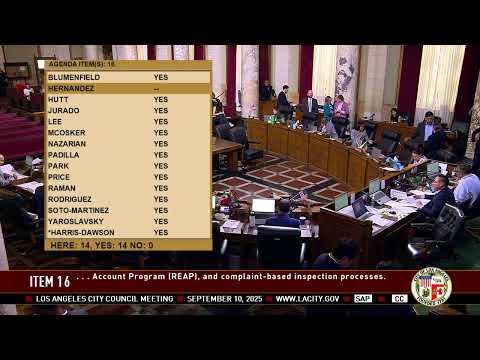
Council action earlier and later in the meeting covered housing items on the agenda. Item 17 was approved as part of a grouped vote earlier in the meeting (the roll call that included items 1,2,6,17 and 40 recorded 15 ayes). Later, Item 16 was considered with a friendly amendment (16a, Hernandez/Bloomfield) and adopted by the council with a recorded vote of 14 ayes.
Advocates at the podium requested a clearer pathway to activate habitability plans and stronger enforcement authority for the Department of Housing and Community Investment so that inspectors could perform mold testing when appropriate. Several speakers also asked for an express rent-reduction mechanism when landlords refuse to make repairs.
Councilmembers who sponsored or amended the housing items said the committee recommendations were a step forward; the record shows the council approved the committee recommendations while advocates asked for further steps. The council did not adopt the specific tenant-requested changes during the meeting; rather, public testimony was recorded and the council voted on the committee items that were on the agenda.
The council's votes on agenda items that included housing committee recommendations do not, by themselves, enact all of the changes requested by tenants; advocacy groups will likely press for additional motions or legislative language in committee or on future agendas.