Get Full Government Meeting Transcripts, Videos, & Alerts Forever!
Get email alerts on the Land Use Zoning topic
No spam. Unsubscribe anytime.
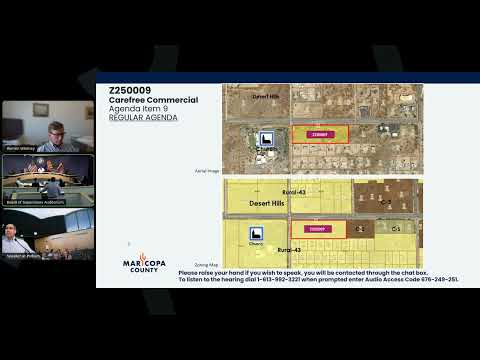
Planning commission recommends denial of Carefree Highway rezoning (Z250009)
Summary
The Maricopa County Planning and Zoning Commission on Sept. 11, 2025 recommended denying a request to rezone a 10‑acre parcel at Carefree Highway and Central Avenue from RU‑43 to C‑2 CUPD, citing unanswered traffic, water and design questions and broad community opposition.
The Maricopa County Planning and Zoning Commission on Sept. 11, 2025 voted 8‑0 to recommend denial of case Z250009, a request to rezone a 10‑acre parcel at the intersection of Carefree Highway and Central Avenue in the Desert Hills area from RU‑43 (one‑acre rural) to C‑2 CUPD to allow neighborhood commercial uses and self‑storage.
The commission’s recommendation followed a staff presentation, a statement by the applicant and extended public comment in which residents and nearby property owners raised concerns about traffic, flood control, water supply and compatibility with the area’s scenic and rural character.
Staff planner Darren Martel summarized the request and its alignment with county plans, saying the applicant proposed a C‑2 CUPD “to accommodate future offices, self service indoor storage, and neighborhood focused convenience retail” and that the request “supports the commercial node land use designation outlined in the Daisy Mountain New River Area Plan.” Martel also said the CUPD would limit some uses, cap building height at 30 feet and include a 10‑foot multi‑use trail along the highway.
Residents who spoke said they oppose commercial rezoning. “The end use is not sufficiently articulated,” said Faye Oakley, who expressed concern about traffic and flood control. Lindsay Toussaint said her well has run dry and that she now uses hauled water, adding: “If we’re not planning accordingly, why are we here?” Jim Davey, Bill Maher and other nearby residents described the area as rural and scenic and said existing commercial options are available miles away.
Other public comments raised technical and cumulative‑impact concerns. Martha Reichenberg, who lives downstream of an existing storage facility, said changes to local flood channels have increased flows through the wash by her property and that flooding had previously endangered animals. Pat Mahoney, who identified himself as an owner of a local self‑storage facility, urged coordinated infrastructure planning, saying developers and multiple agencies must address water and flood infrastructure before additional commercial entitlements proceed.
Applicant Brad Garcia of Century Builders said the proposal was developed with adopted county plans in mind and that the CUPD overlay would exclude certain high‑intensity or incompatible uses. “We have been open with the community and hosted an open forum to hear a lot of the concerns,” Garcia said, and he added that the CUPD limits would prohibit adult entertainment and dispensaries and would require stormwater to be handled to county engineering standards.
Commissioners’ discussion focused on three central gaps: lack of a traffic impact analysis, unclear water supply, and absence of a detailed plan of development. Commissioner Warren Whitney moved to deny the rezoning; Commissioner Rockwallak seconded. Rockwallak explained that while the Daisy Mountain/New River plan allows a commercial node in the corridor in the long term, he opposed a speculative rezoning without a traffic study, a site plan or clarity on water sources. Commissioners also noted the volume of community opposition — staff recorded 13 opposition letters and a petition of 70 signatures — and the number of in‑person speakers.
Staff and the applicant said a traffic impact analysis and site‑specific engineering would be required at the plan‑of‑development stage if a development proceeds, and Garcia told the commission that a well system would likely be used because Cave Creek had placed a hold on expansion of its water supply. Garcia also said on‑site stormwater retention would be designed to meet county engineering standards and that some off‑site flows would be accommodated in existing channels.
The formal action on the record: Motion to recommend denial of Z250009 (Carefree Commercial), moved by Commissioner Warren Whitney and seconded by Commissioner Rockwallak; roll call vote recorded as 8‑0 in favor of the motion.
The commission’s recommendation will be entered in the case record. The transcript and staff report reflect that additional technical studies and a site plan would be required to evaluate traffic, drainage and utility capacity for any future development on the parcel.