Get Full Government Meeting Transcripts, Videos, & Alerts Forever!
Get email alerts on the Transportation Funding topic
No spam. Unsubscribe anytime.
Council directs staff to draft ordinance replacing $20 car-tab fee with 0.1% sales tax for transportation district
Summary
City Manager John Amundsen recommended replacing the $20 vehicle registration fee with a 0.1% local sales tax dedicated to the Transportation Benefit District to increase steady funding for pavement preservation; council asked staff to return with an ordinance and implementation timeline.
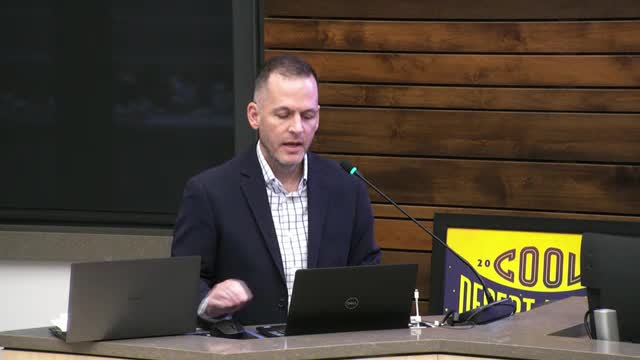
City Manager John Amundsen told the Richland City Council on Sept. 16 that he recommends replacing the city—s $20 annual vehicle registration fee with a 0.1% local sales tax dedicated to the Transportation Benefit District to better fund pavement preservation.
Amundsen said the city maintains about 650 center lane miles and targets a pavement condition index (PCI) of about 70—6 to 75. He told council that reaching and sustaining that PCI requires roughly $4 million annually and that the current $20 car-tab fee produces about $1 million a year, leaving the city to fill the gap with general fund transfers, real estate excise tax (REET) and periodic reserve drawdowns.
The city manager said a 0.1% sales tax ("one-tenth of one percent," about 1cent on $10) would generate an estimated $2.25 million annually based on historical sales-tax performance and would capture spending by visitors and commuters as well as residents. "This broadens the payer base to commuters and visitors, provides higher dedicated revenue, aligns better with growth, and still keeps some of the general fund and REET support in the mix at reduced levels," Amundsen said.
Why it matters: council members said they favor shifting the funding burden away from a flat per-vehicle fee that does not scale with inflation or nonresident use of Richland streets. Council member Luxon called the change "a net decrease to our citizens in the tax burden." Council member Meyer said a sales-tax approach avoids repeated fights to raise a flat fee later and better shares costs with those who use city roads.
Details and trade-offs presented to council included a five-year comparison that, according to staff, would have generated about $11.7 million on a 0.1% sales tax versus about $6.2 million from the car-tab fee over the same period. The analysis cited an average year-over-year sales-tax growth of about 6.4% since 2019 versus 1.2% growth for the vehicle fee. Amundsen also noted new large retail generators such as Costco (estimated conservatively to add roughly $800,000 in sales tax) and CarMax under construction, saying the estimate does not yet include their future contributions.
Equity and exemptions: staff noted that several common purchases are exempt from sales tax (groceries, prescription drugs, utilities, gasoline and real estate). Amundsen—s household-level examples suggested most households would pay less under a sales-tax approach than they do now via the flat $20-per-vehicle charge; his analysis used HUD area median income figures for Richland ($105,600 for a family of four in 2025) and estimated taxable-spending patterns across income tiers.
Legal and procedural notes: Amundsen cited RCW 82.14.0455 (the state law authorizing transportation benefit districts to adopt a sales tax) as the enabling statute and noted the city council serves as the governing board of the Transportation Benefit District. He said a council ordinance and Department of Revenue notice are required to implement the tax; to hit a January 1 start date the city would have had to notify the Department of Revenue by Oct. 17, so staff recommended an April 1, 2026 implementation if council directs staff to proceed.
Council direction: after questions and discussion about transparency, impacts on low-income households, the city—s existing financial commitments and timing, council asked staff to prepare an ordinance, implementation timeline and public communications materials demonstrating how the revenue would be spent to sustain the PCI target. Amundsen said the ordinance could be returned to council by the end of the year and would take effect April 1, 2026 if adopted on that schedule. Mayor Richardson and multiple council members supported sending the proposal back to staff for drafting.
What the council did not do: there was no formal vote to adopt the tax during the Sept. 16 meeting; the council—s action was direction to staff to draft and return an ordinance and timeline for consideration.
Looking ahead: staff will return with the ordinance and an implementation schedule; if the sales tax is adopted it would initially run up to 10 years and be subject to future council review and potential extension.