Get Full Government Meeting Transcripts, Videos, & Alerts Forever!
Get email alerts on the Master Plan topic
No spam. Unsubscribe anytime.
Livingston Parish committee discusses master plan rollout, transportation bonds, complete streets and wastewater options
Summary
Members of the Livingston Parish master plan committee reviewed the updated future land-use map released for this cycle, discussed transportation-bond priorities and complete-streets trade-offs, and raised a push to begin wastewater planning with an emphasis on closed systems; no formal votes were recorded because the meeting lacked a quorum.
Members of the Livingston Parish master plan committee on Oct. 25 reviewed the updated future land-use map released for this cycle, discussed draft transportation and complete-streets guidance, and pressed for earlier work on wastewater collection and funding options.
The committee’s discussion clarified that the updated land-use map from WSP is part of this cycle’s package and will go to the planning commission and then the parish council for final action. Committee members emphasized that the master plan is “a living, breathing document” that can be amended after approval and urged the group to continue making recommendations even after the current cycle ends.
Gerald, a committee member, asked that the committee add two specific agenda items for the next meeting: a review of allocations from House Bill 2 and a discussion of a parish wastewater master plan. “For the last three years, I’ve studied that House Bill over and over,” Gerald said, and offered to circulate a written breakdown showing what Livingston Parish has received and the projects those funds supported.
Why it matters: the land-use map directs long-range development expectations and influences rezoning decisions, while transportation- and wastewater-planning decisions affect infrastructure spending, bond priorities and where public improvements will be built.
Land-use and economic-corridor letter The committee discussed a previously drafted letter that requested extensions and clarifications for an economic corridor designation. Members said the county’s letter had been submitted to WSP; planning staff and the planning commission have since reviewed the consultant’s draft land-use maps. Several members said the consultant extended the corridor north in some areas but did not apply the corridor designation uniformly where members expected it.
Committee members noted the planning commission will approve the map by resolution and then the parish council may adopt it by order; once the council acts the map will guide future rezoning and infrastructure decisions unless it is later amended.
Transportation plan and bonding priorities Committee members reviewed an initial transportation plan that shows new connectors, safety improvements and road classifications the parish will use to seek outside funding. The parish has driven roads with ground-penetrating radar to generate pavement-condition data that will be overlaid with the plan.
Members said the council and administration are identifying specific projects to include in a bond issue intended to accelerate road maintenance and construction. One member said officials have asked finance staff to “start looking at the bonds” to time sales for favorable interest rates and to maximize return on investment.
Complete streets: scope, cost and targeting The committee spent substantial time on “complete streets” guidance — standards that add sidewalks, ADA-compliant crossings, bike lanes, multiuse paths and stormwater features such as rain gardens to road projects.
Members supported the goal of multimodal connectivity for denser corridors but cautioned against uniformly applying full complete-streets sections across rural parish roads because of higher right-of-way and construction costs. One member said complete-streets features are most appropriate in municipalities and near schools or commercial centers; elsewhere the committee should allow a flexible, tailored approach tied to population density and available funding.
The committee discussed design elements typically included in a complete-streets section (bike lanes, 6–10 foot multiuse paths, ADA-compliant crossings and stormwater treatment zones) and noted those features increase right-of-way needs and cost compared with a standard two-lane rural road. Members urged the committee to identify priority corridors where the parish can seek grant funding rather than committing to parish-wide implementation before funding is secured.
Wastewater and sewer systems Committee members returned repeatedly to wastewater and sewer planning, including a recommendation in the updated master plan (noted on page 60) that the parish prepare a wastewater master plan. Several members argued it is essential to begin wastewater planning now in areas that lack collection lines rather than waiting years.
Members discussed system types and expressed a preference for closed, pressurized collection systems (for example vacuum or small grinder-pump/pressurized networks) in many areas. Advantages noted included smaller downstream treatment facilities (because the systems convey sewage with less stormwater inflow), reduced infiltration during heavy rains and potentially lower long-term costs for some site conditions. The committee also discussed common operational issues and the need to specify standard equipment and inspection requirements so municipalities do not face excessive parts inventories or maintenance burdens.
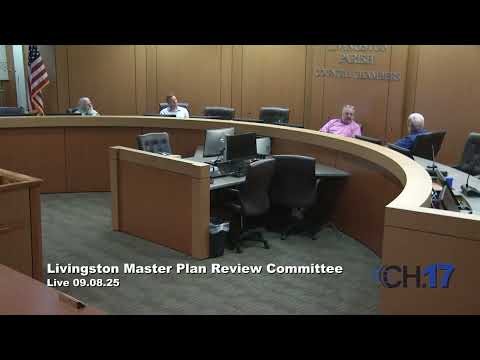
Process, next steps and public involvement The meeting lacked a quorum early; the committee skipped roll call and postponed formal adoption of July minutes to the next meeting. Members agreed to: add a wastewater master-plan discussion and a review of House Bill 2 allocations to the next agenda; circulate the chair’s list of proposed bond projects and road candidates for review; and prepare an exhibit showing recommended land-use changes for public comment before the planning commission hearing.
Timeline: members said the planning commission will take the revised land-use package in early October (planning commission schedule referenced by committee members), after which the parish council will consider it. Several members urged outreach events and displays so residents can view proposed changes and comment before council action.
No formal motions or votes were recorded at this meeting because the committee did not have a quorum; members described items they would bring forward once the committee meets with a quorum.