Get Full Government Meeting Transcripts, Videos, & Alerts Forever!
Get email alerts on the Traffic Calming topic
No spam. Unsubscribe anytime.
NDOT proposes speed cushions, ballot vote and lengthy queue for Cedarmont Drive traffic-calming project
Summary
The Nashville Department of Transportation presented a preliminary plan for speed cushions and supporting measures on Cedarmont Drive after data showed elevated speeds and heavy daily traffic. The project requires a neighborhood ballot and could take most of a year to construct if approved.
The Nashville Department of Transportation on the evening of the recorded neighborhood meeting presented a preliminary traffic-calming plan for Cedarmont Drive that centers on speed cushions, asks property owners to vote in an online ballot and estimates a months-long wait for construction.
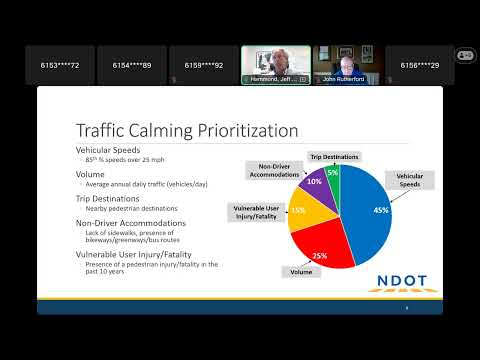
NDOT consultant Jeff Hammond described the agency's recommended package for the one-mile corridor as eight sets of speed cushions spaced about 500 feet apart, placed so they slow traffic without pushing it onto nearby streets. “We look at that relative to all the other, streets that we collected as well. You have, about 3,500 cars a day on the street,” Hammond said while presenting the department’s data and map of the proposed locations.
NDOT said the street’s high-percentile speed is 35 mph and that Cedarmont carries roughly 3,500 vehicles per day; Hammond said NDOT’s program typically works on streets with up to about 5,000 vehicles daily. The department described speed cushions as the primary tool because they slow most passenger vehicles while affecting large-wheelbase emergency vehicles much less.
Why it matters: Neighbors told the agency that speeding, running the four-way stop at Cedarmont Circle and occasional rollovers into a roadside storm culvert have made the corridor dangerous for pedestrians and residents. “I am a senior citizen, and I have mobility issues. And, yes, I'm walking in the road. So, yeah, the speed they come down there concerns me,” said Nancy Parker, who lives at the corner of Cedar Creek and Cedarmont.
What NDOT proposed and why: Hammond showed a concept with five sets of cushions on the south portion and three on the north portion of the project, using a roughly 500-foot spacing that NDOT staff said creates a continuous slowing effect without concentrating traffic onto alternate routes. Hammond said the cushions the city uses are prefabricated rubber devices, about 3 inches high and typically 6 feet wide, and that the city’s “default” design for a suburban street like Cedarmont would use approximately 10.5-foot-long cushions in the direction of travel.
NDOT also described optional supplemental measures: radar feedback signs, pavement edge lines to create a visual narrowing, short plastic delineators in curves, and, in limited circumstances, traffic circles. Hammond cautioned that traffic circles can confuse drivers, pose challenges for school buses and conflict with existing bike lanes.
Resident feedback and design tweaks: Residents supported cushions but pressed for adjustments to address local conditions. Several speakers called out the four-way stop at Cedarmont Circle as a trouble spot where drivers often “take off” and perform burnouts; Steve Menton, who lives three houses south of that stop, urged NDOT to place cushions closer to that intersection. “We need those speed cushions relatively, you know, within a reasonable distance from that stop sign because, like I say, they treat it like a drag strip,” Menton said.
Neighbors also asked why the bike lane ends at Maxine Drive; a participant identified as Mr. Young said the lane was not extended to Barnes Road because that segment was too narrow to accommodate both parking and a bike lane. Several residents described a damaged roadside storm culvert and eroding curb that have led to vehicles leaving the roadway; one resident said a car landed in the culvert and flipped. NDOT staff noted storm-drain and curb repairs are handled through other city channels and suggested residents file a report through the city’s Hub service.
Next steps and timeline: Hammond outlined the remaining steps: more detailed on-the-ground measurements and a design plan, an optional second neighborhood meeting if needed, a mandatory six-week online ballot of eligible property owners, and, if the ballot succeeds, placement in NDOT’s construction queue. Ballot rules: only property owners whose parcels front the project corridor are eligible to vote (corner properties count; commercial, vacant and multi-unit ownership have specific rules); ballots will be mailed to owners and a two-thirds majority of ballots cast is required for approval.
Hammond estimated the ballot and queue process together mean construction would likely be at least several months after any successful vote. “We still are saying 8 to 10 months,” he said of the construction-queue timeframe, and noted design and the six-week ballot add time; he advised residents realistically to expect the full process to approach about a year.
What was not decided: NDOT did not commit to permanent placement until the design and neighborhood ballot are complete. The agency also did not recommend a traffic circle at the four-way stop and said it would be cautious placing full traffic tables that cross an entire roadway because of implications for emergency response.
Ending: NDOT posted meeting materials and the interactive project map on the city’s traffic-calming web page and encouraged residents to use the Engage Nashville feedback portal. Hammond provided an NDOT traffic-calming email address for questions and said the meeting recording would be posted in the next few days.