Get Full Government Meeting Transcripts, Videos, & Alerts Forever!
Get email alerts on the Transportation Grade Separation topic
No spam. Unsubscribe anytime.
Planning study finds elevated track over Vista Transit Center preferred; next phases need major funding
Summary
A planning study funded through an FTA grant and administered by NCTD identifies raising the Sprinter tracks (an aerial-track alternative) over the Vista Transit Center area as the preferred grade-separation option but warns that feasibility, environmental review and design remain to be funded.
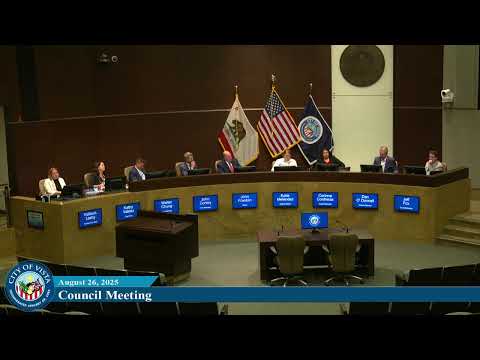
City staff presented a Federal Transit Administration-supported planning study that evaluated alternatives to separate Sprinter rail operations from vehicle traffic at the Vista Transit Center area, including crossings at Vista Village Drive and Main Street. The study was funded through an FTA grant administered by North County Transit District (NCTD) under an MOU with the city and used a consultant to advance three refined alternatives: an aerial track (raising the rail), a track trench and an aerial roadway. The study evaluated traffic, transit operations, emergency-response impacts, pedestrian and bicycle circulation, utilities and community impacts and incorporated public outreach workshops.
Staff said the planning-level evaluation identified Alternative 1A (an aerial-track solution raising the tracks over both Vista Village Drive and Main Street) as the preferred alternative because it best met the studys purpose and need, produced the greatest benefit relative to impacts, and received strong support during public outreach. The presentation noted the study prepared conceptual schematics and planning-level cost estimates for the alternatives; the packet shows a planning-level cost range for the preferred aerial-track alternative of "between 460 and $8,860,000,000" (as presented in the staff report). City staff cautioned that the figure is planning-level and that a more detailed feasibility and environmental phase (a Project Study Report and conceptual design) would be needed before a construction-ready design, and that the next-phase study was roughly estimated at about $1 million for the project study report and conceptual design. Staff made clear no funding for the next phase has been identified.
Public comment urged the council to consider extending the grade separation farther east to include the Guajome Street crossing because rising traffic volumes and planned housing nearby could lengthen gate-down times and impede emergency response; Sid Rothenberg and others raised that issue. Councilmember Manny Contreras, who attended the public workshops, said the aerial-track option aligns with regional objectives to reduce gate downtime and protect emergency response times; he also urged staff to press NCTD and regional partners to pursue construction funding.
Councilmembers noted the regional competitiveness of grant funding for grade separation: many jurisdictions are seeking grade-separation funds, and projects that have completed planning and environmental steps and demonstrable cost estimates are more competitive. The study recommends further work: a project study report and environmental clearance, followed by preliminary design and final design and construction. Staff said the project study report is the next step and estimated its cost around $1 million but said potential funding sources have not been identified.
No formal action was required or taken on the study itself; councilmembers asked staff to pursue regional partners and grant opportunities.