Get Full Government Meeting Transcripts, Videos, & Alerts Forever!
Get email alerts on the Public Safety Alpr topic
No spam. Unsubscribe anytime.
Council pauses decision on deputy sheriff ALPR rollout, asks staff for countywide data and audit records
Summary
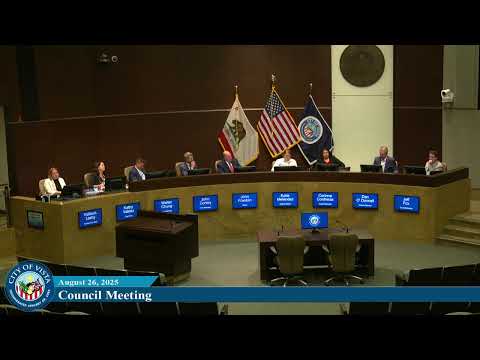
After extensive public comment and council debate over privacy and effectiveness, the Vista City Council declined to authorize automated license plate readers (ALPRs) and other Safe Streets expansions tonight and directed staff to return with detailed data from contract cities, audit records, breach incidents and program costs.
Captain John Malan of the San Diego County Sheriffs Office presented the sheriffs Safe Streets program and a proposal to deploy automated license plate readers (ALPRs) and additional pole-mounted cameras in Vista as part of the countywide Safe Streets initiative. Malan summarized the sheriffs compliance steps under California Senate Bill 34 (SB 34), including published LPR privacy policies, training, logging and a current practice of 30-day retention for non-investigative records. He said the sheriffs office intends to move to quarterly audits beginning January 2026 and described access controls tied to investigative need.
The presentation prompted a large public response. More than a dozen speakers, including residents and civil-rights and community groups, urged the council to reject ALPRs and similar surveillance technologies on civil-liberty, privacy and cost grounds. Public commenters cited local and statewide reporting about unauthorized queries or data-sharing incidents and questioned whether the cameras meet Vistas needs given falling crime rates. Kenneth Zuniga, who identified himself as a resident, said: "We cannot open the door to this kind of mass surveillance in Vista." Several speakers referenced media reports alleging improper access to ALPR or vendor databases in other San Diego County jurisdictions.
Supporters of the technology, including several residents, said the system helps deputies locate stolen vehicles, fugitives and missing persons. Andrew Escalante described ALPRs as a practical tool to recover stolen cars and assist investigations.
Council discussion focused on three questions: (1) measurable effectiveness in contract cities, (2) documented audits or breaches and the sheriff's follow-up, and (3) the financial cost and retention parameters. City staff and the sheriff indicated that Vista is the only contract city not currently using the county's pole-mounted ALPRs; other contract cities and some municipal police departments already have LPR deployments. The sheriffs representative noted the vendor meets CJIS-like standards and uses encrypted cloud storage (AWS GovCloud) and that access is limited to trained deputies, analysts and dispatch personnel.
Councilmember Manny Contreras moved to decline approval of the recommendation as presented and request additional information. The deputy mayor refined the motion into a substitute directing staff to return with a set of specific items for council review before any approval: comparative effectiveness metrics and case-resolution data from other contract cities (how many stolen-vehicle recoveries, missing-persons located and felony apprehensions are attributable to ALPR use), documented instances of policy violations or unauthorized queries (including the countys response), detailed cost estimates (installation and ongoing costs at 12-18 units), the sheriff's proposed audit records and retention justification, and proposed camera mapping options. The substitute was seconded and approved. Council did not authorize deployment or purchase; rather, it asked staff to return with the requested data and analysis as soon as is practically possible.
Captain Malan said the sheriffs office can help obtain those metrics; the consultant for the county program, Sashy Ivanovich, told council that the consultant or staff can re-run analyses and that the city already has the spreadsheet tools necessary to adjust weights and examine sensitivity. Councilmembers said they want the data package to include documented outcomes from other contract cities, examples of recoveries attributable to ALPRs, an accounting of any unauthorized or out-of-state queries and the sheriff's internal investigations and remedial steps in those cases, and an itemized projection of installation and annual costs for the number of cameras Vista may select.
The council also discussed related technology: gunshot detection pilots in San Marcos and the sheriff's demonstration of pole-mounted PTZ cameras. Several members said they are more open to narrowly scoped, public-safety technologies (for example, gunshot detection) than to broad plate-scan databases without stronger oversight. Several councilmembers said they would favor a one-year pilot if clear success metrics and audit reports are in place.
Outcome: Council directed staff to return with a detailed data and policy package that includes the items listed above. No purchase or authorization was approved.