Get Full Government Meeting Transcripts, Videos, & Alerts Forever!
Get email alerts on the Festival Permits topic
No spam. Unsubscribe anytime.
Caroline County board reviews state festival and retail off‑site alcohol permits, finds limits on liquor and local gaps
Summary
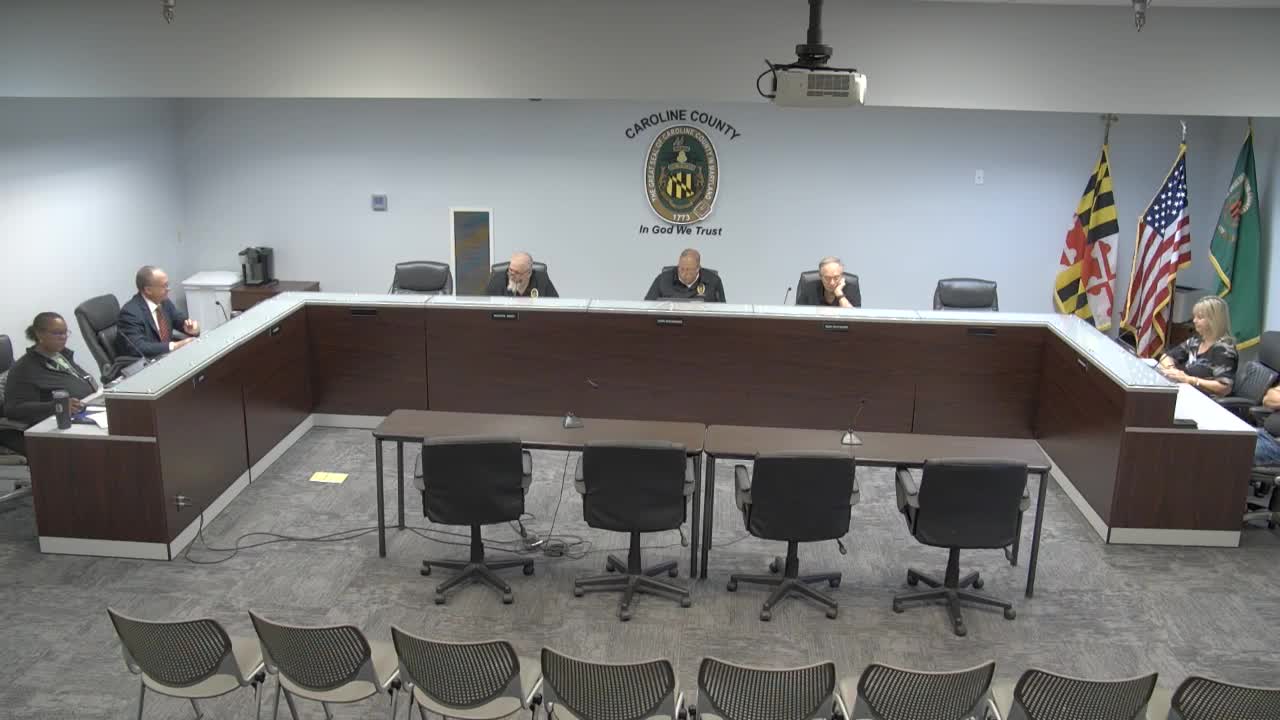
The Chair of the Caroline County Board of License Commissioners called the Aug. 27 meeting to order to discuss festival permits and retail off‑site alcohol permits, and Geneva, board administrator for the board, presented research on Maryland law and what neighboring counties allow.
The Chair of the Caroline County Board of License Commissioners called the Aug. 27 meeting to order to discuss festival permits and retail off‑site alcohol permits, and Geneva, board administrator for the board, presented research on Maryland law and what neighboring counties allow.
Geneva said Maryland "offers a nonprofit beer, wine, and liquor festival permit" and explained the state permit "allows the holder to conduct a nonprofit beer, wine, and liquor festival for at least 1 day, but no more than 3 consecutive days." She said a retail off‑site permit "allows the license holder to sell alcoholic beverages to the public for off‑site consumption" but that the state guidance limits how that off‑site permit may be used, including that the permit may be used at not more than three farmers‑market appearances in the jurisdiction and that off‑site permit holders must be invited to nonprofit festivals.
The nut graf: the board’s research shows most Maryland localities that have festival provisions permit only beer or wine (or both) rather than beer, wine and liquor together, and Caroline County lacks local zoning language authorizing festivals; adopting a local festival permit or different rules for liquor would require state legislative or regulatory changes.
Geneva told the board that among Maryland’s 25 licensing jurisdictions she reviewed, several limit festivals to beer and wine. "It appears that liquor is not currently permittable at the local jurisdiction," she said, adding that her research found most counties either allow beer festivals, wine festivals, or beer‑and‑wine festivals rather than a combined beer‑wine‑and‑liquor festival. She also summarized state limits on retail off‑site permits: the permit can be used at farmers markets and nonprofit festivals, but, according to the state guidance she cited, use is time‑limited (three appearances) and, for farmers markets, requires listing on the Maryland Department of Agriculture directory.
Board members discussed local zoning and permitting constraints. Geneva said Caroline County currently "does not have any sort of zoning regulations for festivals," although municipalities in the county (including Denton and other towns) may have their own rules. Board members noted that even if the liquor board could authorize a festival permit, any event would still need to comply with local zoning and health department requirements.
On next steps, the board directed staff to: 1) survey adjacent counties (members identified Queen Anne’s and Dorchester for comparison) about how many festival permits they issue and what their permits allow; 2) check with the county’s municipalities to see whether current town zoning would permit a festival; and 3) compile counts of Maryland breweries, wineries and distilleries and clarify how the Department of Agriculture directory affects farmers‑market eligibility. Geneva told the board the county commissioners will meet with the legislative delegation Sept. 16, and any request for statewide changes would need to be prepared in advance of that meeting.
The board did not vote on a new permit or adopt rules at the Aug. 27 meeting. Members said they want more information before pursuing legislative changes.
The board plans to return to the topic after staff reports back on adjacent jurisdictions, municipal zoning, and statewide license counts; staff also flagged that any local festival authorization that included liquor could require a state legislative change or explicit delegation from the state.