Get Full Government Meeting Transcripts, Videos, & Alerts Forever!
Get email alerts on the Pans Pandas Ivig Insurance Mandate topic
No spam. Unsubscribe anytime.
Families, Doctors Urge Michigan Law to Require Insurance Coverage for PANS/PANDAS IVIG Treatment
Summary
Parents, clinicians and affected children told a House Oversight subcommittee that Michigan insurers routinely delay or deny intravenous immunoglobulin (IVIG) for severe pediatric acute-onset neuropsychiatric syndrome (PANS/PANDAS), and asked lawmakers to mandate coverage as 15 other states have done.
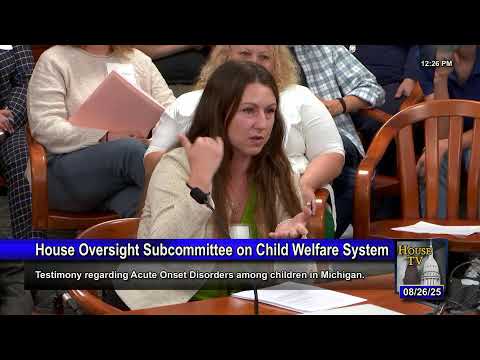
Chair Representative Meerman convened the House Oversight Subcommittee on Children’s Child Welfare System on Oct. 17 to hear public testimony about medical insurance denials for children diagnosed with pediatric acute-onset neuropsychiatric syndrome (PANS) and pediatric autoimmune neuropsychiatric disorders associated with streptococcal infections (PANDAS).
Families, clinicians and affected children described sudden, severe psychiatric and neurologic symptoms they said were caused by immune-driven brain inflammation and said delays or denials of recommended treatment — especially intravenous immunoglobulin (IVIG) — have produced prolonged harm. "Michigan health insurers are not doctors, but they are playing doctor, denying or delaying treatments prescribed by expert pediatric neurologists and physicians," said Bruce Goodman, a grandfather who testified about his granddaughter’s recovery after IVIG.
The witnesses said most children with PANS/PANDAS improve with antibiotics and steroids, but that a minority with severe, treatment‑resistant inflammation require IVIG. "For the most severe cases ... the recommended treatment is IVIG," Goodman said. Dr. Susan Youngs, a triple‑boarded pediatric subspecialist and medical director of a large subspecialty center, told the panel she has treated more than 200 children with PANS and that 10–15% of those patients required IVIG; she said nearly all children who received IVIG in her practice showed dramatic improvement.
Why it matters: Witnesses asked the subcommittee to recommend legislation requiring insurers to cover medically necessary PANS/PANDAS treatments, including IVIG, in whatever setting the treating physician prescribes. Goodman and several parents pointed to 15 other states that passed mandates this year. Goodman cited actuarial estimates from other states that adding coverage would raise premiums by only small amounts — examples he gave ranged from a few cents to 50 cents per month — and argued the societal costs of leaving children untreated are far greater.
What families and clinicians told lawmakers: Multiple parents described immediate and extreme declines in behavior and cognition — including severe obsessive‑compulsive disorder, suicidal ideation, loss of academic skills, tics, incontinence and violent outbursts — and recounted long appeals, peer‑to‑peer denials and months‑long delays. Elizabeth Paddock said her son Caleb required inpatient IVIG because his treating neurologist and the treating health system deemed inpatient monitoring medically necessary; she said Blue Cross Blue Shield denied inpatient coverage repeatedly, approving treatment only after other carriers overrode the denial. "Insurance companies should not practice medicine," Paddock said.
Clinicians described evidence and practice norms: Dr. Youngs told the committee that IVIG is widely used for autoimmune encephalitis and that an emerging body of clinical trials and institutional experience supports IVIG for moderate to severe PANS. She said Stanford and UCLA reported a randomized trial with positive results in moderate to severe cases (referred to in testimony as the Octagon study, pending publication). Dr. Youngs told members she had met with Blue Cross Blue Shield in July 2024 to review literature but did not receive follow‑up.
Disputed cost and access claims: Witnesses gave differing figures for IVIG costs. Dr. Youngs said, in discussion, that the medication itself can be inexpensive to acquire in some contexts but that families paying cash or using out‑of‑network providers often face charges in the thousands of dollars per infusion; parents reported paying roughly $10,000 per infusion when insurance denied coverage. Laurie Cordiville and other parents testified that denials that interrupted a prescribed series of infusions led to relapses and higher overall costs to families and the public system, including special education and hospital care.
Legal and procedural points raised: Witnesses described appeals processes that they said delayed care, cited peer‑to‑peer reviews by reviewers who had not examined the child, and invoked Public Act 60 of 2022 when describing delayed appeals. Several speakers and medical witnesses urged that treating physicians — not insurer reviewers without specialty training — determine medical necessity for PANS/PANDAS treatment.
Committee process: The subcommittee approved the minutes of the July 22 meeting at the start of the hearing on a motion by Representative Regas. Members asked questions of clinicians about FDA approval (Dr. Youngs said IVIG is FDA‑approved for certain autoimmune conditions but not specifically for PANS as a labeled indication), prevalence estimates (Dr. Youngs estimated about 1 in 200 children are affected and suggested roughly 1,500 Michigan children could meet criteria for moderate‑to‑severe illness), and the typical course and dosing regimens for IVIG (serial infusions at immunomodulatory dosing, often varying by patient response).
What witnesses asked the subcommittee to do: Testimony repeatedly requested that the Legislature mandate insurance coverage for medically necessary PANS/PANDAS treatment, including IVIG in the setting the treating clinician prescribes, to prevent delays and financial hardship for families. Families urged lawmakers to require coverage parity so that treatment decisions rest with clinicians who evaluate the child.
What the record does not show: The hearing recorded multiple family experiences and clinicians’ summaries of scientific literature, but did not include testimony from insurers. Several witnesses said Blue Cross Blue Shield was invited and declined. Committee members and clinicians discussed but did not present an actuarial cost estimate specific to Michigan; witnesses cited analyses from other states that they said projected minimal premium impact.
Next steps: Several witnesses offered to follow up with committee members and provide written materials and data. Representative Meerman closed the hearing after final comments and the committee adjourned.