Get Full Government Meeting Transcripts, Videos, & Alerts Forever!
Get email alerts on the Veterans Housing Registration topic
No spam. Unsubscribe anytime.
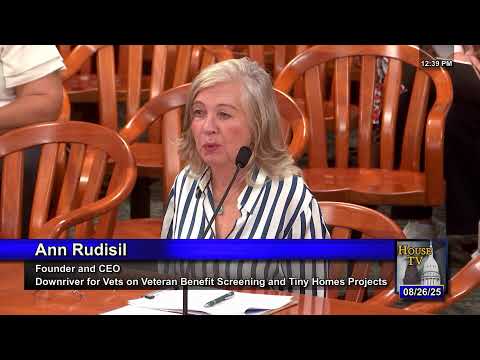
Downriver for Vets founder urges automatic veteran registration at discharge, outlines prefab housing plan
Summary
Anne Rudacille, founder and CEO of Downriver for Vets, told the House Families and Veterans Committee the nonprofit is pursuing prefab housing for veterans but has encountered local opposition and difficulty finding land. She urged that veterans be registered with the VA at discharge and described outreach using the My HealtheVet portal.
Anne Rudacille, founder and CEO of Downriver for Vets, told the House Families and Veterans Committee about the nonprofit's work placing veterans into housing, plans to use prefabricated homes, and widespread difficulty in finding land and local support for such projects.
Rudacille said the nonprofit originally described its project as “tiny homes” but now prefers the term “prefab” and told the committee that prefab units “come already assembled” and can be purchased “as low as $18,000.” She described a vetting process: residents must have income, will pay rent, and after seven years the veteran would own the prefab home or it would be reallocated to another veteran if the occupant moved or died. Rudacille said Downriver for Vets (DFV) has one veteran currently housed in a purchased mobile home and is preparing to place another.
Rudacille said she has sought land in 22 Downriver municipalities and met resistance in multiple places. She recounted a council meeting in her hometown in which neighbors opposed locating prefab homes near their properties. "They said, I don't want them in my neighborhood," Rudacille said, describing a Vietnam veteran with Parkinson's who attended council meetings with her. Rudacille said the repeated local opposition forced her to pause the land‑acquisition effort and “start again.”
She asked state lawmakers to consider a policy change to ensure veterans are registered with the VA before or at discharge. "Can you please register him at a VA in his town? It's not gonna cost a dime more," she said, urging registration as a way to connect veterans to benefits for service‑related conditions and to mental‑health supports. Rudacille also described using the VA's My HealtheVet portal and said DFV has run classes to help veterans enroll and use the system.
Rudacille gave several numerical descriptions of DFV's work and finances: she said the nonprofit has spent "over $1,200,000" in donations since it began, has given away 57 cars, has about $87,000 set aside toward prefab homes and currently operates with roughly $27,000 (speaker did not specify timeframe for that figure). She told committee members she believes DFV has helped “over 5,000” veterans since it began.
Members of the committee asked questions and offered to assist. Representative Wolford said he is working with U.S. Rep. Tim Barrett and others on transition processes from federal to state systems. Representative Thompson and others encouraged local outreach between DFV and municipal leaders. Representatives asked about DFV's vetting, funding and how state officials could assist with registration and local coordination.
Rudacille criticized some veteran service organizations and described uneven service at VA facilities, saying she preferred the Canton and Ann Arbor VA clinics over Detroit for experiences she described on the record. She urged accountability for organizations that refer veterans to local providers when the organizations do not have resources to deliver direct aid.
No committee motion or vote resulted from the presentation; the session concluded after further committee discussion and a closing roll call.