Get Full Government Meeting Transcripts, Videos, & Alerts Forever!
Get email alerts on the Urban Design Guidelines topic
No spam. Unsubscribe anytime.
City staff presents draft urban design guideline layouts; commissioners give direction on graphics, timeline
Summary
City staff presented a preliminary set of visual mockups for the urban design guidelines and sought direction on graphic style, text hierarchy and process.
City staff presented a preliminary set of visual mockups for the city's urban design guidelines and asked the Urban Design Commission for feedback on layout, graphic style and process for producing a formal draft.
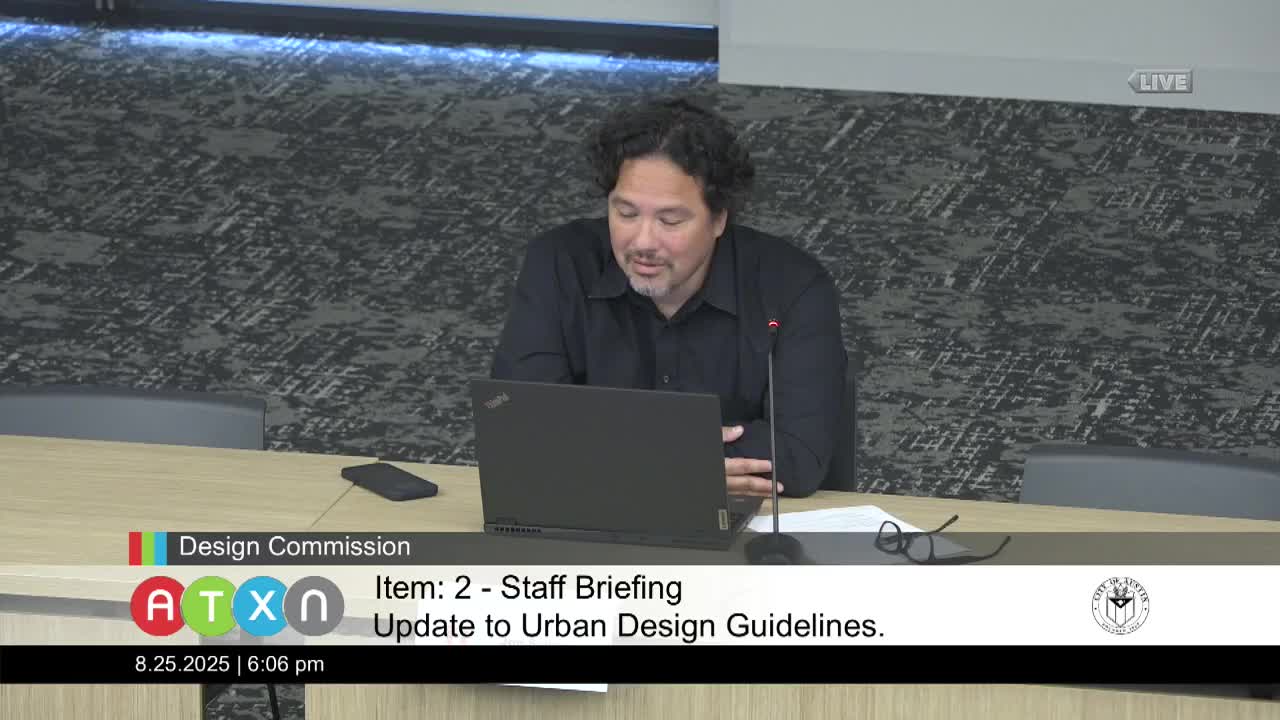
"What we are bringing before you this evening is a sampling of the next iteration of our attempt to start to put together your draft guidelines into a workable InDesign document," Jorge Rosalind, executive liaison to the commission, told commissioners. Rosalind said the materials shown are conceptual mockups, not a final draft, and staff seeks direction before producing a fuller layout.
Steven Cruz, a senior urban planner newly assigned to the project, walked commissioners through several page concepts that staff described as drawing inspiration from Los Angeles and New York City guideline publications. Cruz said the options range from photo-forward presentation to sketch- and diagram-driven pages that place graphics ahead of realistic imagery.
Commissioners generally endorsed a sketch-forward approach that preserves flexibility and avoids overly literal photographic backgrounds. "I like the sketches and I agree with your comment of not making it look too real," Commissioner Carroll said, adding a preference for one guideline per page so each requirement can be read clearly. Commissioner McKinney echoed the need for text and graphics to hold equal weight and cautioned that some graphics in the mockups include elements that the urban design department no longer accepts (for example, certain planter or screening treatments).
Several commissioners pushed for clearer signals in the document on applicability and hierarchy. "I just did want to make sure that we had some sort of, like, standard, somewhat graphic approach to identifying applicability of the guideline and the tier of the guideline," Commissioner Whitstrode said. Commissioner Iyewa suggested the commission consider whether some conditions can be made objective or given enumerated scoring to reduce subjectivity in future reviews.
Staff described the intended process and timeline. Rosalind said the posted layouts are a working draft for commission discussion only and not yet open for public comment. He asked commissioners to submit written feedback through the commission's administrative liaison, Miss Corona, and said staff anticipates a multi-month effort to produce a fuller first draft. "Realistically... you're looking at at least a few months for us to complete the draft," Rosalind said; staff estimated a minimum of three months to incorporate sketches and diagramming into a cohesive InDesign document.
Commissioners also discussed how to use the existing working group. Rosalind told the commission that staff intends to bring the next draft to the full commission so all members can comment publicly; the working group may continue to operate, but any recommendation from that group must come before the full commission. Commissioner Carroll volunteered to act as a point person to gather commission feedback for the working group to integrate into a second draft.
Commissioners gave several concrete design suggestions: prefer sketch/diagram combinations over large background photographs; favor one guideline per page to make requirements easier to read; include a clear graphic treatment to indicate whether a guideline is mandatory, advisory or illustrative; and consider a separate visual layer for examples vs. standards. Commissioners also urged staff to avoid showing design elements in mockups that are unlikely to be approved in actual projects.
Rosalind said staff will proceed with additional layout development based on tonight's comments and any written feedback submitted through Miss Corona. He emphasized the materials shown are an initial visual step and that commissioners will see additional iterations before staff opens the content for public comment.
Ending
Staff requested guidance and returned to the commission for comment; the commission directed staff to continue developing sketch-forward mockups, provide clearer applicability/tier signaling and collect written feedback through the administrative liaison. Staff estimated a minimum three-month timeframe to produce a fuller draft for the commission's review.